



 Chat with AI
Exam 35: Japan, 1333 to 1980

Exam 1: Art in the Stone Age50 Questions
Exam 2: Ancient Mesopotamia and Persia50 Questions
Exam 3: Egypt From Narmer to Cleopatra50 Questions
Exam 4: The Prehistoric Aegean50 Questions
Exam 5: Ancient Greece50 Questions
Exam 6: The Etruscans50 Questions
Exam 7: The Roman Empire50 Questions
Exam 8: Late Antiquity50 Questions
Exam 9: Byzantium50 Questions
Exam 10: The Islamic World50 Questions
Exam 11: Early Medieval Europe50 Questions
Exam 12: Romanesque Europe50 Questions
Exam 13: Gothic Europe North of the Alps50 Questions
Exam 14: Late Medieval Italy50 Questions
Exam 15: South and Southeast Asia Before 120050 Questions
Exam 16: China and Korea to 127950 Questions
Exam 17: Japan Before 133350 Questions
Exam 18: Native American Cultures Before 130049 Questions
Exam 19: Africa Before 180050 Questions
Exam 20: Late Medieval and Early Renaissance Northern Europe50 Questions
Exam 21: The Renaissance in Quattrocento Italy50 Questions
Exam 22: Renaissance and Mannerism in Cinquecento Italy50 Questions
Exam 23: High Renaissance and Mannerism in Northern Europe and Spain50 Questions
Exam 24: The Baroque in Italy and Spain50 Questions
Exam 25: The Baroque in Northern Europe50 Questions
Exam 26: Rococo to Neoclassicism: the 18th Century in Europe and America50 Questions
Exam 27: Romanticism, Realism, Photography: Europe and America, 1800 to 187050 Questions
Exam 28: Impressionism, Post-Impressionism, Symbolism: Europe and America, 1870 to 190050 Questions
Exam 29: Modernism in Europe, 1900 to 194550 Questions
Exam 30: Modernism in the United States and Mexico, 1900 to 194550 Questions
Exam 31: Modernism and Postmodernism in Europe and America, 1945 to 198050 Questions
Exam 32: Contemporary Art Worldwide50 Questions
Exam 33: South and Southeast Asia, 1200 to 198050 Questions
Exam 34: China and Korea, 1279 to 198050 Questions
Exam 35: Japan, 1333 to 198050 Questions
Exam 36: Native American Cultures, 1300 to 198050 Questions
Exam 37: Oceania Before 198050 Questions
Exam 38: Africa, 1800 to 198050 Questions
Select questions type


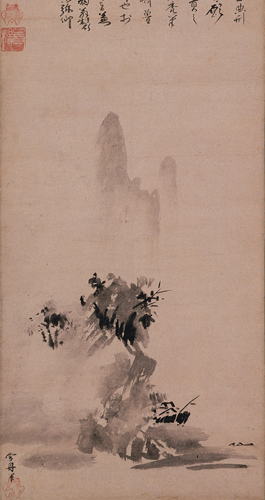 Which artist painted this Muromachi landscape?
Free
(Multiple Choice)
5.0/5  (83)
(83) Correct Answer: Verified
B
Which of the following describes a Japanese element in Hokusai's The Great Wave off Kanagawa ?
Free
(Multiple Choice)
4.9/5 (72)
(72) Correct Answer:Verified
VerifiedB
Which major artistic genre was introduced in Japan in the late 19th century?
Free
(Multiple Choice)
4.9/5 (83)
(83) Correct Answer:Verified
VerifiedD
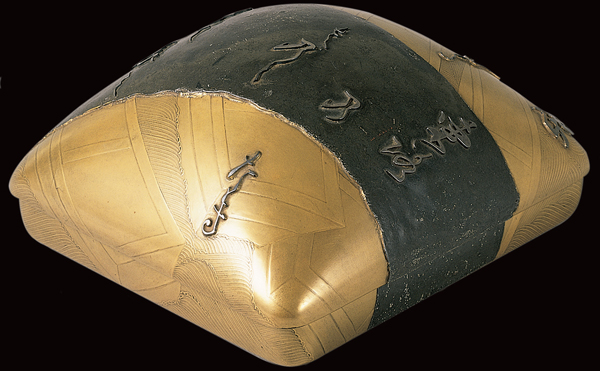 This lacquer writing box Boat Bridge by Honami Koetsu is an example of which style?
 (Multiple Choice)
4.9/5 (96)
(96) Which of the following Japanese artists went to China and was able to study with Ming masters?
(Multiple Choice)
4.8/5 (94)
(94) Kano painters of the Momoyama period were asked to create folding screens and sliding panels for structures built for which group?
(Multiple Choice)
4.8/5 (82)
(82) Which of the following describes one of the most important features of the Katsura Imperial Villa, and why?
(Multiple Choice)
4.7/5 (74)
(74) Which early Japanese literati painter was famed for the lyricism of both his haiku poetry and his painting?
(Multiple Choice)
4.8/5 (67)
(67) Which of the following describes the function of the tatami?
(Multiple Choice)
4.8/5 (59)
(59) Which of the following is an accurate description of Shino ware?
(Multiple Choice)
4.8/5 (66)
(66) During which period were nishiki-e, or brocade, pictures created?
(Multiple Choice)
4.8/5 (72)
(72) Which artist designed the woodblock print Plum Estate, Kameido , which inspired the European painter Vincent van Gogh with its coloration and abstract quality?
(Multiple Choice)
5.0/5 (86)
(86) The rise of the Ashikaga clan in the 14th century introduces which art historical period?
(Multiple Choice)
4.8/5 (87)
(87)
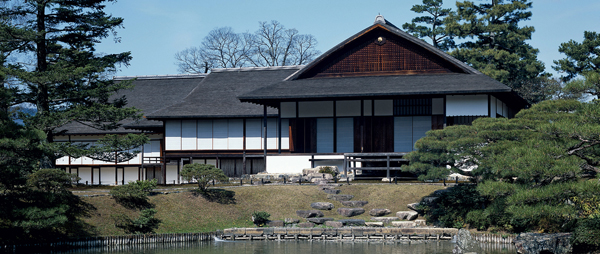 Which design aspect of the Katsura Imperial Villa can be considered most emblematic of Japanese residential architecture?
 (Multiple Choice)
4.9/5 (86)
(86) Honami Koetsu was a talented Edo calligrapher and ceramicist who also designed which of the following?
(Multiple Choice)
4.8/5 (82)
(82) Which of the following accurately describes the aesthetic of the Katsura Imperial Villa in Kyoto?
(Multiple Choice)
4.8/5 (73)
(73) The misty rendering and near formlessness of Hasegawa Tohaku's Pine Forest invokes which precept of Zen Buddhism?
(Multiple Choice)
4.9/5 (73)
(73) Which school did not have a continuity of lineage in which father trained son or master trained pupil?
(Multiple Choice)
4.8/5 (80)
(80) What is the name of the genre in which Western techniques, such as chiaroscuro, perspective, and bright hues, are used in Japanese-style paintings?
(Multiple Choice)
4.8/5 (81)
(81) 
Filters
- Essay(0)
- Multiple Choice(0)
- Short Answer(0)
- True False(0)
- Matching(0)