



 Chat with AI
Exam 4: The Prehistoric Aegean

Exam 1: Art in the Stone Age50 Questions
Exam 2: Ancient Mesopotamia and Persia50 Questions
Exam 3: Egypt From Narmer to Cleopatra50 Questions
Exam 4: The Prehistoric Aegean50 Questions
Exam 5: Ancient Greece50 Questions
Exam 6: The Etruscans50 Questions
Exam 7: The Roman Empire50 Questions
Exam 8: Late Antiquity50 Questions
Exam 9: Byzantium50 Questions
Exam 10: The Islamic World50 Questions
Exam 11: Early Medieval Europe50 Questions
Exam 12: Romanesque Europe50 Questions
Exam 13: Gothic Europe North of the Alps50 Questions
Exam 14: Late Medieval Italy50 Questions
Exam 15: South and Southeast Asia Before 120050 Questions
Exam 16: China and Korea to 127950 Questions
Exam 17: Japan Before 133350 Questions
Exam 18: Native American Cultures Before 130049 Questions
Exam 19: Africa Before 180050 Questions
Exam 20: Late Medieval and Early Renaissance Northern Europe50 Questions
Exam 21: The Renaissance in Quattrocento Italy50 Questions
Exam 22: Renaissance and Mannerism in Cinquecento Italy50 Questions
Exam 23: High Renaissance and Mannerism in Northern Europe and Spain50 Questions
Exam 24: The Baroque in Italy and Spain50 Questions
Exam 25: The Baroque in Northern Europe50 Questions
Exam 26: Rococo to Neoclassicism: the 18th Century in Europe and America50 Questions
Exam 27: Romanticism, Realism, Photography: Europe and America, 1800 to 187050 Questions
Exam 28: Impressionism, Post-Impressionism, Symbolism: Europe and America, 1870 to 190050 Questions
Exam 29: Modernism in Europe, 1900 to 194550 Questions
Exam 30: Modernism in the United States and Mexico, 1900 to 194550 Questions
Exam 31: Modernism and Postmodernism in Europe and America, 1945 to 198050 Questions
Exam 32: Contemporary Art Worldwide50 Questions
Exam 33: South and Southeast Asia, 1200 to 198050 Questions
Exam 34: China and Korea, 1279 to 198050 Questions
Exam 35: Japan, 1333 to 198050 Questions
Exam 36: Native American Cultures, 1300 to 198050 Questions
Exam 37: Oceania Before 198050 Questions
Exam 38: Africa, 1800 to 198050 Questions
Select questions type


The tholos tombs of the Mycenaeans are best described by which term?

Free
(Multiple Choice)
4.8/5  (85)
(85) Correct Answer: Verified
C
Which of the following appeared on Crete in the Middle Minoan period?
Free
(Multiple Choice)
4.8/5 (77)
(77) Correct Answer:Verified
VerifiedC
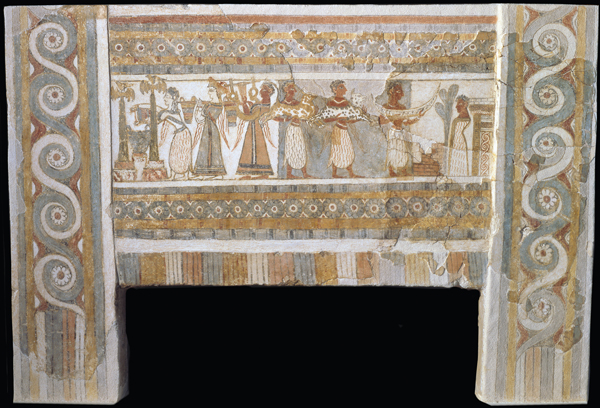 What function did this object serve?
Free
(Multiple Choice)
4.8/5 (83)
(83) Correct Answer:Verified
VerifiedD
What term is used for the stone fortification walls of such Mycenaean sites as Tiryns and Mycenae?
(Multiple Choice)
4.7/5 (87)
(87) 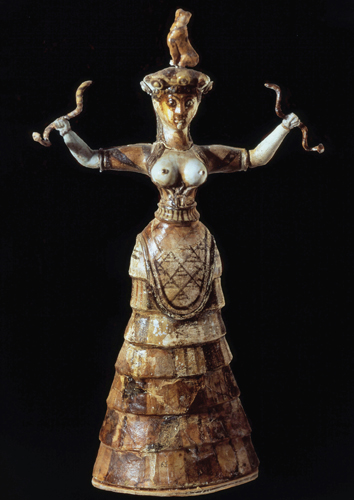 Which culture produced this figure?
The Spring Fresco from Akrotiri is the first large-scale example of which genre?
(Multiple Choice)
4.7/5 (77)
(77) What best describes the arrangement of the soldiers on the Warrior Vase ?
(Multiple Choice)
4.9/5 (68)
(68) What instrument is being played by the Cycladic Keros musician?
(Multiple Choice)
5.0/5 (72)
(72) Minoans coated the rough surface of their rubble walls with a fine white lime plaster that required rapid execution and great skill. Which painting method was used with this type of fabrication?
(Multiple Choice)
4.9/5 (94)
(94) The Mycenaean practice of placing death masks over the deceased's face is reminiscent of which group?
(Multiple Choice)
4.8/5 (73)
(73) What construction technique was used to make the gallery at Tiryns?
(Multiple Choice)
4.8/5 (72)
(72) The Homeric poems inspired Heinrich Schliemann's discovery of which site?
(Multiple Choice)
4.9/5 (90)
(90) Which phrase best describes the rendition of the body of Cycladic figurines?
(Multiple Choice)
5.0/5 (87)
(87) What is an innovative feature of the Minoan Harvesters Vase ?
(Multiple Choice)
4.8/5 (73)
(73) 
Filters
- Essay(0)
- Multiple Choice(0)
- Short Answer(0)
- True False(0)
- Matching(0)