



 Chat with AI
Exam 4: The Prehistoric Aegean

Exam 1: Art in the Stone Age50 Questions
Exam 2: Ancient Mesopotamia and Persia50 Questions
Exam 3: Egypt From Narmer to Cleopatra50 Questions
Exam 4: The Prehistoric Aegean50 Questions
Exam 5: Ancient Greece50 Questions
Exam 6: The Etruscans50 Questions
Exam 7: The Roman Empire50 Questions
Exam 8: Late Antiquity50 Questions
Exam 9: Byzantium50 Questions
Exam 10: The Islamic World50 Questions
Exam 11: Early Medieval Europe50 Questions
Exam 12: Romanesque Europe50 Questions
Exam 13: Gothic Europe North of the Alps50 Questions
Exam 14: Late Medieval Italy50 Questions
Exam 15: South and Southeast Asia Before 120050 Questions
Exam 16: China and Korea to 127950 Questions
Exam 17: Japan Before 133350 Questions
Exam 18: Native American Cultures Before 130049 Questions
Exam 19: Africa Before 180050 Questions
Exam 20: Late Medieval and Early Renaissance Northern Europe50 Questions
Exam 21: The Renaissance in Quattrocento Italy50 Questions
Exam 22: Renaissance and Mannerism in Cinquecento Italy50 Questions
Exam 23: High Renaissance and Mannerism in Northern Europe and Spain50 Questions
Exam 24: The Baroque in Italy and Spain50 Questions
Exam 25: The Baroque in Northern Europe50 Questions
Exam 26: Rococo to Neoclassicism: the 18th Century in Europe and America50 Questions
Exam 27: Romanticism, Realism, Photography: Europe and America, 1800 to 187050 Questions
Exam 28: Impressionism, Post-Impressionism, Symbolism: Europe and America, 1870 to 190050 Questions
Exam 29: Modernism in Europe, 1900 to 194550 Questions
Exam 30: Modernism in the United States and Mexico, 1900 to 194550 Questions
Exam 31: Modernism and Postmodernism in Europe and America, 1945 to 198050 Questions
Exam 32: Contemporary Art Worldwide50 Questions
Exam 33: South and Southeast Asia, 1200 to 198050 Questions
Exam 34: China and Korea, 1279 to 198050 Questions
Exam 35: Japan, 1333 to 198050 Questions
Exam 36: Native American Cultures, 1300 to 198050 Questions
Exam 37: Oceania Before 198050 Questions
Exam 38: Africa, 1800 to 198050 Questions
Select questions type


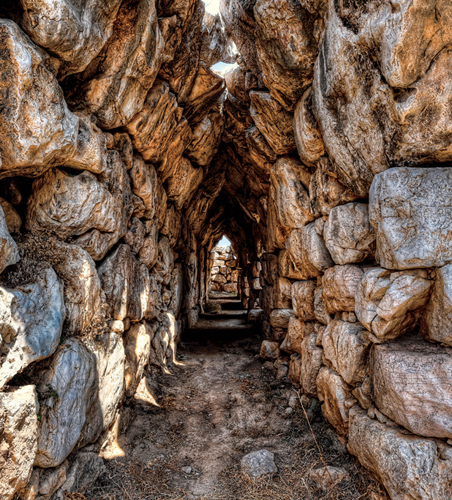 Which Mycenaean site includes corbel-vaulted galleries in its fortification walls?
 (Multiple Choice)
4.8/5  (70)
(70) What original decorative component of Cycladic figurines is now almost entirely missing?
(Multiple Choice)
4.8/5 (85)
(85) Which region of Greece has yielded significant numbers of small marble figurines representing naked women with arms folded over abdomens?
(Multiple Choice)
4.9/5 (79)
(79) Which object differs from earlier Minoan and Greek art in its simplified narrative and use of repetitious pattern?
(Multiple Choice)
4.9/5 (84)
(84)
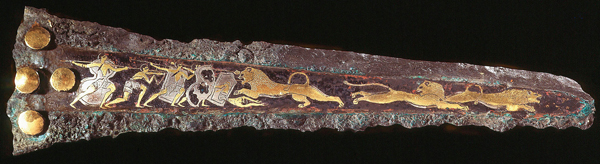 The subject of this inlaid dagger is most prevalent in which culture?
 (Multiple Choice)
4.8/5 (70)
(70) Which of the following elements show that the new palace at Knossos was carefully planned?
(Multiple Choice)
4.9/5 (79)
(79)
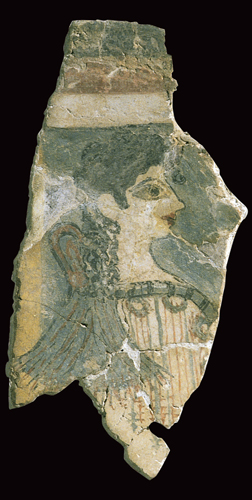 Which earlier culture(s) also followed the drawing convention of a frontal eye in a profile head for a human figure?
 (Multiple Choice)
4.9/5 (86)
(86) What is the name art historians give to the style of Minoan pottery in which creamy white and reddish-brown motifs were applied to a black background?
(Multiple Choice)
4.8/5 (76)
(76) Which architectural form does the Treasury of Atreus exemplify?
(Multiple Choice)
4.7/5 (76)
(76) The use of guardian figures on the Lion Gate is reminiscent of which monument?
(Multiple Choice)
4.8/5 (79)
(79) Which of the following works of art provides information about the Minoan religion?
(Multiple Choice)
4.8/5 (75)
(75) The heraldic arrangement of the guardian figures of the Lion Gate can also be found in what group of works?
(Multiple Choice)
4.9/5 (93)
(93) The complex and extensive plan of the palace at Knossos gave rise to which myth?
(Multiple Choice)
4.9/5 (83)
(83) 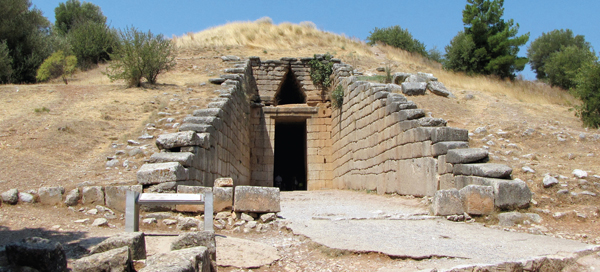 What is the term for the feature above the lintel here?
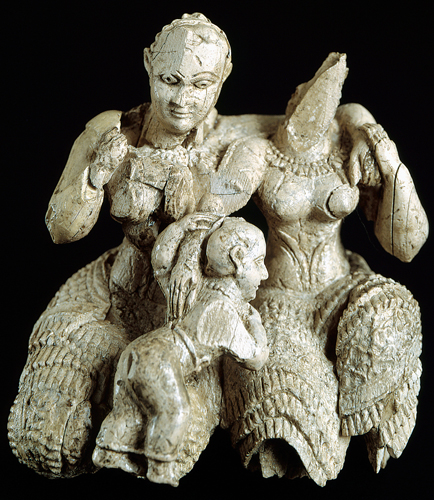 Which description best conveys the artist and the findspot of this object?
 (Multiple Choice)
4.8/5 (89)
(89) 
Filters
- Essay(0)
- Multiple Choice(0)
- Short Answer(0)
- True False(0)
- Matching(0)