



 Chat with AI
Exam 11: Early Medieval Europe

Exam 1: Art in the Stone Age50 Questions
Exam 2: Ancient Mesopotamia and Persia50 Questions
Exam 3: Egypt From Narmer to Cleopatra50 Questions
Exam 4: The Prehistoric Aegean50 Questions
Exam 5: Ancient Greece50 Questions
Exam 6: The Etruscans50 Questions
Exam 7: The Roman Empire50 Questions
Exam 8: Late Antiquity50 Questions
Exam 9: Byzantium50 Questions
Exam 10: The Islamic World50 Questions
Exam 11: Early Medieval Europe50 Questions
Exam 12: Romanesque Europe50 Questions
Exam 13: Gothic Europe North of the Alps50 Questions
Exam 14: Late Medieval Italy50 Questions
Exam 15: South and Southeast Asia Before 120050 Questions
Exam 16: China and Korea to 127950 Questions
Exam 17: Japan Before 133350 Questions
Exam 18: Native American Cultures Before 130049 Questions
Exam 19: Africa Before 180050 Questions
Exam 20: Late Medieval and Early Renaissance Northern Europe50 Questions
Exam 21: The Renaissance in Quattrocento Italy50 Questions
Exam 22: Renaissance and Mannerism in Cinquecento Italy50 Questions
Exam 23: High Renaissance and Mannerism in Northern Europe and Spain50 Questions
Exam 24: The Baroque in Italy and Spain50 Questions
Exam 25: The Baroque in Northern Europe50 Questions
Exam 26: Rococo to Neoclassicism: the 18th Century in Europe and America50 Questions
Exam 27: Romanticism, Realism, Photography: Europe and America, 1800 to 187050 Questions
Exam 28: Impressionism, Post-Impressionism, Symbolism: Europe and America, 1870 to 190050 Questions
Exam 29: Modernism in Europe, 1900 to 194550 Questions
Exam 30: Modernism in the United States and Mexico, 1900 to 194550 Questions
Exam 31: Modernism and Postmodernism in Europe and America, 1945 to 198050 Questions
Exam 32: Contemporary Art Worldwide50 Questions
Exam 33: South and Southeast Asia, 1200 to 198050 Questions
Exam 34: China and Korea, 1279 to 198050 Questions
Exam 35: Japan, 1333 to 198050 Questions
Exam 36: Native American Cultures, 1300 to 198050 Questions
Exam 37: Oceania Before 198050 Questions
Exam 38: Africa, 1800 to 198050 Questions
Select questions type


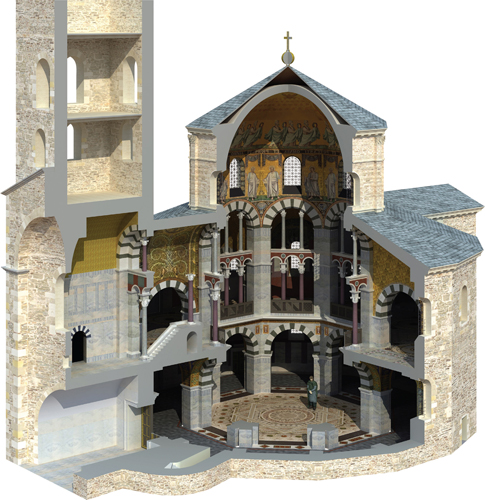 What is the name of the building in this image, and where is it located?
Free
(Multiple Choice)
4.9/5  (75)
(75) Correct Answer: Verified
B
The Carolingian architectural plan that demonstrated the beginnings of the modular system was found at which place?
Free
(Multiple Choice)
4.7/5 (77)
(77) Correct Answer:Verified
VerifiedD
What aspect of illuminated manuscripts allowed Christian monks to impress and influence the illiterate Christian population?
Free
(Multiple Choice)
4.8/5 (80)
(80) Correct Answer:Verified
VerifiedD
What earlier building may have inspired the presence of two apses and a side entrance at Saint Michael's, Hildesheim?
(Multiple Choice)
4.8/5 (85)
(85) The primary sacred text of Christianity was the Bible, consisting of the Old Testament, originally written in Hebrew, and the New Testament, written in Greek. In what language is the Vulgate version of the Bible written?
(Multiple Choice)
4.7/5 (75)
(75) What manuscript is commonly considered the greatest of the extant early medieval Irish books?
(Multiple Choice)
4.8/5 (85)
(85) Which monuments, because of their large scale, are rare yet majestic artistic productions in Ireland and northern England?
(Multiple Choice)
4.7/5 (79)
(79) What is the name of the lengthy poem that mentions that heroes were buried with items of prestige, such as rings and brooches, as a testament to their greatness?
(Multiple Choice)
4.8/5 (79)
(79) Bernward's doors for Saint Michael's, Hildesheim, juxtapose scenes from Genesis with scenes from which source?
(Multiple Choice)
4.7/5 (78)
(78) Which of the following embodies the Carolingian-Ottonian taste for costly portable objects?
(Multiple Choice)
4.9/5 (72)
(72) What was the primary vehicle used in the Christianization of the British Isles?
(Multiple Choice)
4.9/5 (65)
(65)
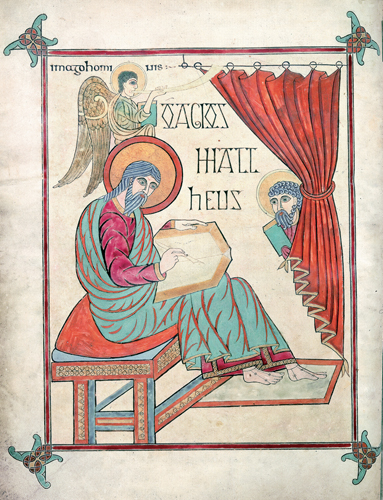 It has been theorized that the author-portrait of Saint Matthew from the Lindisfarne Gospels shows classical influences. What supports this statement?
 (Multiple Choice)
4.9/5 (77)
(77) Which group of barbarian invaders at one time controlled part of Italy, formed a kingdom in southern France, and were forced into Spain by the Franks?
(Multiple Choice)
4.8/5 (70)
(70) Early 11th-century England was briefly part of what empire?
(Multiple Choice)
4.9/5 (71)
(71)
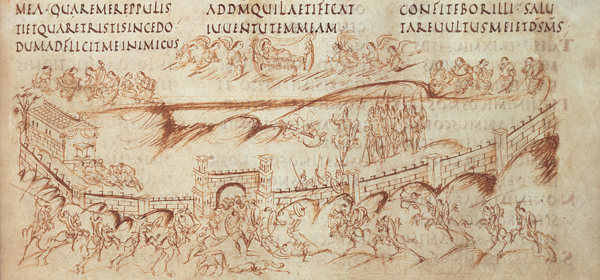 Which manuscript, shown here, is known for its pen-and-ink drawings that evoke the daily life of late antiquity?
 (Multiple Choice)
4.8/5 (84)
(84)
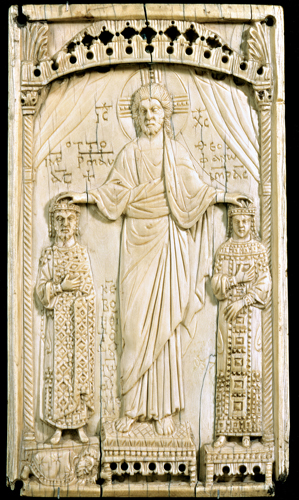 This panel, highlighting the new ties between the Ottonian court and Byzantine Constantinople, celebrates the marriage of which people?
 (Multiple Choice)
4.8/5 (72)
(72)
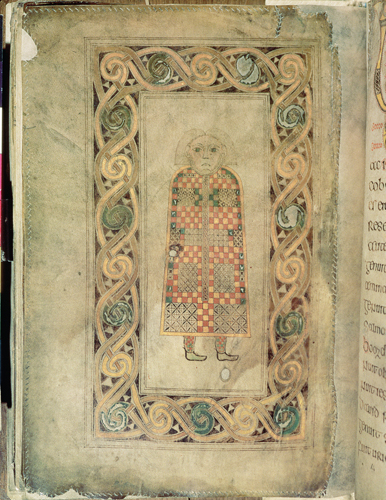 The figure representing the symbol of Matthew in the Book of Durrow shows frontal head, profile feet, and cloak and frame designs that recall contemporaneous cloisonné metalwork. Which of the following statements explains this work?
 (Multiple Choice)
4.8/5 (84)
(84)
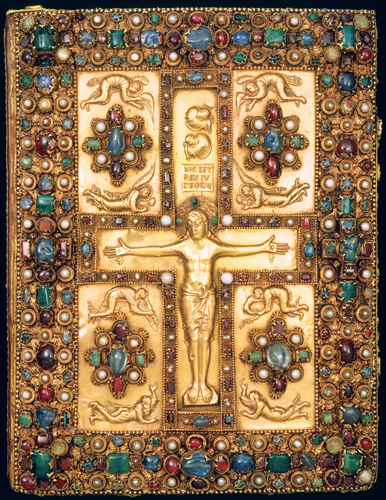 The Lindau Gospels cover encompasses the stylistic diversity of early medieval art. Which of the following best describes the contrast seen here?
 (Multiple Choice)
4.9/5 (69)
(69) Full-page abstract designs of great richness and complexity appear in which of the following manuscripts?
(Multiple Choice)
4.8/5 (87)
(87) Which of the following did NOT contribute to the innovative design of Charlemagne's Palatine Chapel?
(Multiple Choice)
4.9/5 (62)
(62) 
Filters
- Essay(0)
- Multiple Choice(0)
- Short Answer(0)
- True False(0)
- Matching(0)