



 Chat with AI
Exam 25: The Baroque in Northern Europe

Exam 1: Art in the Stone Age50 Questions
Exam 2: Ancient Mesopotamia and Persia50 Questions
Exam 3: Egypt From Narmer to Cleopatra50 Questions
Exam 4: The Prehistoric Aegean50 Questions
Exam 5: Ancient Greece50 Questions
Exam 6: The Etruscans50 Questions
Exam 7: The Roman Empire50 Questions
Exam 8: Late Antiquity50 Questions
Exam 9: Byzantium50 Questions
Exam 10: The Islamic World50 Questions
Exam 11: Early Medieval Europe50 Questions
Exam 12: Romanesque Europe50 Questions
Exam 13: Gothic Europe North of the Alps50 Questions
Exam 14: Late Medieval Italy50 Questions
Exam 15: South and Southeast Asia Before 120050 Questions
Exam 16: China and Korea to 127950 Questions
Exam 17: Japan Before 133350 Questions
Exam 18: Native American Cultures Before 130049 Questions
Exam 19: Africa Before 180050 Questions
Exam 20: Late Medieval and Early Renaissance Northern Europe50 Questions
Exam 21: The Renaissance in Quattrocento Italy50 Questions
Exam 22: Renaissance and Mannerism in Cinquecento Italy50 Questions
Exam 23: High Renaissance and Mannerism in Northern Europe and Spain50 Questions
Exam 24: The Baroque in Italy and Spain50 Questions
Exam 25: The Baroque in Northern Europe50 Questions
Exam 26: Rococo to Neoclassicism: the 18th Century in Europe and America50 Questions
Exam 27: Romanticism, Realism, Photography: Europe and America, 1800 to 187050 Questions
Exam 28: Impressionism, Post-Impressionism, Symbolism: Europe and America, 1870 to 190050 Questions
Exam 29: Modernism in Europe, 1900 to 194550 Questions
Exam 30: Modernism in the United States and Mexico, 1900 to 194550 Questions
Exam 31: Modernism and Postmodernism in Europe and America, 1945 to 198050 Questions
Exam 32: Contemporary Art Worldwide50 Questions
Exam 33: South and Southeast Asia, 1200 to 198050 Questions
Exam 34: China and Korea, 1279 to 198050 Questions
Exam 35: Japan, 1333 to 198050 Questions
Exam 36: Native American Cultures, 1300 to 198050 Questions
Exam 37: Oceania Before 198050 Questions
Exam 38: Africa, 1800 to 198050 Questions
Select questions type


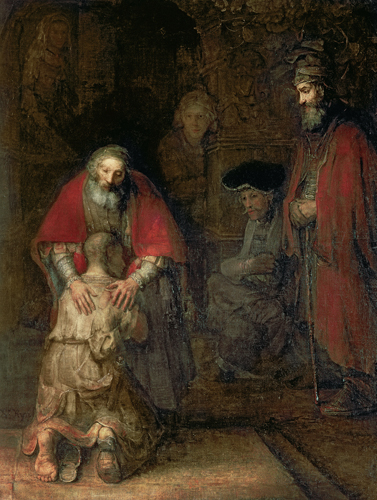 In his painting Return of the Prodigal Son , where does Rembrandt choose to focus the light?
Free
(Multiple Choice)
4.9/5  (86)
(86) Correct Answer: Verified
C
Who was the preeminent French art patron of the 17th century?
Free
(Multiple Choice)
4.9/5 (84)
(84) Correct Answer:Verified
VerifiedD
Which artist created one of the first pictorial records of the human disaster armed conflict leaves in its wake?
Free
(Multiple Choice)
4.9/5 (73)
(73) Correct Answer:Verified
VerifiedB
Which artist combined the innovations of many of the Italian Renaissance and Baroque masters to formulate the first pan-European painting style?
(Multiple Choice)
4.9/5 (75)
(75) Which Dutch artist made the subject of much of his art the interiors of Dutch middle-class dwellings?
(Multiple Choice)
4.9/5 (73)
(73) Which painting by Rembrandt is known to have been reduced in size when moved from its original location to Amsterdam's town hall?
(Multiple Choice)
5.0/5 (82)
(82) The work of which artist is emblematic of the Dutch Republic's position as the leading grower and exporter of flowers in Europe?
(Multiple Choice)
4.9/5 (93)
(93) Which French building of the 17th century resembles a classical temple front with the sides spread out next to it like wings?
(Multiple Choice)
5.0/5 (77)
(77) Who was a leading portrait painter in Haarlem and is known for his lively, relaxed group portraits?
(Multiple Choice)
4.8/5 (71)
(71) During what period did English architect Inigo Jones produce most of his works?
(Multiple Choice)
4.8/5 (80)
(80)
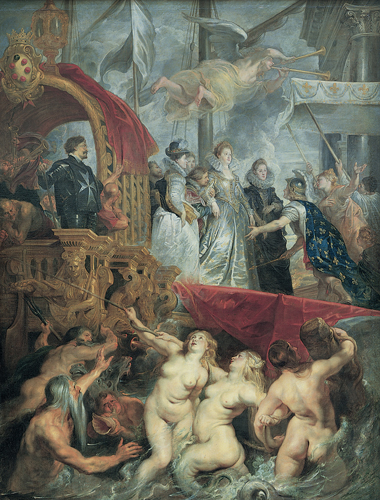 Which figure is the personification of France in Rubens's Arrival of Marie de' Medici at Marseilles ?
 (Multiple Choice)
4.8/5 (70)
(70)
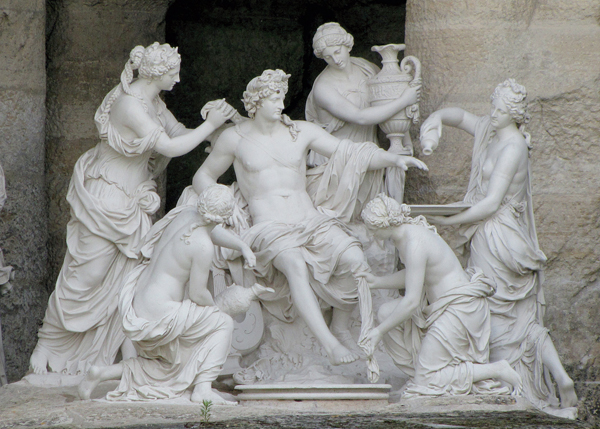 François Girardon's arrangement of the figures in Apollo Attended by the Nymphs of Thetis is based on the figural compositions of which artist?
 (Multiple Choice)
4.9/5 (83)
(83) In which church did Christopher Wren integrate Palladian, French, and Italian Baroque features?
(Multiple Choice)
4.8/5 (86)
(86) Inigo Jones adopted the design principles of which Venetian architect to his own work?
(Multiple Choice)
4.8/5 (86)
(86) Why does Judith Leyster appear elegantly attired, rather than in an artist's smock as Rembrandt did, in her Self-Portrait ?
(Multiple Choice)
4.7/5 (83)
(83) A painting of inanimate objects such as flowers and fruit is referred to as what?
(Multiple Choice)
4.9/5 (81)
(81)
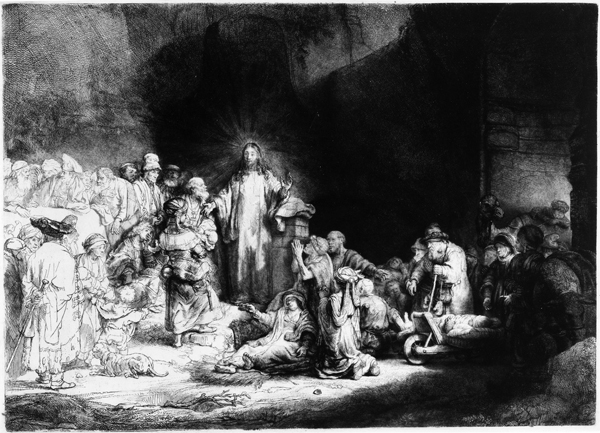 What method(s) did Rembrandt use to create Christ with the Sick around Him ?
 (Multiple Choice)
4.9/5 (84)
(84) Which Netherlandish artist is known to have created more than 70 self-portraits?
(Multiple Choice)
4.8/5 (76)
(76)
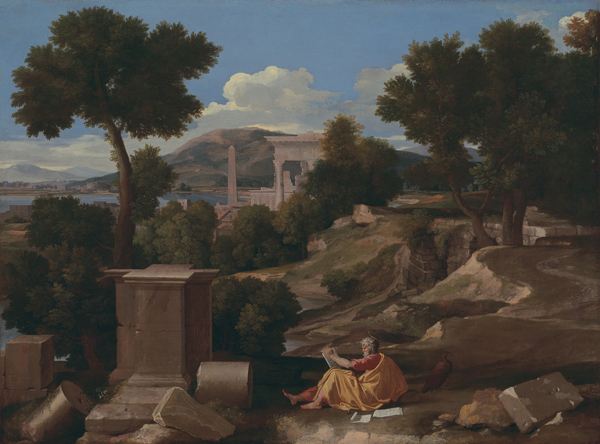 What attribute accompanies Saint John in this painting by Poussin?
 (Multiple Choice)
4.7/5 (87)
(87) 
Filters
- Essay(0)
- Multiple Choice(0)
- Short Answer(0)
- True False(0)
- Matching(0)