



 Chat with AI
Exam 37: Oceania Before 1980

Exam 1: Art in the Stone Age50 Questions
Exam 2: Ancient Mesopotamia and Persia50 Questions
Exam 3: Egypt From Narmer to Cleopatra50 Questions
Exam 4: The Prehistoric Aegean50 Questions
Exam 5: Ancient Greece50 Questions
Exam 6: The Etruscans50 Questions
Exam 7: The Roman Empire50 Questions
Exam 8: Late Antiquity50 Questions
Exam 9: Byzantium50 Questions
Exam 10: The Islamic World50 Questions
Exam 11: Early Medieval Europe50 Questions
Exam 12: Romanesque Europe50 Questions
Exam 13: Gothic Europe North of the Alps50 Questions
Exam 14: Late Medieval Italy50 Questions
Exam 15: South and Southeast Asia Before 120050 Questions
Exam 16: China and Korea to 127950 Questions
Exam 17: Japan Before 133350 Questions
Exam 18: Native American Cultures Before 130049 Questions
Exam 19: Africa Before 180050 Questions
Exam 20: Late Medieval and Early Renaissance Northern Europe50 Questions
Exam 21: The Renaissance in Quattrocento Italy50 Questions
Exam 22: Renaissance and Mannerism in Cinquecento Italy50 Questions
Exam 23: High Renaissance and Mannerism in Northern Europe and Spain50 Questions
Exam 24: The Baroque in Italy and Spain50 Questions
Exam 25: The Baroque in Northern Europe50 Questions
Exam 26: Rococo to Neoclassicism: the 18th Century in Europe and America50 Questions
Exam 27: Romanticism, Realism, Photography: Europe and America, 1800 to 187050 Questions
Exam 28: Impressionism, Post-Impressionism, Symbolism: Europe and America, 1870 to 190050 Questions
Exam 29: Modernism in Europe, 1900 to 194550 Questions
Exam 30: Modernism in the United States and Mexico, 1900 to 194550 Questions
Exam 31: Modernism and Postmodernism in Europe and America, 1945 to 198050 Questions
Exam 32: Contemporary Art Worldwide50 Questions
Exam 33: South and Southeast Asia, 1200 to 198050 Questions
Exam 34: China and Korea, 1279 to 198050 Questions
Exam 35: Japan, 1333 to 198050 Questions
Exam 36: Native American Cultures, 1300 to 198050 Questions
Exam 37: Oceania Before 198050 Questions
Exam 38: Africa, 1800 to 198050 Questions
Select questions type


The shape of the Iatmul men's ceremonial house is meant to represent what?
(Multiple Choice)
4.8/5  (74)
(74) Which Polynesian group engages in barkcloth weaving and decorating?
(Multiple Choice)
4.9/5 (81)
(81) Which element of a Maori men's meeting house is known to be manufactured by women?
(Multiple Choice)
4.7/5 (69)
(69)
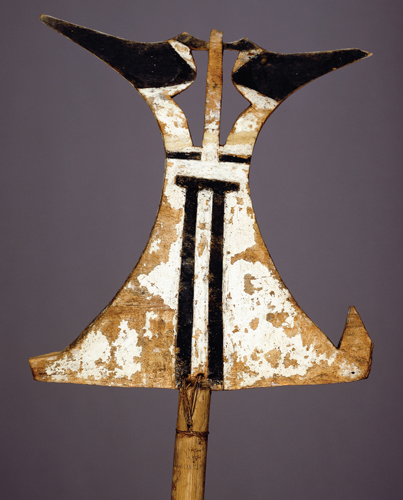 The canoe prow ornament illustrated here is meant to show what design?
 (Multiple Choice)
4.9/5 (77)
(77) The moai of Rapa Nui, serving as silent sentinels on stone platforms, are believed to depict which beings?
(Multiple Choice)
4.8/5 (77)
(77)
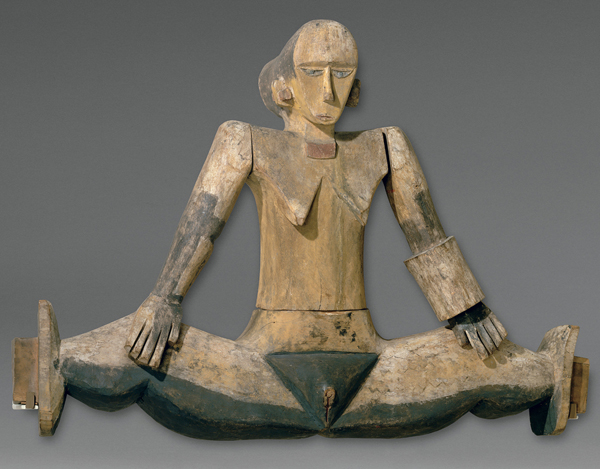 What is the term for this figure, placed over the entrance of a Belau bai as a means of invoking fertility and protection?
 (Multiple Choice)
4.9/5 (63)
(63)
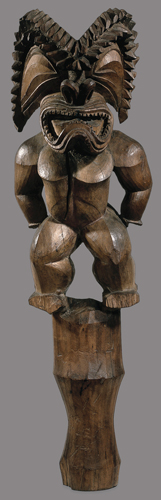 The stance and expression of this Hawaiian figure support its identification as what?
 (Multiple Choice)
4.8/5 (82)
(82) The painted-gable storyboards on Belau ceremonial houses provide information about which of the following?
(Multiple Choice)
4.8/5 (69)
(69) Protective ornaments in the form of carvings of exalted ancestor figures are called what?
(Multiple Choice)
4.8/5 (80)
(80) The Asmat have a rich artistic vocabulary of visual symbols in which the female praying mantis is meant to have what meaning?
(Multiple Choice)
4.9/5 (84)
(84) Which people developed the most stratified society of all of those in the Pacific region?
(Multiple Choice)
4.8/5 (78)
(78) The decorated storyboards on Belau ceremonial houses (bai) include which figure as a warning to women to keep out of the structure?
(Multiple Choice)
4.8/5 (83)
(83) In Asmat society, pledges to avenge the death of a relative are embodied in which art form?
(Multiple Choice)
4.9/5 (75)
(75) Aside from serving as instruments of communication, what other function did the Iatmul slit-gongs have?
(Multiple Choice)
4.9/5 (84)
(84) Which medium forms the basis of the majority of Australian Aboriginal art?
(Multiple Choice)
4.8/5 (80)
(80) The Abelam culture of Papua New Guinea is centered on which of the following?
(Multiple Choice)
4.9/5 (69)
(69) The mana of Polynesian art objects is best described as what?
(Multiple Choice)
4.8/5 (71)
(71) The Hawaiian cloak worn by Kamehameha III provided the wearer with the gods' protection and was made of what rare material?
(Multiple Choice)
4.9/5 (69)
(69) 
Filters
- Essay(0)
- Multiple Choice(0)
- Short Answer(0)
- True False(0)
- Matching(0)