



 Chat with AI
Exam 31: Modernism and Postmodernism in Europe and America, 1945 to 1980

Exam 1: Art in the Stone Age50 Questions
Exam 2: Ancient Mesopotamia and Persia50 Questions
Exam 3: Egypt From Narmer to Cleopatra50 Questions
Exam 4: The Prehistoric Aegean50 Questions
Exam 5: Ancient Greece50 Questions
Exam 6: The Etruscans50 Questions
Exam 7: The Roman Empire50 Questions
Exam 8: Late Antiquity50 Questions
Exam 9: Byzantium50 Questions
Exam 10: The Islamic World50 Questions
Exam 11: Early Medieval Europe50 Questions
Exam 12: Romanesque Europe50 Questions
Exam 13: Gothic Europe North of the Alps50 Questions
Exam 14: Late Medieval Italy50 Questions
Exam 15: South and Southeast Asia Before 120050 Questions
Exam 16: China and Korea to 127950 Questions
Exam 17: Japan Before 133350 Questions
Exam 18: Native American Cultures Before 130049 Questions
Exam 19: Africa Before 180050 Questions
Exam 20: Late Medieval and Early Renaissance Northern Europe50 Questions
Exam 21: The Renaissance in Quattrocento Italy50 Questions
Exam 22: Renaissance and Mannerism in Cinquecento Italy50 Questions
Exam 23: High Renaissance and Mannerism in Northern Europe and Spain50 Questions
Exam 24: The Baroque in Italy and Spain50 Questions
Exam 25: The Baroque in Northern Europe50 Questions
Exam 26: Rococo to Neoclassicism: the 18th Century in Europe and America50 Questions
Exam 27: Romanticism, Realism, Photography: Europe and America, 1800 to 187050 Questions
Exam 28: Impressionism, Post-Impressionism, Symbolism: Europe and America, 1870 to 190050 Questions
Exam 29: Modernism in Europe, 1900 to 194550 Questions
Exam 30: Modernism in the United States and Mexico, 1900 to 194550 Questions
Exam 31: Modernism and Postmodernism in Europe and America, 1945 to 198050 Questions
Exam 32: Contemporary Art Worldwide50 Questions
Exam 33: South and Southeast Asia, 1200 to 198050 Questions
Exam 34: China and Korea, 1279 to 198050 Questions
Exam 35: Japan, 1333 to 198050 Questions
Exam 36: Native American Cultures, 1300 to 198050 Questions
Exam 37: Oceania Before 198050 Questions
Exam 38: Africa, 1800 to 198050 Questions
Select questions type


Piano and Rogers designed the Centre Georges Pompidou, meant as a cultural arts center, to imitate which building type?
(Multiple Choice)
4.9/5  (73)
(73) Which 20th-century art movement sought to harness the communicative power of art to reach a wide audience?
(Multiple Choice)
4.9/5 (67)
(67) What was the source of the images of women de Kooning used as the focus of his Woman series?
(Multiple Choice)
4.8/5 (84)
(84) What did Minimalist sculptors such as Tony Smith choose to emphasize as the essential characteristic of their medium?
(Multiple Choice)
4.8/5 (75)
(75) In creating his sculptures specifically for open-air settings, what element did David Smith prioritize?
(Multiple Choice)
5.0/5 (86)
(86) Which of the following works is the product of its creator's study of the way advertising shapes public attitudes?
(Multiple Choice)
4.8/5 (69)
(69) Which of the following artists was a color-field painter, who poured diluted paint onto unprimed canvas to emphasize that painting is simply pigment on a flat surface?
(Multiple Choice)
4.8/5 (93)
(93) Which of the following was NOT one of Judy Chicago's intentions in creating The Dinner Party ?
(Multiple Choice)
4.9/5 (63)
(63) What artist chose to employ the commercial printing technique of benday dots on a large scale?
(Multiple Choice)
4.9/5 (81)
(81)
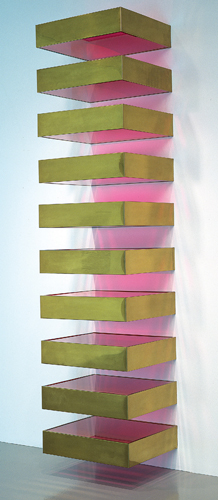 Which element of Donald Judd's sculpture Untitled reflects his intention of banishing ambiguity from his work and using a visual vocabulary that does not deceive as illusionism would?
 (Multiple Choice)
4.8/5 (76)
(76) Which of the following artists is best known for his large-scale portraits?
(Multiple Choice)
4.9/5 (85)
(85) What printing method did Andy Warhol employ to create multiple images of the same object, such as a Coke bottle or a soup can?
(Multiple Choice)
4.8/5 (87)
(87)
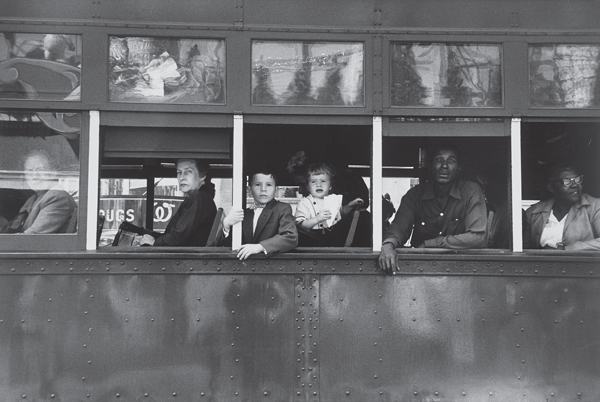 Robert Frank's photograph illustrating the realities of segregation was taken in which American city?
 (Multiple Choice)
4.8/5 (86)
(86) The iconic Sydney Opera House was designed by which architect?
(Multiple Choice)
4.9/5 (70)
(70) What art movement arose in the United States as a result of the emigration of European artists after World War II?
(Multiple Choice)
4.7/5 (72)
(72) Which New York artist evolved in style to compositionally simple paintings in which color was the primary conveyor of meaning?
(Multiple Choice)
4.9/5 (76)
(76) Which phrase best characterizes the sculptural works of Louise Bourgeois such as Cumul I ?
(Multiple Choice)
4.9/5 (82)
(82) 
Filters
- Essay(0)
- Multiple Choice(0)
- Short Answer(0)
- True False(0)
- Matching(0)