



 Chat with AI
Exam 10: The Islamic World

Exam 1: Art in the Stone Age50 Questions
Exam 2: Ancient Mesopotamia and Persia50 Questions
Exam 3: Egypt From Narmer to Cleopatra50 Questions
Exam 4: The Prehistoric Aegean50 Questions
Exam 5: Ancient Greece50 Questions
Exam 6: The Etruscans50 Questions
Exam 7: The Roman Empire50 Questions
Exam 8: Late Antiquity50 Questions
Exam 9: Byzantium50 Questions
Exam 10: The Islamic World50 Questions
Exam 11: Early Medieval Europe50 Questions
Exam 12: Romanesque Europe50 Questions
Exam 13: Gothic Europe North of the Alps50 Questions
Exam 14: Late Medieval Italy50 Questions
Exam 15: South and Southeast Asia Before 120050 Questions
Exam 16: China and Korea to 127950 Questions
Exam 17: Japan Before 133350 Questions
Exam 18: Native American Cultures Before 130049 Questions
Exam 19: Africa Before 180050 Questions
Exam 20: Late Medieval and Early Renaissance Northern Europe50 Questions
Exam 21: The Renaissance in Quattrocento Italy50 Questions
Exam 22: Renaissance and Mannerism in Cinquecento Italy50 Questions
Exam 23: High Renaissance and Mannerism in Northern Europe and Spain50 Questions
Exam 24: The Baroque in Italy and Spain50 Questions
Exam 25: The Baroque in Northern Europe50 Questions
Exam 26: Rococo to Neoclassicism: the 18th Century in Europe and America50 Questions
Exam 27: Romanticism, Realism, Photography: Europe and America, 1800 to 187050 Questions
Exam 28: Impressionism, Post-Impressionism, Symbolism: Europe and America, 1870 to 190050 Questions
Exam 29: Modernism in Europe, 1900 to 194550 Questions
Exam 30: Modernism in the United States and Mexico, 1900 to 194550 Questions
Exam 31: Modernism and Postmodernism in Europe and America, 1945 to 198050 Questions
Exam 32: Contemporary Art Worldwide50 Questions
Exam 33: South and Southeast Asia, 1200 to 198050 Questions
Exam 34: China and Korea, 1279 to 198050 Questions
Exam 35: Japan, 1333 to 198050 Questions
Exam 36: Native American Cultures, 1300 to 198050 Questions
Exam 37: Oceania Before 198050 Questions
Exam 38: Africa, 1800 to 198050 Questions
Select questions type


Which is the supposed precursor of hypostyle-designed mosques, such as the one at Kairouan?
(Multiple Choice)
4.8/5  (89)
(89) Although Muhammad had all the idols within it destroyed, why did he allow the Kaaba to be preserved?
(Multiple Choice)
4.7/5 (78)
(78) Where did the Abbasids establish a new capital after the overthrow of the Umayyad caliphs?
(Multiple Choice)
4.8/5 (70)
(70) What was the occupation of Sinan before he became architect for Suleyman the Magnificent?
(Multiple Choice)
4.8/5 (70)
(70) The positioning of all mosques, no matter period or country, must be oriented toward which of the following cities?
(Multiple Choice)
5.0/5 (78)
(78) The Great Mosque at Córdoba has a hypostyle prayer hall with horseshoe-shaped arches adapted from which people?
(Multiple Choice)
4.8/5 (100)
(100) Which decorative element does not appear in the Ardabil carpet designed by Maqsud of Kashan?
(Multiple Choice)
4.9/5 (83)
(83) Where are masterworks of Islamic calligraphy least likely to be found?
(Multiple Choice)
4.8/5 (82)
(82)
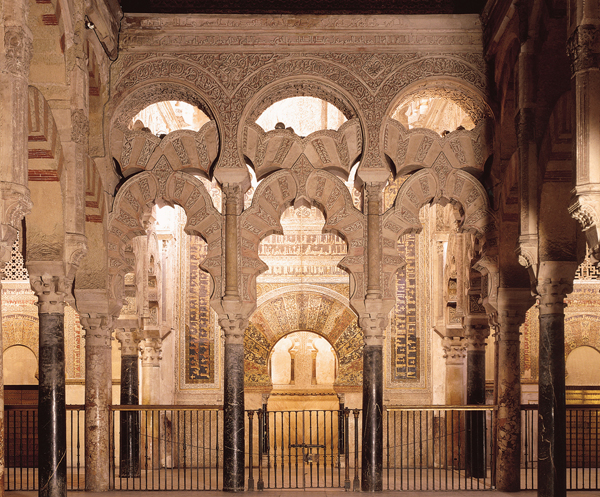 Which component of the mosque plan appears in this image?
 (Multiple Choice)
4.9/5 (78)
(78) Which capital, established by the Abbasid caliph al-Mansur, was referred to as the City of Peace?
(Multiple Choice)
4.9/5 (82)
(82) 
Filters
- Essay(0)
- Multiple Choice(0)
- Short Answer(0)
- True False(0)
- Matching(0)