



 Chat with AI
Exam 52: Animal Behavior

Exam 1: A View of Life72 Questions
Exam 2: Atoms and Molecules: the Chemical Basis of Life75 Questions
Exam 3: The Chemistry of Life: Organic Compounds75 Questions
Exam 4: Organization of the Cell76 Questions
Exam 5: Biological Membranes73 Questions
Exam 6: Cell Communication73 Questions
Exam 7: Energy and Metabolism73 Questions
Exam 8: How Cells Make Atp: Energy-Releasing Pathways75 Questions
Exam 9: Photosynthesis: Capturing Light Energy79 Questions
Exam 10: Chromosomes, Mitosis, and Meiosis78 Questions
Exam 11: The Basic Principles of Heredity87 Questions
Exam 12: DNA: The Carrier of Genetic Information83 Questions
Exam 13: Gene Expression92 Questions
Exam 14: Gene Regulation86 Questions
Exam 15: DNA Technology and Genomics98 Questions
Exam 16: Human Genetics and the Human Genome82 Questions
Exam 17: Developmental Genetics90 Questions
Exam 18: Introduction to Darwinian Evolution66 Questions
Exam 19: Evolutionary Change in Populations72 Questions
Exam 20: Speciation and Macroevolution72 Questions
Exam 21: The Origin and Evolutionary History of Life71 Questions
Exam 22: The Evolution of Primates73 Questions
Exam 23: Understanding Diversity: Systematics70 Questions
Exam 24: Viruses and Subviral Agents55 Questions
Exam 25: Bacteria and Archaea63 Questions
Exam 26: Protists76 Questions
Exam 27: Seedless Plants76 Questions
Exam 28: Seed Plants76 Questions
Exam 29: The Fungi78 Questions
Exam 30: An Introduction to Animal Diversity71 Questions
Exam 31: Sponges, Cnidarians, Ctenophores, and Protostomes114 Questions
Exam 32: The Deuterostomes79 Questions
Exam 33: Plant Structure, Growth, and Development94 Questions
Exam 34: Leaf Structure and Function90 Questions
Exam 35: Stem Structure and Transport91 Questions
Exam 36: Roots and Mineral Nutrition105 Questions
Exam 37: Reproduction in Flowering Plants107 Questions
Exam 38: Plant Developmental Responses to External and Internal Signals113 Questions
Exam 39: Animal Structure and Function: an Introduction106 Questions
Exam 40: Protection, Support, and Movement75 Questions
Exam 41: Neural Signaling76 Questions
Exam 42: Neural Regulation81 Questions
Exam 43: Sensory Systems83 Questions
Exam 44: Internal Transport119 Questions
Exam 45: The Immune System: Internal Defense93 Questions
Exam 46: Gas Exchange123 Questions
Exam 47: Processing Food and Nutrition127 Questions
Exam 48: Osmoregulation and Disposal of Metabolic Wastes111 Questions
Exam 49: Endocrine Regulation87 Questions
Exam 50: Reproduction121 Questions
Exam 51: Animal Development117 Questions
Exam 52: Animal Behavior91 Questions
Exam 53: Introduction to Ecology: Population Ecology99 Questions
Exam 54: Community Ecology91 Questions
Exam 55: Ecosystems and the Biosphere101 Questions
Exam 56: Ecology and the Geography of Life99 Questions
Exam 57: Biological Diversity and Conservation Biology82 Questions
Select questions type


Which of the following is an organ that is NOT a primary influencer of animal behavior?
(Multiple Choice)
4.7/5  (78)
(78) Figure 52-3
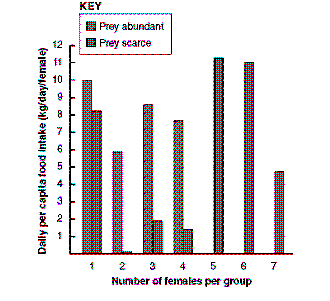
Based on the accompanying figure, when prey are abundant, the most effective hunting group size is:
Based on the accompanying figure, when prey are abundant, the most effective hunting group size is: (Multiple Choice)
4.8/5 (72)
(72) You see an advertisement on the television with a very good-looking person showing off a new, shiny, powerful car. You seriously think about buying that particular car. Therefore, the person in the advertisement could best be described as the:
(Multiple Choice)
4.7/5 (75)
(75) Which of the following is a correct statement regarding biological clocks?
(Multiple Choice)
4.8/5 (76)
(76) A human urban dweller reports that she does not sleep well in a rural area. This is most clearly an example of which of the following?
(Multiple Choice)
4.8/5 (86)
(86) Males of some animal species have a display area where they compete for reproductively available females. This area is known as a:
(Multiple Choice)
4.8/5 (99)
(99) Match the behavior type with its description.
Premises:
Learning to produce a behavior to gain a reward or avoid a punishment
Responses:
Problem solving
Operant conditioning
Imprinting
Correct Answer: Verified
Premises:
Responses:
(Matching)
4.8/5 (70)
(70) Which of the following is an INCORRECT statement regarding animal behavior?
(Multiple Choice)
4.9/5 (80)
(80) Match the behavior type with its description.
Premises:
Learning to distinguish care provider based off early critical period exposure
Responses:
Problem solving
Habituation
Classical conditioning
Correct Answer:Verified
VerifiedPremises:
Responses:
(Matching)
4.8/5 (81)
(81) The field of sociobiology was much expanded by the book, Sociobiology: The New Synthesis , written by:
(Multiple Choice)
4.9/5 (75)
(75) 
Filters
- Essay(0)
- Multiple Choice(0)
- Short Answer(0)
- True False(0)
- Matching(0)