



 Chat with AI
Exam 16: Human Genetics and the Human Genome

Exam 1: A View of Life72 Questions
Exam 2: Atoms and Molecules: the Chemical Basis of Life75 Questions
Exam 3: The Chemistry of Life: Organic Compounds75 Questions
Exam 4: Organization of the Cell76 Questions
Exam 5: Biological Membranes73 Questions
Exam 6: Cell Communication73 Questions
Exam 7: Energy and Metabolism73 Questions
Exam 8: How Cells Make Atp: Energy-Releasing Pathways75 Questions
Exam 9: Photosynthesis: Capturing Light Energy79 Questions
Exam 10: Chromosomes, Mitosis, and Meiosis78 Questions
Exam 11: The Basic Principles of Heredity87 Questions
Exam 12: DNA: The Carrier of Genetic Information83 Questions
Exam 13: Gene Expression92 Questions
Exam 14: Gene Regulation86 Questions
Exam 15: DNA Technology and Genomics98 Questions
Exam 16: Human Genetics and the Human Genome82 Questions
Exam 17: Developmental Genetics90 Questions
Exam 18: Introduction to Darwinian Evolution66 Questions
Exam 19: Evolutionary Change in Populations72 Questions
Exam 20: Speciation and Macroevolution72 Questions
Exam 21: The Origin and Evolutionary History of Life71 Questions
Exam 22: The Evolution of Primates73 Questions
Exam 23: Understanding Diversity: Systematics70 Questions
Exam 24: Viruses and Subviral Agents55 Questions
Exam 25: Bacteria and Archaea63 Questions
Exam 26: Protists76 Questions
Exam 27: Seedless Plants76 Questions
Exam 28: Seed Plants76 Questions
Exam 29: The Fungi78 Questions
Exam 30: An Introduction to Animal Diversity71 Questions
Exam 31: Sponges, Cnidarians, Ctenophores, and Protostomes114 Questions
Exam 32: The Deuterostomes79 Questions
Exam 33: Plant Structure, Growth, and Development94 Questions
Exam 34: Leaf Structure and Function90 Questions
Exam 35: Stem Structure and Transport91 Questions
Exam 36: Roots and Mineral Nutrition105 Questions
Exam 37: Reproduction in Flowering Plants107 Questions
Exam 38: Plant Developmental Responses to External and Internal Signals113 Questions
Exam 39: Animal Structure and Function: an Introduction106 Questions
Exam 40: Protection, Support, and Movement75 Questions
Exam 41: Neural Signaling76 Questions
Exam 42: Neural Regulation81 Questions
Exam 43: Sensory Systems83 Questions
Exam 44: Internal Transport119 Questions
Exam 45: The Immune System: Internal Defense93 Questions
Exam 46: Gas Exchange123 Questions
Exam 47: Processing Food and Nutrition127 Questions
Exam 48: Osmoregulation and Disposal of Metabolic Wastes111 Questions
Exam 49: Endocrine Regulation87 Questions
Exam 50: Reproduction121 Questions
Exam 51: Animal Development117 Questions
Exam 52: Animal Behavior91 Questions
Exam 53: Introduction to Ecology: Population Ecology99 Questions
Exam 54: Community Ecology91 Questions
Exam 55: Ecosystems and the Biosphere101 Questions
Exam 56: Ecology and the Geography of Life99 Questions
Exam 57: Biological Diversity and Conservation Biology82 Questions
Select questions type


Briefly explain the different purposes for genetic screening in newborns and adults.
(Essay)
4.9/5  (72)
(72) The human genome contains about ____ genes, which comprises about _____ of the genome.
(Multiple Choice)
4.9/5 (71)
(71) A genetic counselor will know that the probability of having a child affected with a condition inherited as an autosomal recessive would be:
(Multiple Choice)
4.9/5 (72)
(72) According to data from the ENCODE project, approximately 80% of the human genome is associated with biological function.
(True/False)
4.9/5 (74)
(74) An individual who inherits the specific chromosome ____ deletion from his/her ____ will most likely have Prader-Willi syndrome rather than Angelman syndrome.
(Multiple Choice)
4.8/5 (82)
(82) Figure 16-2
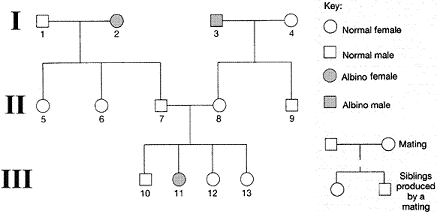 The inheritance pattern demonstrated by the pedigree in accompanying figure is:
 (Multiple Choice)
4.9/5 (71)
(71) A karyotype reveals that an individual is XYY. Based on your knowledge of human genetics, you correctly conclude that this individual has ____, and is a phenotypically _____.
(Multiple Choice)
5.0/5 (87)
(87) The science of comparative genomics to study human gene function is possible because much of the human genome is conserved among other closely related species.
(True/False)
4.7/5 (80)
(80) Comparing the human and mouse genomes has revealed that the mouse and human:
(Multiple Choice)
4.9/5 (91)
(91) The normal human karyotype contains ____ total chromosomes, consisting of ____ autosomes and ____ sex chromosomes.
(Multiple Choice)
5.0/5 (70)
(70) What explains the viability of individuals with aneuploidies for the sex chromosomes?
(Multiple Choice)
4.7/5 (87)
(87) 
Filters
- Essay(0)
- Multiple Choice(0)
- Short Answer(0)
- True False(0)
- Matching(0)