



 Chat with AI
Exam 10: Externalities

Exam 1: Ten Lessons From Economics146 Questions
Exam 2: Thinking Like an Economist133 Questions
Exam 3: Interdependence and the Gains From Trade139 Questions
Exam 4: The Market Forces of Supply and Demand215 Questions
Exam 5: Elasticity and Its Application178 Questions
Exam 6: Supply, Demand and Government Policies145 Questions
Exam 7: Consumers, Producers and the Efficiency of Markets171 Questions
Exam 8: Application: the Costs of Taxation135 Questions
Exam 9: Application: International Trade151 Questions
Exam 10: Externalities199 Questions
Exam 11: Public Goods and Common Resources178 Questions
Exam 12: The Design of the Tax System154 Questions
Exam 13: The Costs of Production191 Questions
Exam 14: Firms in Competitive Markets198 Questions
Exam 15: Monopoly212 Questions
Exam 16: Monopolistic Competition212 Questions
Exam 17: Business Strategy and Oligopoly179 Questions
Exam 18: Competition Policy103 Questions
Exam 19: The Markets for the Factors of Production214 Questions
Exam 20: Earnings, Unions and Discrimination201 Questions
Exam 21: Income Inequity and Poverty111 Questions
Exam 22: The Theory of Consumer Choice158 Questions
Exam 23: Frontiers of Microeconomics111 Questions
Exam 24: Measuring a Nations Income51 Questions
Exam 25: Measuring the Cost of Living55 Questions
Exam 26: Production and Growth62 Questions
Exam 27: Saving, Investment and the Financial System62 Questions
Exam 28: The Natural Rate of Unemployment58 Questions
Exam 29: The Monetary System66 Questions
Exam 30: Inflation: Its Causes and Costs74 Questions
Exam 31: Open-Economy Macroeconomics: Basic Concepts68 Questions
Exam 32: A Macroeconomic Theory of the Open Economy61 Questions
Exam 33: Aggregate Demand and Aggregate Supply81 Questions
Exam 34: The Influence of Monetary and Fiscal Policy on Aggregate Demand73 Questions
Exam 35: The Short-Run Trade-Off Between Inflation and Unemployment57 Questions
Exam 36: Global Financial Crisis of 2008 and Beyond37 Questions
Exam 37: Five Debates Over Macroeconomic Policy38 Questions
Select questions type


In which of the following ways are Pigovian taxes and pollution permits similar?
(i) in both cases, firms pay for their pollution.(ii) both internalise the externality of pollution by making it costly to pollute.(iii) each policy allows for a market-based solution.
(Multiple Choice)
4.7/5  (81)
(81) Graph 10-5 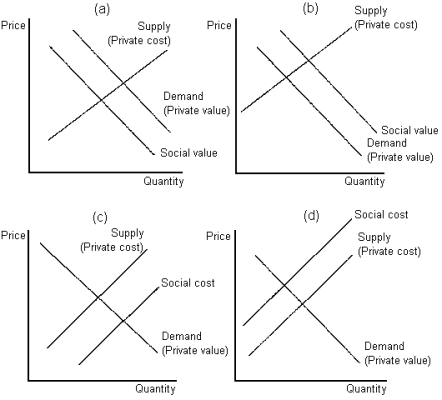 -Refer to Graph 10-5.Which of the graphs shown best depicts the case of a positive consumption externality?
 (Multiple Choice)
4.9/5 (82)
(82) The most efficient way to achieve reductions in pollution is for each firm to reduce their pollution by the same amount.
(True/False)
4.9/5 (83)
(83) Consider the following negative production externality as depicted: 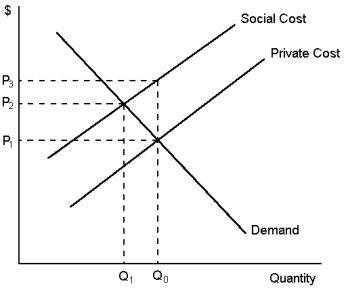 Identify the social optimum and explain what methods the government could use to achieve this outcome.
 (Essay)
4.8/5 (71)
(71) In Australia, hunting regulations for kangaroos are closely monitored and enforced.This is an example of a policy:
(Multiple Choice)
4.8/5 (87)
(87) Negative consumption externalities will have a socially optimal quantity that is smaller than the quantity determined by the private market.
(True/False)
4.9/5 (86)
(86) One advantage of allowing a market for pollution permits to control the total amount of pollution released in an area is that:
(Multiple Choice)
4.8/5 (75)
(75) According to the Coase theorem, which of the following conditions must hold, in order for private solutions to externalities to be possible?
(i) bargaining costs are small
(ii) property ownership/rights cannot be defined
(iii) the number of parties involved is large
(Multiple Choice)
4.9/5 (74)
(74) Internalising a positive production externality through technology policy:
(Multiple Choice)
4.8/5 (74)
(74) Assume that your housemate is very messy.(There is no law against being messy.) Suppose she gets a $100 benefit from being messy but imposes a $200 cost on you.The Coase theorem would suggest that an efficient solution would be for you to:
(Multiple Choice)
4.8/5 (87)
(87) Private parties can negotiate a solution to an externality in all cases.
(True/False)
4.9/5 (76)
(76) When the government decides to dredge a bay to let big ships into the port, they are causing:
(Multiple Choice)
4.9/5 (77)
(77) The owner of a luxury 4WD enjoys a positive externality because the luxury 4WD offers added safety when compared to a small car.
(True/False)
4.9/5 (79)
(79) All remedies that attempt to solve an externality problem share the goal of moving the allocation of resources closer to the private optimum.
(True/False)
4.9/5 (69)
(69) In order for a Pigovian tax to be efficient, it often requires detailed information about:
(Multiple Choice)
4.9/5 (80)
(80) Once tradeable pollution permits have been allocated to firms:
(Multiple Choice)
4.7/5 (88)
(88) What is meant by 'internalising' an externality? How can a negative externality be internalised?
(Essay)
4.8/5 (90)
(90) Which of the following is true of positive consumption externalities?
(Multiple Choice)
4.9/5 (79)
(79) When private solutions fail to arise, an externality will:
(Multiple Choice)
4.9/5 (84)
(84) 
Filters
- Essay(0)
- Multiple Choice(0)
- Short Answer(0)
- True False(0)
- Matching(0)