



 Chat with AI
Exam 27: Saving, Investment and the Financial System

Exam 1: Ten Lessons From Economics146 Questions
Exam 2: Thinking Like an Economist133 Questions
Exam 3: Interdependence and the Gains From Trade139 Questions
Exam 4: The Market Forces of Supply and Demand215 Questions
Exam 5: Elasticity and Its Application178 Questions
Exam 6: Supply, Demand and Government Policies145 Questions
Exam 7: Consumers, Producers and the Efficiency of Markets171 Questions
Exam 8: Application: the Costs of Taxation135 Questions
Exam 9: Application: International Trade151 Questions
Exam 10: Externalities199 Questions
Exam 11: Public Goods and Common Resources178 Questions
Exam 12: The Design of the Tax System154 Questions
Exam 13: The Costs of Production191 Questions
Exam 14: Firms in Competitive Markets198 Questions
Exam 15: Monopoly212 Questions
Exam 16: Monopolistic Competition212 Questions
Exam 17: Business Strategy and Oligopoly179 Questions
Exam 18: Competition Policy103 Questions
Exam 19: The Markets for the Factors of Production214 Questions
Exam 20: Earnings, Unions and Discrimination201 Questions
Exam 21: Income Inequity and Poverty111 Questions
Exam 22: The Theory of Consumer Choice158 Questions
Exam 23: Frontiers of Microeconomics111 Questions
Exam 24: Measuring a Nations Income51 Questions
Exam 25: Measuring the Cost of Living55 Questions
Exam 26: Production and Growth62 Questions
Exam 27: Saving, Investment and the Financial System62 Questions
Exam 28: The Natural Rate of Unemployment58 Questions
Exam 29: The Monetary System66 Questions
Exam 30: Inflation: Its Causes and Costs74 Questions
Exam 31: Open-Economy Macroeconomics: Basic Concepts68 Questions
Exam 32: A Macroeconomic Theory of the Open Economy61 Questions
Exam 33: Aggregate Demand and Aggregate Supply81 Questions
Exam 34: The Influence of Monetary and Fiscal Policy on Aggregate Demand73 Questions
Exam 35: The Short-Run Trade-Off Between Inflation and Unemployment57 Questions
Exam 36: Global Financial Crisis of 2008 and Beyond37 Questions
Exam 37: Five Debates Over Macroeconomic Policy38 Questions
Select questions type


A company is looking to see what rate of return it is receiving from a project when the project's initial investment is $14 million today and will receive $18.5 million in four years.

Free
(Multiple Choice)
4.8/5  (80)
(80) Correct Answer: Verified
A
An increase in the government's budget deficit ____ the real interest rate and ____ the equilibrium quantity of national saving.
Free
(Multiple Choice)
4.9/5 (80)
(80) Correct Answer:Verified
VerifiedB
Using a graph representing the market for loanable funds, show and explain what happens to interest rates and investment if the investment tax credit is abolished.
Free
(Essay)
4.9/5 (84)
(84) Correct Answer:Verified
VerifiedAs shown in the graph below, the economy starts in equilibrium at point E₀, with interest rate r₀ and equilibrium quantity saved and invested at q₀.If the investment tax credit is abolished, the incentive to invest is reduced, and less investment will be undertaken at each interest rate.Therefore, the demand-for-loanable-funds curve shifts from D₀ to D₁.The new equilibrium is at E₁, with a lower interest rate, r₁, and a lower level of saving and investment, Q₁.Hence, elimination of the investment tax credit reduces interest rates and reduces investment. 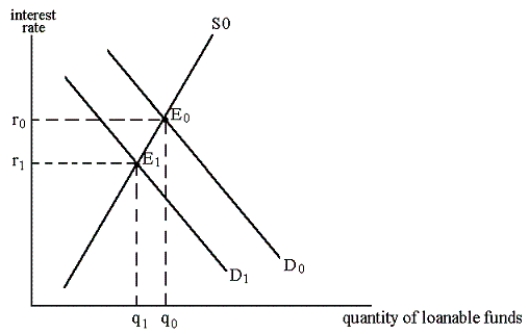
When the government borrows to finance its budget, private borrowers are still able to finance investment.
(True/False)
4.9/5 (84)
(84) When the government runs a budget surplus, it uses the funds to:
(Multiple Choice)
4.8/5 (105)
(105) If the real interest rate and the nominal interest rate was three per cent in 2005, then the inflation rate in 2005 would be:
(Multiple Choice)
4.9/5 (85)
(85) Australian government bonds are considered as being less risky and pay relatively low interest rates because:
(Multiple Choice)
4.9/5 (74)
(74) How does the introduction of new technologies affect saving, investment and the real interest rate?
(Essay)
4.7/5 (85)
(85) If consumption spending increases by $10 million with no changes in net transfer payments, then:
(Multiple Choice)
4.9/5 (68)
(68) The financial system consists of those institutions in the economy that help to match one person's saving with another person's investment.
(True/False)
4.8/5 (81)
(81) Where Y is GDP, C is consumption, T is net taxes and G is government spending, if there is no international trade, then the government budget surplus equals:
(Multiple Choice)
4.9/5 (73)
(73) If a company's bond can be purchased today and expects to earn investors 5% p.a, paying $100 at the end of 25 years, what is today's price? What could occur, to the price of the bonds if the company's level of risk increases? Why?
(Essay)
4.9/5 (68)
(68) Shares enable firms to raise debt financing as the firm is in debt to its owners.
(True/False)
5.0/5 (65)
(65) Investing in managed funds is an attempt to diversify risk across a range of investment options.
(True/False)
4.7/5 (90)
(90) Holding other factors constant, if a change in tax laws encourages people to save more for retirement, then the real interest rate will increase and the equilibrium quantity of saving and investment will decrease.
(True/False)
4.9/5 (82)
(82) Where Y is GDP, C is consumption, I is investment and G is government spending, if there is no international trade, then national saving equals:
(Multiple Choice)
5.0/5 (80)
(80) 
Filters
- Essay(0)
- Multiple Choice(0)
- Short Answer(0)
- True False(0)
- Matching(0)