



 Chat with AI
Exam 15: Monopoly

Exam 1: Ten Lessons From Economics146 Questions
Exam 2: Thinking Like an Economist133 Questions
Exam 3: Interdependence and the Gains From Trade139 Questions
Exam 4: The Market Forces of Supply and Demand215 Questions
Exam 5: Elasticity and Its Application178 Questions
Exam 6: Supply, Demand and Government Policies145 Questions
Exam 7: Consumers, Producers and the Efficiency of Markets171 Questions
Exam 8: Application: the Costs of Taxation135 Questions
Exam 9: Application: International Trade151 Questions
Exam 10: Externalities199 Questions
Exam 11: Public Goods and Common Resources178 Questions
Exam 12: The Design of the Tax System154 Questions
Exam 13: The Costs of Production191 Questions
Exam 14: Firms in Competitive Markets198 Questions
Exam 15: Monopoly212 Questions
Exam 16: Monopolistic Competition212 Questions
Exam 17: Business Strategy and Oligopoly179 Questions
Exam 18: Competition Policy103 Questions
Exam 19: The Markets for the Factors of Production214 Questions
Exam 20: Earnings, Unions and Discrimination201 Questions
Exam 21: Income Inequity and Poverty111 Questions
Exam 22: The Theory of Consumer Choice158 Questions
Exam 23: Frontiers of Microeconomics111 Questions
Exam 24: Measuring a Nations Income51 Questions
Exam 25: Measuring the Cost of Living55 Questions
Exam 26: Production and Growth62 Questions
Exam 27: Saving, Investment and the Financial System62 Questions
Exam 28: The Natural Rate of Unemployment58 Questions
Exam 29: The Monetary System66 Questions
Exam 30: Inflation: Its Causes and Costs74 Questions
Exam 31: Open-Economy Macroeconomics: Basic Concepts68 Questions
Exam 32: A Macroeconomic Theory of the Open Economy61 Questions
Exam 33: Aggregate Demand and Aggregate Supply81 Questions
Exam 34: The Influence of Monetary and Fiscal Policy on Aggregate Demand73 Questions
Exam 35: The Short-Run Trade-Off Between Inflation and Unemployment57 Questions
Exam 36: Global Financial Crisis of 2008 and Beyond37 Questions
Exam 37: Five Debates Over Macroeconomic Policy38 Questions
Select questions type


Which of the following statements about a firm's market pricing of its product is true?

Free
(Multiple Choice)
4.8/5  (81)
(81) Correct Answer: Verified
A
A monopoly firm is able to charge a price that is higher than their marginal revenue.
Free
(True/False)
4.7/5 (87)
(87) Correct Answer:Verified
VerifiedTrue
The most important feature of a natural monopoly is:
Free
(Multiple Choice)
4.8/5 (95)
(95) Correct Answer:Verified
VerifiedD
When the government creates a monopoly, the social loss may include:
(Multiple Choice)
4.8/5 (92)
(92) Consider the following graph of a monopoly. 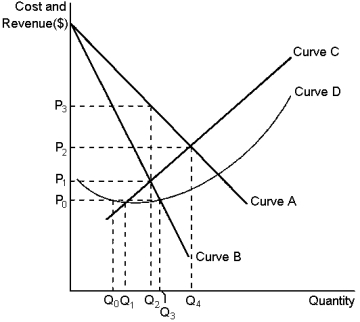 Use the graph to identify the marginal-revenue curve, the average-revenue curve, the average-total-cost curve and the marginal-cost curve.Then identify the price a profit-maximising monopolist would charge and the output it would produce.
 (Essay)
4.9/5 (76)
(76) Monopoly firms can employ their market power to charge a price that is:
(Multiple Choice)
4.9/5 (98)
(98) The monopolist's demand curve slopes downwards whenever marginal costs are increasing.
(True/False)
4.8/5 (72)
(72) Suppose monopoly firm has exclusive ownership of a key resource, this results in:
(Multiple Choice)
4.8/5 (87)
(87) A monopoly is likely to occur if it is the incumbent firm and there are significant barriers to entry.
(True/False)
4.9/5 (90)
(90) A profit-maximising monopolist chooses the output level where marginal revenue equals marginal cost and chooses the corresponding price off the market demand curve.
(True/False)
4.9/5 (73)
(73) When a natural monopoly exists, it is never more cost-effective for two or more private firms to produce the product.
(True/False)
4.9/5 (71)
(71) If a firm is in a competitive market, it is not able to price discriminate.
(True/False)
4.9/5 (89)
(89) Price discrimination explains why high-ranking universities often set rules that determine prices of admission based on the students:
(Multiple Choice)
4.9/5 (70)
(70) When a firm operates under conditions of a monopoly, its price is unconstrained.
(True/False)
4.8/5 (75)
(75) When deciding what price to charge consumers, the monopolist may choose to charge them different prices based on:
(Multiple Choice)
4.8/5 (90)
(90) The De Beers Diamond company is not worried about differentiating their product from all the other gemstones.
(True/False)
4.8/5 (81)
(81) Using the above information, what is the dead-weight loss of monopoly if the publisher can price-discriminate?
(Multiple Choice)
4.9/5 (76)
(76) Which of the following is an impossible feat for a monopolist to accomplish?
(Multiple Choice)
4.8/5 (69)
(69) 
Filters
- Essay(0)
- Multiple Choice(0)
- Short Answer(0)
- True False(0)
- Matching(0)