



 Chat with AI
Exam 15: Monopoly

Exam 1: Ten Lessons From Economics146 Questions
Exam 2: Thinking Like an Economist133 Questions
Exam 3: Interdependence and the Gains From Trade139 Questions
Exam 4: The Market Forces of Supply and Demand215 Questions
Exam 5: Elasticity and Its Application178 Questions
Exam 6: Supply, Demand and Government Policies145 Questions
Exam 7: Consumers, Producers and the Efficiency of Markets171 Questions
Exam 8: Application: the Costs of Taxation135 Questions
Exam 9: Application: International Trade151 Questions
Exam 10: Externalities199 Questions
Exam 11: Public Goods and Common Resources178 Questions
Exam 12: The Design of the Tax System154 Questions
Exam 13: The Costs of Production191 Questions
Exam 14: Firms in Competitive Markets198 Questions
Exam 15: Monopoly212 Questions
Exam 16: Monopolistic Competition212 Questions
Exam 17: Business Strategy and Oligopoly179 Questions
Exam 18: Competition Policy103 Questions
Exam 19: The Markets for the Factors of Production214 Questions
Exam 20: Earnings, Unions and Discrimination201 Questions
Exam 21: Income Inequity and Poverty111 Questions
Exam 22: The Theory of Consumer Choice158 Questions
Exam 23: Frontiers of Microeconomics111 Questions
Exam 24: Measuring a Nations Income51 Questions
Exam 25: Measuring the Cost of Living55 Questions
Exam 26: Production and Growth62 Questions
Exam 27: Saving, Investment and the Financial System62 Questions
Exam 28: The Natural Rate of Unemployment58 Questions
Exam 29: The Monetary System66 Questions
Exam 30: Inflation: Its Causes and Costs74 Questions
Exam 31: Open-Economy Macroeconomics: Basic Concepts68 Questions
Exam 32: A Macroeconomic Theory of the Open Economy61 Questions
Exam 33: Aggregate Demand and Aggregate Supply81 Questions
Exam 34: The Influence of Monetary and Fiscal Policy on Aggregate Demand73 Questions
Exam 35: The Short-Run Trade-Off Between Inflation and Unemployment57 Questions
Exam 36: Global Financial Crisis of 2008 and Beyond37 Questions
Exam 37: Five Debates Over Macroeconomic Policy38 Questions
Select questions type


Table 15-1
Qunatity Price Total revenue Average revenue Marginal revenue 1 47 47 2 88 44 41 3 41 4 29 5 35 23 6 192 7 29 11 8 5 9 207 23 -1 10 20 200
-Refer to Table 15-1.If the monopolist wants to maximise its revenue, how many units of its product should it sell?
(Multiple Choice)
4.7/5  (80)
(80) When the price of a good increases, which of the following happen(s) to the quantity sold for a monopoly firm?
(i) customers are forced to buy at the higher price
(ii) quantity sold will stay the same
(iii) revenue will necessarily increase
(iv) quantity sold will fall
(Multiple Choice)
4.9/5 (71)
(71) When a monopolist increases the number of units it sells, there are two effects on revenue: the output effect and the price effect.
(True/False)
4.8/5 (92)
(92) Encouraging firms to invest in research and development and individuals to engage in creative endeavours such as writing novels is one justification for:
(Multiple Choice)
4.9/5 (72)
(72) According to the information provided, if dozens of residents have their own wells, which of the following statements most adequately describes the behaviour of sellers of water?
(Multiple Choice)
4.9/5 (91)
(91) For a monopoly market, total surplus can be defined as the value of the good to:
(Multiple Choice)
4.9/5 (83)
(83) Airlines often separate their customers into business travellers and personal travellers by giving a discount to those travellers who stay over a Saturday night.
(True/False)
4.8/5 (76)
(76) Consider a profit-maximising monopoly pricing under the following conditions.The profit-maximising price charged for goods produced is $18.The intersection of the marginal-revenue and marginal-cost curves occurs where output is 10 units and marginal cost is $6.The socially efficient level of production is 14 units.The demand curve and marginal-cost curves are linear.What is the deadweight loss?
(Multiple Choice)
4.9/5 (75)
(75) Total welfare when a monopoly can perfectly price discriminate is at least as high as when a monopoly must set one price.
(True/False)
4.9/5 (78)
(78) Graph 15-2 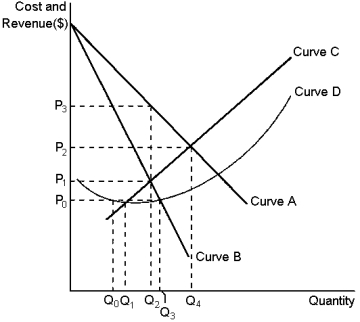 This graph reflects the cost and revenue structure for a monopoly firm.Use the graph to answer the following question(s).
-Refer to Graph 15-2.If the monopoly firm is currently producing output at a level of Q₃, reducing output will always cause profit to:
This graph reflects the cost and revenue structure for a monopoly firm.Use the graph to answer the following question(s).
-Refer to Graph 15-2.If the monopoly firm is currently producing output at a level of Q₃, reducing output will always cause profit to: (Multiple Choice)
5.0/5 (74)
(74) If the current price charged by a monopolist is $5 and marginal cost is $3, then increasing output will always lead to an increase in profit as P>MC.
(True/False)
4.7/5 (70)
(70) An important assumption about a monopoly is that it behaves as a:
(Multiple Choice)
4.8/5 (73)
(73) Which of the following statements is(are) true of monopolies?
(i) they cannot make unlimited profits
(ii) they have the ability to set prices at whatever level they desire
(iii) they do not have to worry about their revenue falling if they increase the prices
(Multiple Choice)
4.9/5 (68)
(68) Using the above information, if the publisher cannot price-discriminate then there is a dead-weight loss equal to:
(Multiple Choice)
5.0/5 (85)
(85) Consider the following diagram of a monopoly. 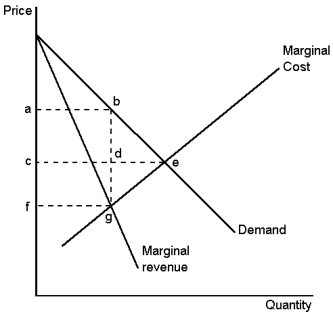 Assuming that the monopoly is at its profit-maximising point, identify the values of its marginal revenue, marginal cost, average revenue and price.
 (Essay)
4.8/5 (70)
(70) 
Filters
- Essay(0)
- Multiple Choice(0)
- Short Answer(0)
- True False(0)
- Matching(0)