



 Chat with AI
Exam 15: Monopoly

Exam 1: Ten Lessons From Economics146 Questions
Exam 2: Thinking Like an Economist133 Questions
Exam 3: Interdependence and the Gains From Trade139 Questions
Exam 4: The Market Forces of Supply and Demand215 Questions
Exam 5: Elasticity and Its Application178 Questions
Exam 6: Supply, Demand and Government Policies145 Questions
Exam 7: Consumers, Producers and the Efficiency of Markets171 Questions
Exam 8: Application: the Costs of Taxation135 Questions
Exam 9: Application: International Trade151 Questions
Exam 10: Externalities199 Questions
Exam 11: Public Goods and Common Resources178 Questions
Exam 12: The Design of the Tax System154 Questions
Exam 13: The Costs of Production191 Questions
Exam 14: Firms in Competitive Markets198 Questions
Exam 15: Monopoly212 Questions
Exam 16: Monopolistic Competition212 Questions
Exam 17: Business Strategy and Oligopoly179 Questions
Exam 18: Competition Policy103 Questions
Exam 19: The Markets for the Factors of Production214 Questions
Exam 20: Earnings, Unions and Discrimination201 Questions
Exam 21: Income Inequity and Poverty111 Questions
Exam 22: The Theory of Consumer Choice158 Questions
Exam 23: Frontiers of Microeconomics111 Questions
Exam 24: Measuring a Nations Income51 Questions
Exam 25: Measuring the Cost of Living55 Questions
Exam 26: Production and Growth62 Questions
Exam 27: Saving, Investment and the Financial System62 Questions
Exam 28: The Natural Rate of Unemployment58 Questions
Exam 29: The Monetary System66 Questions
Exam 30: Inflation: Its Causes and Costs74 Questions
Exam 31: Open-Economy Macroeconomics: Basic Concepts68 Questions
Exam 32: A Macroeconomic Theory of the Open Economy61 Questions
Exam 33: Aggregate Demand and Aggregate Supply81 Questions
Exam 34: The Influence of Monetary and Fiscal Policy on Aggregate Demand73 Questions
Exam 35: The Short-Run Trade-Off Between Inflation and Unemployment57 Questions
Exam 36: Global Financial Crisis of 2008 and Beyond37 Questions
Exam 37: Five Debates Over Macroeconomic Policy38 Questions
Select questions type


Graph 15-3 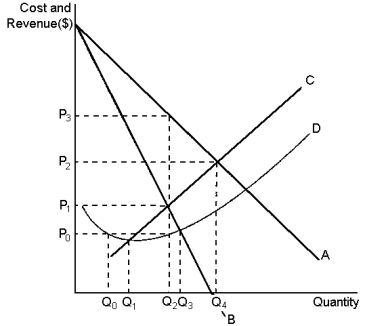 This graph reflects the cost and revenue structure for a monopoly firm.Use the graph to answer the following question(s).
-Refer to Graph 15-3.A profit-maximising monopoly would have a total cost equal to:
This graph reflects the cost and revenue structure for a monopoly firm.Use the graph to answer the following question(s).
-Refer to Graph 15-3.A profit-maximising monopoly would have a total cost equal to: (Multiple Choice)
4.8/5  (94)
(94) Supply curves tell us how much producers are willing to supply at any given price.Hence monopoly firms have:
(Multiple Choice)
4.8/5 (90)
(90) An unregulated monopoly is likely to have its marginal cost set:
(Multiple Choice)
4.7/5 (76)
(76) For a monopolist, marginal revenue will turn negative when:
(Multiple Choice)
4.7/5 (83)
(83) Table 15-1
Qunatity Price Total revenue Average revenue Marginal revenue 1 47 47 2 88 44 41 3 41 4 29 5 35 23 6 192 7 29 11 8 5 9 207 23 -1 10 20 200
-Refer to Table 15-1.What is the marginal revenue for the monopolist from the sixth unit sold?
(Multiple Choice)
4.9/5 (67)
(67) For price discrimination to be feasible it is necessary for the firm to:
(Multiple Choice)
4.9/5 (87)
(87) If a monopoly sells its good at a level that is below the socially optimal level, the price:
(Multiple Choice)
4.8/5 (75)
(75) When a monopolist increases the number of units it sells, there are two effects on revenue, the:
(Multiple Choice)
4.9/5 (74)
(74) Graph 15-1 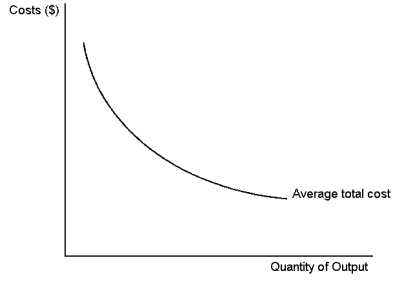 -Refer to Graph 15-1.The shape of the average-total-cost curve reveals information about the nature of the 'barrier to entry' that might exist in a monopoly market.Which of the following monopoly types best coincides with the figure?
 (Multiple Choice)
4.8/5 (79)
(79) A significant difference between a competitive firm and a monopoly firm is the ability to select:
(Multiple Choice)
4.9/5 (89)
(89) Graph 15-1
-Refer to Graph 15-1.The shape of the average-total-cost curve in the figure suggests an opportunity for a profit-maximising monopolist to exploit:
-Refer to Graph 15-1.The shape of the average-total-cost curve in the figure suggests an opportunity for a profit-maximising monopolist to exploit: (Multiple Choice)
4.8/5 (76)
(76) When a firm operates under conditions of a monopoly, its price is constrained by marginal cost.
(True/False)
4.8/5 (72)
(72) Consider the following graph of a monopoly. 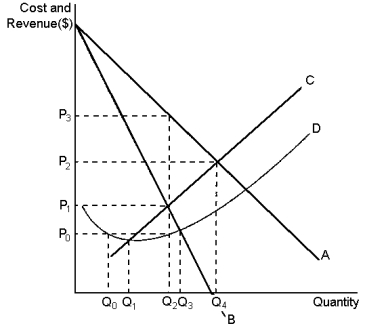 Identify the firm's total revenue, total cost and total profit at the profit-maximising point.What is the value of the unit-profit?
 (Essay)
4.8/5 (90)
(90) Compared to the output in a competitive market, monopoly pricing has the consequence of the market output being:
(Multiple Choice)
4.9/5 (91)
(91) Graph 15-2 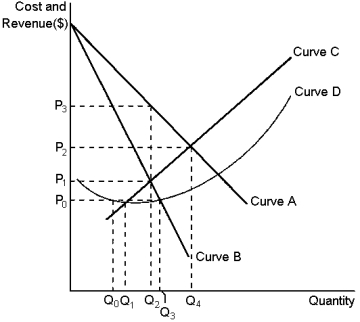 This graph reflects the cost and revenue structure for a monopoly firm.Use the graph to answer the following question(s).
-Refer to Graph 15-2.The marginal-cost curve for a monopoly firm is depicted by curve:
This graph reflects the cost and revenue structure for a monopoly firm.Use the graph to answer the following question(s).
-Refer to Graph 15-2.The marginal-cost curve for a monopoly firm is depicted by curve: (Multiple Choice)
4.7/5 (101)
(101) A firm's supply curve in a competitive market dictates the amount it will supply whereas in a monopoly market, the:
(Multiple Choice)
4.9/5 (80)
(80) Describe how government is involved in creating a monopoly.Why might the government create one? Give an example.
(Essay)
4.8/5 (85)
(85) 
Filters
- Essay(0)
- Multiple Choice(0)
- Short Answer(0)
- True False(0)
- Matching(0)