



 Chat with AI
Exam 6: Supply, Demand and Government Policies

Exam 1: Ten Lessons From Economics146 Questions
Exam 2: Thinking Like an Economist133 Questions
Exam 3: Interdependence and the Gains From Trade139 Questions
Exam 4: The Market Forces of Supply and Demand215 Questions
Exam 5: Elasticity and Its Application178 Questions
Exam 6: Supply, Demand and Government Policies145 Questions
Exam 7: Consumers, Producers and the Efficiency of Markets171 Questions
Exam 8: Application: the Costs of Taxation135 Questions
Exam 9: Application: International Trade151 Questions
Exam 10: Externalities199 Questions
Exam 11: Public Goods and Common Resources178 Questions
Exam 12: The Design of the Tax System154 Questions
Exam 13: The Costs of Production191 Questions
Exam 14: Firms in Competitive Markets198 Questions
Exam 15: Monopoly212 Questions
Exam 16: Monopolistic Competition212 Questions
Exam 17: Business Strategy and Oligopoly179 Questions
Exam 18: Competition Policy103 Questions
Exam 19: The Markets for the Factors of Production214 Questions
Exam 20: Earnings, Unions and Discrimination201 Questions
Exam 21: Income Inequity and Poverty111 Questions
Exam 22: The Theory of Consumer Choice158 Questions
Exam 23: Frontiers of Microeconomics111 Questions
Exam 24: Measuring a Nations Income51 Questions
Exam 25: Measuring the Cost of Living55 Questions
Exam 26: Production and Growth62 Questions
Exam 27: Saving, Investment and the Financial System62 Questions
Exam 28: The Natural Rate of Unemployment58 Questions
Exam 29: The Monetary System66 Questions
Exam 30: Inflation: Its Causes and Costs74 Questions
Exam 31: Open-Economy Macroeconomics: Basic Concepts68 Questions
Exam 32: A Macroeconomic Theory of the Open Economy61 Questions
Exam 33: Aggregate Demand and Aggregate Supply81 Questions
Exam 34: The Influence of Monetary and Fiscal Policy on Aggregate Demand73 Questions
Exam 35: The Short-Run Trade-Off Between Inflation and Unemployment57 Questions
Exam 36: Global Financial Crisis of 2008 and Beyond37 Questions
Exam 37: Five Debates Over Macroeconomic Policy38 Questions
Select questions type


Using a demand-supply diagram, show how OPEC's raising of oil prices in the 1970s combined with a government-imposed price ceiling on petrol created a shortage of petrol.

Free
(Essay)
4.8/5  (82)
(82) Correct Answer: Verified
The graph should look like the following. 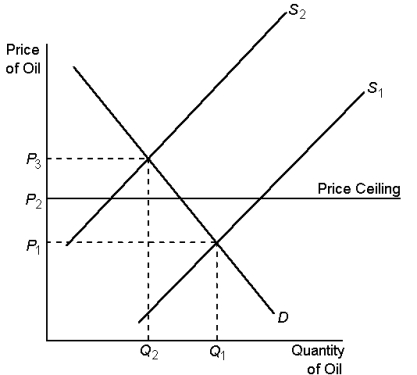
A coffee-producing country requires all its growers to sell to a single, government-owned marketing board.This marketing board sells the coffee on behalf of the growers into the world market.Suppose the marketing board puts a price ceiling of $3.00 on the coffee it buys from its growers while the market equilibrium price is $5.00.What effect will this have on coffee production in this country? Quantity is given in kg. 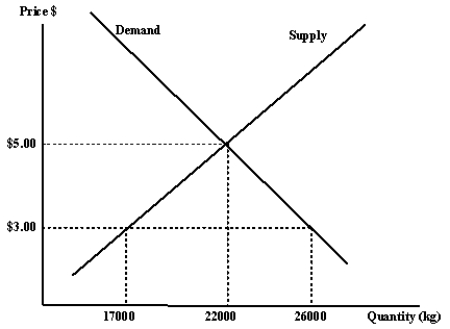
Free
(Essay)
4.8/5 (84)
(84) Correct Answer:Verified
VerifiedIn this example, a price of $3.00 would lead to a shortage of coffee of 9000 kg.The price is below the market equilibrium.Many people who used to produce coffee no longer do so and growers will be getting much lower returns.The primary beneficiary of this arrangement is the marketing board.
Which of the following is NOT a mechanism of rationing used by landlords in cities with rent control?
Free
(Multiple Choice)
4.8/5 (82)
(82) Correct Answer:Verified
VerifiedC
Most of the burden of a luxury tax falls on the middle-class workers who supply luxury goods, rather than on the rich who buy them.
(True/False)
4.9/5 (70)
(70) A binding price ceiling allows consumers to buy all the goods they demand at a lower price.
(True/False)
4.9/5 (82)
(82) Some developing countries have used price ceilings to keep rice cheap to assist the poor.At the ceiling price:
(Multiple Choice)
4.9/5 (86)
(86) Graph 6-7 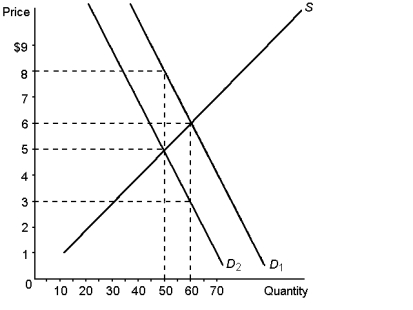 -According to Graph 6-7, the amount of the tax that buyers would pay would be:
 (Multiple Choice)
4.8/5 (83)
(83) A tax on the sellers of coffee will cause the price the buyer pays:
(Multiple Choice)
4.8/5 (73)
(73) Some countries use price floors for their domestic farmers to guarantee them a high return on their production.Suppose there is a price floor on wool that is binding.What will be the effect on the wool market? Identify who benefits from this policy and who bears the cost.Are there instances of this occurring in Australia's history?
(Essay)
4.8/5 (83)
(83) Australia exports cattle to Indonesia.If Australia puts an export subsidy on cattle and the Australian supply of cattle is elastic while the demand for cattle in Indonesia is inelastic then:
(Multiple Choice)
4.9/5 (73)
(73) Graph 6-5  -According to Graph 6-5, if the government imposes a binding price floor of $6.00 in this market, the result will be a:
 (Multiple Choice)
4.9/5 (70)
(70) Using a supply-demand diagram, show a labour market with a binding minimum wage.Now use the diagram to show those who are helped by the minimum wage and those who are hurt by the minimum wage.
(Essay)
4.9/5 (88)
(88) Suppose a price ceiling is placed on rice.The price ceiling is set below the equilibrium price.This will result in the quantity demanded of rice exceeding the quantity supplied.
(True/False)
5.0/5 (69)
(69) A legal minimum price at which a good can be sold is a price:
(Multiple Choice)
4.9/5 (78)
(78) Graph 6-2  -According to Graph 6-2, if the government imposes a binding price floor in this market at a price of $8.00, the result will be a:
 (Multiple Choice)
4.8/5 (81)
(81) Australia has a higher tax on luxury cars compared to other cars.Is this an effective way to raise revenue for the government from the rich?
(Essay)
4.9/5 (85)
(85) Common rationing mechanisms under price ceilings include waiting in long lines and biases of the sellers.
(True/False)
4.9/5 (90)
(90) If demand is less elastic than supply, then the burden of a tax will fall more heavily upon sellers of a good.
(True/False)
4.9/5 (84)
(84) 
Filters
- Essay(0)
- Multiple Choice(0)
- Short Answer(0)
- True False(0)
- Matching(0)