



 Chat with AI
Exam 6: Supply, Demand and Government Policies

Exam 1: Ten Lessons From Economics146 Questions
Exam 2: Thinking Like an Economist133 Questions
Exam 3: Interdependence and the Gains From Trade139 Questions
Exam 4: The Market Forces of Supply and Demand215 Questions
Exam 5: Elasticity and Its Application178 Questions
Exam 6: Supply, Demand and Government Policies145 Questions
Exam 7: Consumers, Producers and the Efficiency of Markets171 Questions
Exam 8: Application: the Costs of Taxation135 Questions
Exam 9: Application: International Trade151 Questions
Exam 10: Externalities199 Questions
Exam 11: Public Goods and Common Resources178 Questions
Exam 12: The Design of the Tax System154 Questions
Exam 13: The Costs of Production191 Questions
Exam 14: Firms in Competitive Markets198 Questions
Exam 15: Monopoly212 Questions
Exam 16: Monopolistic Competition212 Questions
Exam 17: Business Strategy and Oligopoly179 Questions
Exam 18: Competition Policy103 Questions
Exam 19: The Markets for the Factors of Production214 Questions
Exam 20: Earnings, Unions and Discrimination201 Questions
Exam 21: Income Inequity and Poverty111 Questions
Exam 22: The Theory of Consumer Choice158 Questions
Exam 23: Frontiers of Microeconomics111 Questions
Exam 24: Measuring a Nations Income51 Questions
Exam 25: Measuring the Cost of Living55 Questions
Exam 26: Production and Growth62 Questions
Exam 27: Saving, Investment and the Financial System62 Questions
Exam 28: The Natural Rate of Unemployment58 Questions
Exam 29: The Monetary System66 Questions
Exam 30: Inflation: Its Causes and Costs74 Questions
Exam 31: Open-Economy Macroeconomics: Basic Concepts68 Questions
Exam 32: A Macroeconomic Theory of the Open Economy61 Questions
Exam 33: Aggregate Demand and Aggregate Supply81 Questions
Exam 34: The Influence of Monetary and Fiscal Policy on Aggregate Demand73 Questions
Exam 35: The Short-Run Trade-Off Between Inflation and Unemployment57 Questions
Exam 36: Global Financial Crisis of 2008 and Beyond37 Questions
Exam 37: Five Debates Over Macroeconomic Policy38 Questions
Select questions type


Graph 6-10 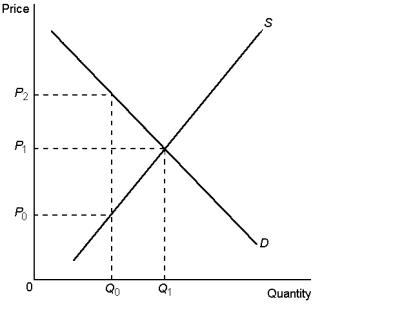 -In Graph 6-10, the per-unit burden of the tax on the sellers is:
 (Multiple Choice)
4.9/5  (89)
(89) Most labour economists believe that the supply of labour is less elastic than demand.This means:
(Multiple Choice)
4.9/5 (91)
(91) If the government lowered the minimum wage but this had no effect on unemployment, one possible explanation could be:
(Multiple Choice)
4.7/5 (73)
(73) Suppose that the government places a tax of $5 per tyre on the buyers of automobile tyres.Use a supply-demand diagram to show the effect of the tax on the tyre market and the incidence of taxation on buyers and sellers.Now suppose that the government switches to a tax of $5 per tyre on the sellers of automobile tyres.Use a second supply-demand diagram to show the effects of this tax on the tyre market and the incidence of taxation on buyers and sellers.Can you say anything about the relative effects of the two alternative taxes on the tyre market and on the incidence of taxation?
(Essay)
4.9/5 (85)
(85) Who pays the majority of a tax levied on a product depends on whether the tax is placed on the buyer or the seller.
(True/False)
4.9/5 (71)
(71) Rent control reduces the incentive for landlords to properly maintain their properties.
(True/False)
4.9/5 (75)
(75) Graph 6-9 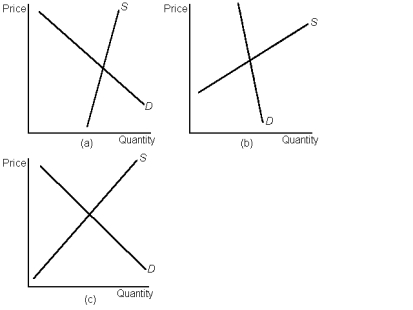 -Refer to Graph 6-9.In which market will the majority of a tax be paid by the seller?
 (Multiple Choice)
4.9/5 (75)
(75) Which is the most correct statement about the benefits of a subsidy on toothbrushes?
(Multiple Choice)
4.9/5 (85)
(85) The effect of a tax on a product is always to reduce the total size of its market.
(True/False)
4.8/5 (90)
(90) Suppose the government imposes a binding price ceiling on interest rates in the mortgage lending market.What would benefit from such actions and who would bear the costs?
(Essay)
4.8/5 (74)
(74) If buyers of bananas are required to pay a $1.00 tax on each bunch of bananas purchased, then the demand curve for bananas will shift:
(Multiple Choice)
4.8/5 (86)
(86) A binding price floor in a competitive market will result in persistent shortages of a product.
(True/False)
4.8/5 (90)
(90) The incidence of a tax is determined by whether the tax is imposed on the seller or the buyer.
(True/False)
4.8/5 (70)
(70) Graph 6-8 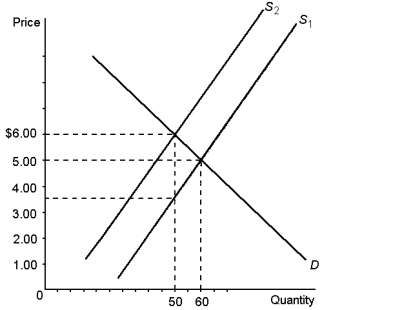 -According to Graph 6-8, the equilibrium price in the market before the tax is imposed is:
 (Multiple Choice)
4.9/5 (80)
(80) Does a tax encourage increased market activity? How does a tax affect the amount paid by buyers and the amount received by sellers as a result of a tax on a good?
(Essay)
4.8/5 (76)
(76) Graph 6-4  -According to Graph 6-4, when the supply curve shifts from S1 to S2:
 (Multiple Choice)
4.9/5 (77)
(77) 
Filters
- Essay(0)
- Multiple Choice(0)
- Short Answer(0)
- True False(0)
- Matching(0)