



 Chat with AI
Exam 8: Application: the Costs of Taxation

Exam 1: Ten Lessons From Economics146 Questions
Exam 2: Thinking Like an Economist133 Questions
Exam 3: Interdependence and the Gains From Trade139 Questions
Exam 4: The Market Forces of Supply and Demand215 Questions
Exam 5: Elasticity and Its Application178 Questions
Exam 6: Supply, Demand and Government Policies145 Questions
Exam 7: Consumers, Producers and the Efficiency of Markets171 Questions
Exam 8: Application: the Costs of Taxation135 Questions
Exam 9: Application: International Trade151 Questions
Exam 10: Externalities199 Questions
Exam 11: Public Goods and Common Resources178 Questions
Exam 12: The Design of the Tax System154 Questions
Exam 13: The Costs of Production191 Questions
Exam 14: Firms in Competitive Markets198 Questions
Exam 15: Monopoly212 Questions
Exam 16: Monopolistic Competition212 Questions
Exam 17: Business Strategy and Oligopoly179 Questions
Exam 18: Competition Policy103 Questions
Exam 19: The Markets for the Factors of Production214 Questions
Exam 20: Earnings, Unions and Discrimination201 Questions
Exam 21: Income Inequity and Poverty111 Questions
Exam 22: The Theory of Consumer Choice158 Questions
Exam 23: Frontiers of Microeconomics111 Questions
Exam 24: Measuring a Nations Income51 Questions
Exam 25: Measuring the Cost of Living55 Questions
Exam 26: Production and Growth62 Questions
Exam 27: Saving, Investment and the Financial System62 Questions
Exam 28: The Natural Rate of Unemployment58 Questions
Exam 29: The Monetary System66 Questions
Exam 30: Inflation: Its Causes and Costs74 Questions
Exam 31: Open-Economy Macroeconomics: Basic Concepts68 Questions
Exam 32: A Macroeconomic Theory of the Open Economy61 Questions
Exam 33: Aggregate Demand and Aggregate Supply81 Questions
Exam 34: The Influence of Monetary and Fiscal Policy on Aggregate Demand73 Questions
Exam 35: The Short-Run Trade-Off Between Inflation and Unemployment57 Questions
Exam 36: Global Financial Crisis of 2008 and Beyond37 Questions
Exam 37: Five Debates Over Macroeconomic Policy38 Questions
Select questions type


Assume that a tax is levied on a good and the government uses the funds to build statues of former prime ministers.In this case there would be:

Free
(Multiple Choice)
4.8/5  (82)
(82) Correct Answer: Verified
D
According to the information provided, assume that Joe is required to pay a tax of $30 when he hires someone to clean his house.Which of the following is true?
Free
(Multiple Choice)
4.9/5 (68)
(68) Correct Answer:Verified
VerifiedA
When a tax is levied on a good it usually leads to a change in quantity demanded.All else equal, this change in quantity will be greater the more inelastic the demand curve.
(True/False)
4.7/5 (72)
(72) If the supply of labour is inelastic, the deadweight loss from labour taxes is large.
(True/False)
4.9/5 (75)
(75) Graph 8-3 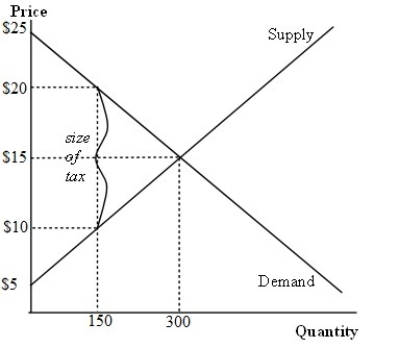 -According to Graph 8-3, the reduction in consumer surplus caused by the tax is:
 (Multiple Choice)
4.8/5 (89)
(89) Economists generally agree that the most important tax in the Australian economy is the tax on:
(Multiple Choice)
4.8/5 (79)
(79) Although tax revenue eventually begins to fall as tax rates increase, the revenue will always be greater than zero, no matter how large the tax is.
(True/False)
4.9/5 (74)
(74) What factors must be taken into account in order to fully understand the effect of taxes on economic wellbeing?
(Essay)
4.9/5 (70)
(70) Suppose a tax is imposed on a good, this generates a loss in total surplus called:
(Multiple Choice)
5.0/5 (82)
(82) Graph 8-1 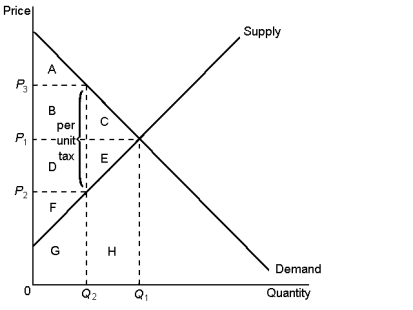 -According to Graph 8-1, the price sellers receive after the tax is:
 (Multiple Choice)
4.9/5 (79)
(79) A tax on unimproved land falls entirely on landowners, because the supply of land is perfectly inelastic.
(True/False)
4.8/5 (87)
(87) 'Assume that the demand for entertainment is more elastic than the demand for petrol'.According to this statement, a tax levied on petrol will cause the loss of consumer surplus to be:
(Multiple Choice)
4.9/5 (69)
(69) When a tax is imposed on a market, the government collects revenues.These revenues however, are less than the loss in consumer surplus and producer surplus.
(True/False)
4.8/5 (82)
(82) 'Assume that the demand for entertainment is more elastic than the demand for petrol'.According to this statement, compared to the decline in purchases from a similar percentage tax on petrol, we would expect that a tax on entertainment will cause the quantity of entertainment purchased to decline:
(Multiple Choice)
4.8/5 (79)
(79) Taxes on land are relatively efficient as the supply of land is inelastic.
(True/False)
4.8/5 (83)
(83) A source of the deadweight loss of taxation is the inefficient use of tax revenue by the government.
(True/False)
4.8/5 (85)
(85) The benefit received by buyers in the market for good X is measured by:
(Multiple Choice)
4.8/5 (85)
(85) The greater the social pressure for mothers to be housekeepers and stay out of the labour force the:
(Multiple Choice)
4.8/5 (68)
(68) 
Filters
- Essay(0)
- Multiple Choice(0)
- Short Answer(0)
- True False(0)
- Matching(0)