



 Chat with AI
Exam 2: Thinking Like an Economist

Exam 1: Ten Lessons From Economics146 Questions
Exam 2: Thinking Like an Economist133 Questions
Exam 3: Interdependence and the Gains From Trade139 Questions
Exam 4: The Market Forces of Supply and Demand215 Questions
Exam 5: Elasticity and Its Application178 Questions
Exam 6: Supply, Demand and Government Policies145 Questions
Exam 7: Consumers, Producers and the Efficiency of Markets171 Questions
Exam 8: Application: the Costs of Taxation135 Questions
Exam 9: Application: International Trade151 Questions
Exam 10: Externalities199 Questions
Exam 11: Public Goods and Common Resources178 Questions
Exam 12: The Design of the Tax System154 Questions
Exam 13: The Costs of Production191 Questions
Exam 14: Firms in Competitive Markets198 Questions
Exam 15: Monopoly212 Questions
Exam 16: Monopolistic Competition212 Questions
Exam 17: Business Strategy and Oligopoly179 Questions
Exam 18: Competition Policy103 Questions
Exam 19: The Markets for the Factors of Production214 Questions
Exam 20: Earnings, Unions and Discrimination201 Questions
Exam 21: Income Inequity and Poverty111 Questions
Exam 22: The Theory of Consumer Choice158 Questions
Exam 23: Frontiers of Microeconomics111 Questions
Exam 24: Measuring a Nations Income51 Questions
Exam 25: Measuring the Cost of Living55 Questions
Exam 26: Production and Growth62 Questions
Exam 27: Saving, Investment and the Financial System62 Questions
Exam 28: The Natural Rate of Unemployment58 Questions
Exam 29: The Monetary System66 Questions
Exam 30: Inflation: Its Causes and Costs74 Questions
Exam 31: Open-Economy Macroeconomics: Basic Concepts68 Questions
Exam 32: A Macroeconomic Theory of the Open Economy61 Questions
Exam 33: Aggregate Demand and Aggregate Supply81 Questions
Exam 34: The Influence of Monetary and Fiscal Policy on Aggregate Demand73 Questions
Exam 35: The Short-Run Trade-Off Between Inflation and Unemployment57 Questions
Exam 36: Global Financial Crisis of 2008 and Beyond37 Questions
Exam 37: Five Debates Over Macroeconomic Policy38 Questions
Select questions type


Dean says that, 'the imposition of a tax on beer will raise its price'.Kylie argues that, 'taxes should be imposed on beer because university students drink too much'.We can conclude that:

Free
(Multiple Choice)
4.9/5  (78)
(78) Correct Answer: Verified
B
In the circular-flow diagram, the only return households get from supplying factors of production to firms are wages.
Free
(True/False)
4.9/5 (70)
(70) Correct Answer:Verified
VerifiedFalse
In a circular-flow diagram, spending on goods and services flows from households to firms and income flows from firms to households.
Free
(True/False)
4.9/5 (82)
(82) Correct Answer:Verified
VerifiedTrue
Consider the statement 'banning the export of live parrots from Australia has resulted in the black market price for cockatoos rising and an increase in poaching'.This is an example of a normative statement.
(True/False)
4.8/5 (69)
(69) Because it is difficult for economists to use experiments to generate economic data, they:
(Multiple Choice)
4.8/5 (70)
(70) Graph 2-3 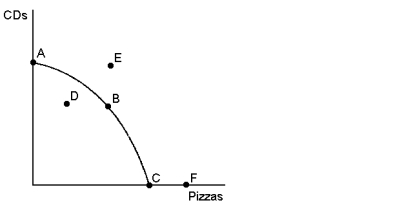 -Refer to Graph 2-3.On the production possibilities frontier shown, what does point F represent?
 (Multiple Choice)
4.7/5 (72)
(72) Table 2-1
Vodka (l) Potatoes (kg) 1000 0 850 400 650 760 430 900 175 1200 0 1700
-Refer to Table 2-1.What is the opportunity cost to Poland of increasing the production of Vodka from 430 to 850?
(Multiple Choice)
4.8/5 (81)
(81) An economy is being efficient if it is impossible to produce more of one good without producing less of another.
(True/False)
4.7/5 (79)
(79) Economists mostly agree that their role in public policy formation is to analyse proposals and inform public debate.
(True/False)
4.8/5 (90)
(90) Graph 2-7 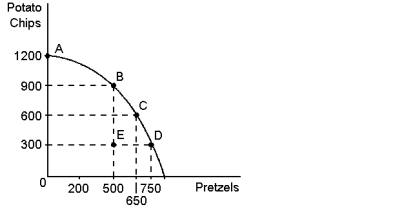 -Refer to Graph 2-7.In the production possibilities frontier unemployment most likely caused a movement from:
 (Multiple Choice)
4.8/5 (69)
(69) Sometimes economists who have the same positive views about how the economy works give conflicting advice on policy because they have different values.
(True/False)
4.9/5 (81)
(81) Any point inside the production possibilities frontier is an efficient one.
(True/False)
4.8/5 (93)
(93) What is the purpose of models in economics? What are the two economic models presented in chapter two?
(Essay)
4.8/5 (90)
(90) According to John Maynard Keynes, an economist should only give advice based on disinterested observations.
(True/False)
4.9/5 (86)
(86) For economists, statements about the world are of two types:
(Multiple Choice)
4.7/5 (70)
(70) The foundation stones from which economic models are built are:
(Multiple Choice)
4.8/5 (86)
(86) 
Filters
- Essay(0)
- Multiple Choice(0)
- Short Answer(0)
- True False(0)
- Matching(0)