



 Chat with AI
Exam 2: Thinking Like an Economist

Exam 1: Ten Lessons From Economics146 Questions
Exam 2: Thinking Like an Economist133 Questions
Exam 3: Interdependence and the Gains From Trade139 Questions
Exam 4: The Market Forces of Supply and Demand215 Questions
Exam 5: Elasticity and Its Application178 Questions
Exam 6: Supply, Demand and Government Policies145 Questions
Exam 7: Consumers, Producers and the Efficiency of Markets171 Questions
Exam 8: Application: the Costs of Taxation135 Questions
Exam 9: Application: International Trade151 Questions
Exam 10: Externalities199 Questions
Exam 11: Public Goods and Common Resources178 Questions
Exam 12: The Design of the Tax System154 Questions
Exam 13: The Costs of Production191 Questions
Exam 14: Firms in Competitive Markets198 Questions
Exam 15: Monopoly212 Questions
Exam 16: Monopolistic Competition212 Questions
Exam 17: Business Strategy and Oligopoly179 Questions
Exam 18: Competition Policy103 Questions
Exam 19: The Markets for the Factors of Production214 Questions
Exam 20: Earnings, Unions and Discrimination201 Questions
Exam 21: Income Inequity and Poverty111 Questions
Exam 22: The Theory of Consumer Choice158 Questions
Exam 23: Frontiers of Microeconomics111 Questions
Exam 24: Measuring a Nations Income51 Questions
Exam 25: Measuring the Cost of Living55 Questions
Exam 26: Production and Growth62 Questions
Exam 27: Saving, Investment and the Financial System62 Questions
Exam 28: The Natural Rate of Unemployment58 Questions
Exam 29: The Monetary System66 Questions
Exam 30: Inflation: Its Causes and Costs74 Questions
Exam 31: Open-Economy Macroeconomics: Basic Concepts68 Questions
Exam 32: A Macroeconomic Theory of the Open Economy61 Questions
Exam 33: Aggregate Demand and Aggregate Supply81 Questions
Exam 34: The Influence of Monetary and Fiscal Policy on Aggregate Demand73 Questions
Exam 35: The Short-Run Trade-Off Between Inflation and Unemployment57 Questions
Exam 36: Global Financial Crisis of 2008 and Beyond37 Questions
Exam 37: Five Debates Over Macroeconomic Policy38 Questions
Select questions type


Select the statement below that is an example of a microeconomic issue?
(Multiple Choice)
4.7/5  (88)
(88) Graph 2-3 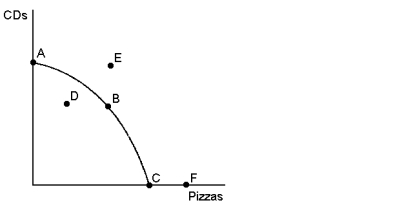 -Refer to Graph 2-3.On the production possibilities frontier shown, at which point or points is the economy inefficient?
 (Multiple Choice)
4.8/5 (78)
(78) In a simple circular-flow diagram, the two types of markets in which households and firms interact are the markets for goods and services and the markets for factors of production.
(True/False)
4.8/5 (72)
(72) Graph 2-3
-Refer to Graph 2-3.On the production possibilities frontier shown, at which point or points is the economy efficient?
-Refer to Graph 2-3.On the production possibilities frontier shown, at which point or points is the economy efficient? (Multiple Choice)
4.9/5 (80)
(80) Which is the best statement about the roles of economists?
(Multiple Choice)
4.9/5 (88)
(88) Graph 2-7 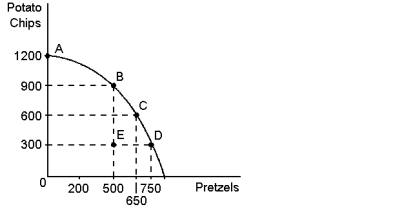 -Refer to Graph 2-7.In the production possibilities frontier shown, what is the opportunity cost to society of moving from point C to point E?
 (Multiple Choice)
4.9/5 (72)
(72) Which of the following is the most accurate statement about production possibilities?
(Multiple Choice)
4.8/5 (84)
(84) Understanding how an economic system works is aided by the use of many complex and rigorous, true assumptions.
(True/False)
4.8/5 (86)
(86) A production possibilities frontier is a graph that shows the various combinations of outputs the economy can possibly produce, given its factors of production and technology.
(True/False)
4.8/5 (71)
(71) Graph 2-9 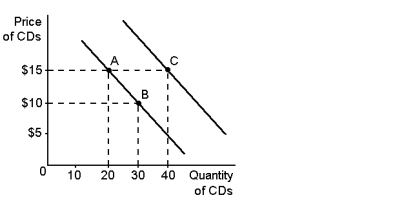 -Refer to Graph 2-9.In the graph shown, the movement from point A to point C could have been caused by:
 (Multiple Choice)
4.7/5 (79)
(79) Graph 2-1  -Refer to Graph 2-1.In the graph shown, points A, B and D represent efficient outcomes for society.
 (True/False)
4.9/5 (81)
(81) The single most important purpose of an Economics Principles text and course is to help students learn the economist's way of thinking.
(True/False)
4.7/5 (59)
(59) If an economist develops a theory about international trade based on the assumption that there are only two countries and two goods:
(Multiple Choice)
5.0/5 (74)
(74) An inefficient outcome on the production possibilities frontier might be characterised by:
(Multiple Choice)
4.8/5 (73)
(73) Microeconomics approaches the study of economics from the viewpoint of:
(Multiple Choice)
4.8/5 (67)
(67) 
Filters
- Essay(0)
- Multiple Choice(0)
- Short Answer(0)
- True False(0)
- Matching(0)