



 Chat with AI
Exam 2: Thinking Like an Economist

Exam 1: Ten Lessons From Economics146 Questions
Exam 2: Thinking Like an Economist133 Questions
Exam 3: Interdependence and the Gains From Trade139 Questions
Exam 4: The Market Forces of Supply and Demand215 Questions
Exam 5: Elasticity and Its Application178 Questions
Exam 6: Supply, Demand and Government Policies145 Questions
Exam 7: Consumers, Producers and the Efficiency of Markets171 Questions
Exam 8: Application: the Costs of Taxation135 Questions
Exam 9: Application: International Trade151 Questions
Exam 10: Externalities199 Questions
Exam 11: Public Goods and Common Resources178 Questions
Exam 12: The Design of the Tax System154 Questions
Exam 13: The Costs of Production191 Questions
Exam 14: Firms in Competitive Markets198 Questions
Exam 15: Monopoly212 Questions
Exam 16: Monopolistic Competition212 Questions
Exam 17: Business Strategy and Oligopoly179 Questions
Exam 18: Competition Policy103 Questions
Exam 19: The Markets for the Factors of Production214 Questions
Exam 20: Earnings, Unions and Discrimination201 Questions
Exam 21: Income Inequity and Poverty111 Questions
Exam 22: The Theory of Consumer Choice158 Questions
Exam 23: Frontiers of Microeconomics111 Questions
Exam 24: Measuring a Nations Income51 Questions
Exam 25: Measuring the Cost of Living55 Questions
Exam 26: Production and Growth62 Questions
Exam 27: Saving, Investment and the Financial System62 Questions
Exam 28: The Natural Rate of Unemployment58 Questions
Exam 29: The Monetary System66 Questions
Exam 30: Inflation: Its Causes and Costs74 Questions
Exam 31: Open-Economy Macroeconomics: Basic Concepts68 Questions
Exam 32: A Macroeconomic Theory of the Open Economy61 Questions
Exam 33: Aggregate Demand and Aggregate Supply81 Questions
Exam 34: The Influence of Monetary and Fiscal Policy on Aggregate Demand73 Questions
Exam 35: The Short-Run Trade-Off Between Inflation and Unemployment57 Questions
Exam 36: Global Financial Crisis of 2008 and Beyond37 Questions
Exam 37: Five Debates Over Macroeconomic Policy38 Questions
Select questions type


The opportunity cost of obtaining more of one good is shown on the production possibilities frontier as the:
(Multiple Choice)
4.9/5  (87)
(87) Microeconomics is the study of decision making at the level of the individual household and firm, while macroeconomics is the study of the economy as a whole.
(True/False)
4.9/5 (75)
(75) Australia harvests five to seven million kangaroos a year.Consider the statement 'Australia would be better off if the harvest of kangaroos was banned'.This is an example of a normative statement.
(True/False)
4.9/5 (88)
(88) Which of the following is an example of a normative statement?
(Multiple Choice)
4.9/5 (77)
(77) Draw a production possibilities frontier for a country that produces green energy and four-wheel drives.How does your graph illustrate a trade-off between the two? If an engineering firm discovered how to reduce the cost of producing each four-wheel drive by $50, what would this do to the production possibilities frontier?
(Essay)
4.7/5 (64)
(64) Given a two-good production possibilities frontier, an increase in the economy's productivity will cause the frontier to shift outward.
(True/False)
4.9/5 (88)
(88) Economists might disagree on a question of policy because:
(i) They have made different assumptions
(ii) They have different normative views on policies
(iii) They disagree about the role economics should play in society
(Multiple Choice)
4.7/5 (76)
(76) Scientific models are designed to simplify reality because they are built with simplifying assumptions.
(True/False)
4.8/5 (72)
(72) Graph 2-2  -Refer to Graph 2-2.In the circular-flow diagram shown, which arrow shows the flow of goods and services?
 (Multiple Choice)
4.8/5 (83)
(83) In a simple circular-flow diagram, firms have to hire or purchase factors of production from households in order to produce goods and services.
(True/False)
4.8/5 (81)
(81) Graph 2-2
-Refer to Graph 2-2.In the circular-flow diagram shown, which arrow shows the flow of spending by households?
-Refer to Graph 2-2.In the circular-flow diagram shown, which arrow shows the flow of spending by households? (Multiple Choice)
4.8/5 (72)
(72) Inflation is a microeconomic issue because it affects what households decide to buy.
(True/False)
4.8/5 (90)
(90) Graph 2-3 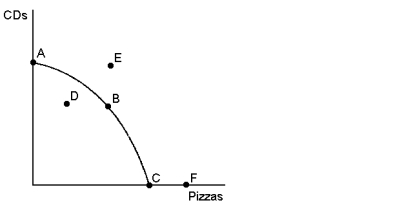 -Refer to Graph 2-3.On the production possibilities frontier shown, at which point or points is it possible for this economy to produce?
 (Multiple Choice)
4.9/5 (76)
(76) Making the argument that because empty alcohol containers are found at many accidents, containers therefore cause accidents, is an example of:
(Multiple Choice)
4.9/5 (64)
(64) 
Filters
- Essay(0)
- Multiple Choice(0)
- Short Answer(0)
- True False(0)
- Matching(0)