



 Chat with AI
Exam 9: Application: International Trade

Exam 1: Ten Lessons From Economics146 Questions
Exam 2: Thinking Like an Economist133 Questions
Exam 3: Interdependence and the Gains From Trade139 Questions
Exam 4: The Market Forces of Supply and Demand215 Questions
Exam 5: Elasticity and Its Application178 Questions
Exam 6: Supply, Demand and Government Policies145 Questions
Exam 7: Consumers, Producers and the Efficiency of Markets171 Questions
Exam 8: Application: the Costs of Taxation135 Questions
Exam 9: Application: International Trade151 Questions
Exam 10: Externalities199 Questions
Exam 11: Public Goods and Common Resources178 Questions
Exam 12: The Design of the Tax System154 Questions
Exam 13: The Costs of Production191 Questions
Exam 14: Firms in Competitive Markets198 Questions
Exam 15: Monopoly212 Questions
Exam 16: Monopolistic Competition212 Questions
Exam 17: Business Strategy and Oligopoly179 Questions
Exam 18: Competition Policy103 Questions
Exam 19: The Markets for the Factors of Production214 Questions
Exam 20: Earnings, Unions and Discrimination201 Questions
Exam 21: Income Inequity and Poverty111 Questions
Exam 22: The Theory of Consumer Choice158 Questions
Exam 23: Frontiers of Microeconomics111 Questions
Exam 24: Measuring a Nations Income51 Questions
Exam 25: Measuring the Cost of Living55 Questions
Exam 26: Production and Growth62 Questions
Exam 27: Saving, Investment and the Financial System62 Questions
Exam 28: The Natural Rate of Unemployment58 Questions
Exam 29: The Monetary System66 Questions
Exam 30: Inflation: Its Causes and Costs74 Questions
Exam 31: Open-Economy Macroeconomics: Basic Concepts68 Questions
Exam 32: A Macroeconomic Theory of the Open Economy61 Questions
Exam 33: Aggregate Demand and Aggregate Supply81 Questions
Exam 34: The Influence of Monetary and Fiscal Policy on Aggregate Demand73 Questions
Exam 35: The Short-Run Trade-Off Between Inflation and Unemployment57 Questions
Exam 36: Global Financial Crisis of 2008 and Beyond37 Questions
Exam 37: Five Debates Over Macroeconomic Policy38 Questions
Select questions type


Benefits from free trade include increased variety of goods and increased competition.

Free
(True/False)
4.8/5  (73)
(73) Correct Answer: Verified
True
Free trade causes job losses in industries in which a country does not have a comparative advantage but it also causes job gains in industries in which the country has a comparative advantage.
Free
(True/False)
4.8/5 (88)
(88) Correct Answer:Verified
VerifiedTrue
Graph 9-7 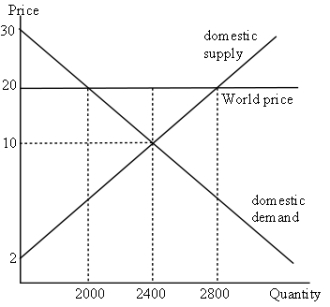 -According to Graph 9-7, producer surplus after trade would be:
Free
(Multiple Choice)
4.9/5 (71)
(71) Correct Answer:Verified
VerifiedB
If a country allows trade and the domestic price of a good is lower than the world price:
(Multiple Choice)
4.8/5 (69)
(69) Graph 9-7
-According to Graph 9-7, how many units of this product would be exported after trade is allowed?
-According to Graph 9-7, how many units of this product would be exported after trade is allowed? (Multiple Choice)
4.8/5 (77)
(77) An import quota increases domestic producer surplus and the surplus of import licence holders, reduces domestic consumer surplus, and creates deadweight loss.
(True/False)
4.9/5 (83)
(83) If a tariff is placed on clocks, the price of both domestic and imported clocks will rise by the amount of the tariff.
(True/False)
4.9/5 (79)
(79) Policymakers in Australia are increasingly considering trade restrictions in order to protect domestic producers from foreign competitors.
(True/False)
4.8/5 (87)
(87) Graph 9-9 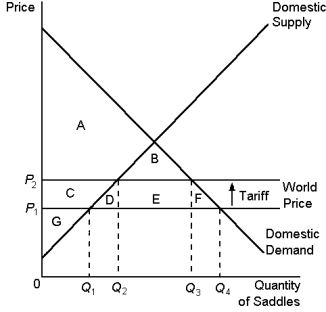 -In Graph 9-9, the domestic price and quantity demanded after the tariff would be:
 (Multiple Choice)
5.0/5 (86)
(86) Graph 9-8 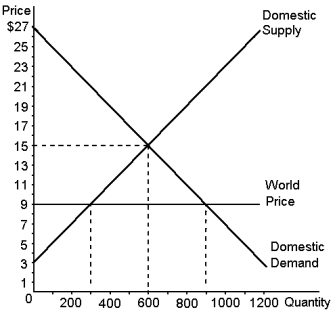 -According to Graph 9-8, consumer surplus after trade would be:
 (Multiple Choice)
4.9/5 (83)
(83) Import quotas and tariffs both cause the quantity of imports to fall.
(True/False)
4.8/5 (90)
(90) When Ford and General Motors import automobile parts from Mexico at prices below those they must pay in the US:
(Multiple Choice)
4.9/5 (67)
(67) Graph 9-7
-According to Graph 9-7, producer surplus before trade would be:
-According to Graph 9-7, producer surplus before trade would be: (Multiple Choice)
4.9/5 (66)
(66) When resources devoted to lobbying are included in the analysis of restrictions to international trade:
(Multiple Choice)
4.7/5 (77)
(77) Suppose a country becomes more open to trade and imports increase.This means that:
(Multiple Choice)
4.9/5 (79)
(79) If the cost of producing wool in New Zealand is higher than in China but New Zealand exports wool to China, it is likely that:
(Multiple Choice)
4.9/5 (77)
(77) The Closer Economic Relations agreement between New Zealand and Australia is designed to ensure both Australia and New Zealand can exercise their own comparative advantage.
(True/False)
4.9/5 (74)
(74) 
Filters
- Essay(0)
- Multiple Choice(0)
- Short Answer(0)
- True False(0)
- Matching(0)