



 Chat with AI
Exam 9: Application: International Trade

Exam 1: Ten Lessons From Economics146 Questions
Exam 2: Thinking Like an Economist133 Questions
Exam 3: Interdependence and the Gains From Trade139 Questions
Exam 4: The Market Forces of Supply and Demand215 Questions
Exam 5: Elasticity and Its Application178 Questions
Exam 6: Supply, Demand and Government Policies145 Questions
Exam 7: Consumers, Producers and the Efficiency of Markets171 Questions
Exam 8: Application: the Costs of Taxation135 Questions
Exam 9: Application: International Trade151 Questions
Exam 10: Externalities199 Questions
Exam 11: Public Goods and Common Resources178 Questions
Exam 12: The Design of the Tax System154 Questions
Exam 13: The Costs of Production191 Questions
Exam 14: Firms in Competitive Markets198 Questions
Exam 15: Monopoly212 Questions
Exam 16: Monopolistic Competition212 Questions
Exam 17: Business Strategy and Oligopoly179 Questions
Exam 18: Competition Policy103 Questions
Exam 19: The Markets for the Factors of Production214 Questions
Exam 20: Earnings, Unions and Discrimination201 Questions
Exam 21: Income Inequity and Poverty111 Questions
Exam 22: The Theory of Consumer Choice158 Questions
Exam 23: Frontiers of Microeconomics111 Questions
Exam 24: Measuring a Nations Income51 Questions
Exam 25: Measuring the Cost of Living55 Questions
Exam 26: Production and Growth62 Questions
Exam 27: Saving, Investment and the Financial System62 Questions
Exam 28: The Natural Rate of Unemployment58 Questions
Exam 29: The Monetary System66 Questions
Exam 30: Inflation: Its Causes and Costs74 Questions
Exam 31: Open-Economy Macroeconomics: Basic Concepts68 Questions
Exam 32: A Macroeconomic Theory of the Open Economy61 Questions
Exam 33: Aggregate Demand and Aggregate Supply81 Questions
Exam 34: The Influence of Monetary and Fiscal Policy on Aggregate Demand73 Questions
Exam 35: The Short-Run Trade-Off Between Inflation and Unemployment57 Questions
Exam 36: Global Financial Crisis of 2008 and Beyond37 Questions
Exam 37: Five Debates Over Macroeconomic Policy38 Questions
Select questions type


In practice, it has proven to be extraordinarily difficult for governments to pick the right infant industries to protect.
(True/False)
4.8/5  (88)
(88) If Australia imports toys from other countries, this means the world price of toys is lower than the Australian price of toys.
(True/False)
4.8/5 (83)
(83) Graph 9-3 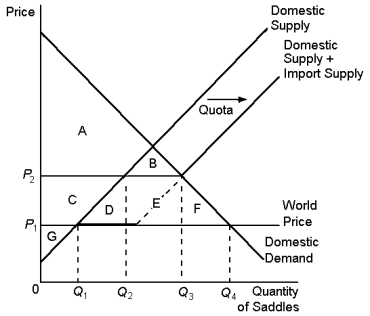 -In Graph 9-3, the equilibrium price and quantity after the quota would be:
 (Multiple Choice)
4.9/5 (71)
(71) According to this statement, if trade in corn is allowed, the price of corn in Australia will be:
(Multiple Choice)
4.9/5 (67)
(67) Import quotas increase the domestic price of the product to at least the world price.
(True/False)
4.8/5 (84)
(84) Graph 9-6
This graph refers to the market for oil in Spain. 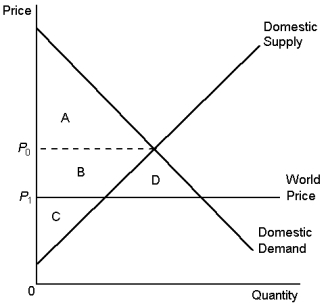 -According to Graph 9-6, consumer surplus in Spain after trade would be:
 (Multiple Choice)
4.9/5 (76)
(76) Graph 9-3
-In Graph 9-3, after the quota, imports would be equal to:
-In Graph 9-3, after the quota, imports would be equal to: (Multiple Choice)
4.9/5 (80)
(80) When a country allows trade and becomes an exporter of a good:
(Multiple Choice)
4.9/5 (79)
(79) Graph 9-6
This graph refers to the market for oil in Spain.
-According to Graph 9-6, producer surplus plus consumer surplus in Spain before trade would be:
-According to Graph 9-6, producer surplus plus consumer surplus in Spain before trade would be: (Multiple Choice)
4.8/5 (88)
(88) Suppose that Australia has a comparative advantage over the New Zealand in providing financial services and New Zealand has a comparative advantage over Australia in producing milk products.By reducing trade barriers, CER allowed both Australia and New Zealand to export more of the products in which it enjoys a comparative advantage.Do all people in both countries benefit from this free trade agreement? Explain.
(Essay)
4.7/5 (75)
(75) Suppose that Tonga, a small country, imports apples at the world price of $4 per kilogram.If Tonga imposes a tariff of $1 per kilogram on imported apples, the price of apples in Tonga will increase, but by less than $1, ceteris paribus.
(True/False)
4.8/5 (85)
(85) Jess usually buys a muffin before work every day.If the government decides to impose a tariff on muffins, how will Jess' behaviour change?
(Multiple Choice)
4.8/5 (79)
(79) What are the arguments in favour of trade restrictions and what are the counter-arguments?
(Essay)
4.8/5 (78)
(78) Graph 9-5
This graph refers to the market for oil in Spain. 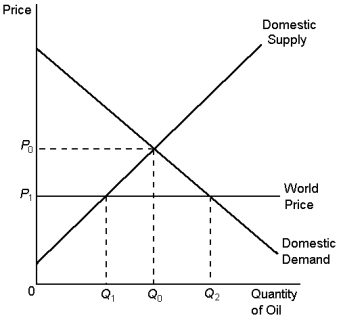 -According to Graph 9-5, the price and quantity of oil in Spain before trade would be:
 (Multiple Choice)
4.8/5 (76)
(76) Graph 9-7 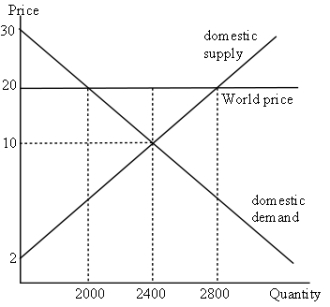 -According to Graph 9-7, consumer surplus before trade would be:
 (Multiple Choice)
4.8/5 (91)
(91) If country A produces all goods at a cheaper price than country B, country B will specialise in producing the goods for which it has comparative advantage.
(True/False)
4.8/5 (76)
(76) Suppose that Australia and China do not trade with each other.If they then allow trade and Australia becomes an exporter of mineral products to China, which group or groups in each country are better off, and which are worse off?
(Essay)
4.8/5 (72)
(72) The main justification for imposing restrictions on free international trade is:
(Multiple Choice)
4.9/5 (75)
(75) 
Filters
- Essay(0)
- Multiple Choice(0)
- Short Answer(0)
- True False(0)
- Matching(0)