



 Chat with AI
Exam 9: Application: International Trade

Exam 1: Ten Lessons From Economics146 Questions
Exam 2: Thinking Like an Economist133 Questions
Exam 3: Interdependence and the Gains From Trade139 Questions
Exam 4: The Market Forces of Supply and Demand215 Questions
Exam 5: Elasticity and Its Application178 Questions
Exam 6: Supply, Demand and Government Policies145 Questions
Exam 7: Consumers, Producers and the Efficiency of Markets171 Questions
Exam 8: Application: the Costs of Taxation135 Questions
Exam 9: Application: International Trade151 Questions
Exam 10: Externalities199 Questions
Exam 11: Public Goods and Common Resources178 Questions
Exam 12: The Design of the Tax System154 Questions
Exam 13: The Costs of Production191 Questions
Exam 14: Firms in Competitive Markets198 Questions
Exam 15: Monopoly212 Questions
Exam 16: Monopolistic Competition212 Questions
Exam 17: Business Strategy and Oligopoly179 Questions
Exam 18: Competition Policy103 Questions
Exam 19: The Markets for the Factors of Production214 Questions
Exam 20: Earnings, Unions and Discrimination201 Questions
Exam 21: Income Inequity and Poverty111 Questions
Exam 22: The Theory of Consumer Choice158 Questions
Exam 23: Frontiers of Microeconomics111 Questions
Exam 24: Measuring a Nations Income51 Questions
Exam 25: Measuring the Cost of Living55 Questions
Exam 26: Production and Growth62 Questions
Exam 27: Saving, Investment and the Financial System62 Questions
Exam 28: The Natural Rate of Unemployment58 Questions
Exam 29: The Monetary System66 Questions
Exam 30: Inflation: Its Causes and Costs74 Questions
Exam 31: Open-Economy Macroeconomics: Basic Concepts68 Questions
Exam 32: A Macroeconomic Theory of the Open Economy61 Questions
Exam 33: Aggregate Demand and Aggregate Supply81 Questions
Exam 34: The Influence of Monetary and Fiscal Policy on Aggregate Demand73 Questions
Exam 35: The Short-Run Trade-Off Between Inflation and Unemployment57 Questions
Exam 36: Global Financial Crisis of 2008 and Beyond37 Questions
Exam 37: Five Debates Over Macroeconomic Policy38 Questions
Select questions type


In general, importing will always increase the wellbeing of a country if the world price of a good is lower than the domestic price.
(True/False)
4.8/5  (84)
(84) Tariffs cause deadweight loss because they move the price of an imported product closer to the equilibrium price without trade, thus reducing the gains from trade.
(True/False)
4.9/5 (75)
(75) Suppose that Australia imposes a tariff on imported computer chips.If the increase in producer surplus is $100 million, the increase in tariff revenue is $200 million and the reduction in consumer surplus is $500 million, then the deadweight loss of the tariff is $200 million.
(True/False)
4.9/5 (67)
(67) Graph 9-6
This graph refers to the market for oil in Spain. 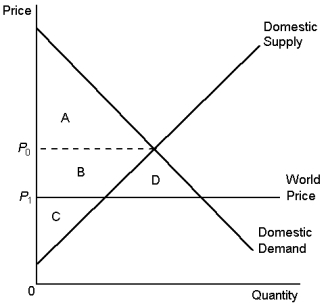 -According to Graph 9-6, producer surplus in Spain before trade would be:
 (Multiple Choice)
4.8/5 (87)
(87) 'Tariffs are needed to reduce imports during times of recession in order to increase domestic output.' This statement would be most closely associated with which argument for restricting trade?
(Multiple Choice)
5.0/5 (77)
(77) Graph 9-9 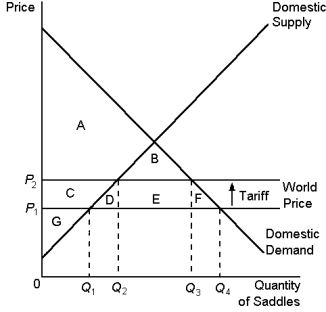 -In Graph 9-9, the free-trade price and quantity demanded would be:
 (Multiple Choice)
4.9/5 (76)
(76) If Colombia exports coffee to the rest of the world, Colombian coffee sellers benefit from higher producer surplus.Colombian coffee buyers are worse off because of lower consumer surplus, but total surplus in Colombia increases because of trade.
(True/False)
4.8/5 (67)
(67) Graph 9-9
-In Graph 9-9, consumer surplus with free trade would be:
-In Graph 9-9, consumer surplus with free trade would be: (Multiple Choice)
4.9/5 (70)
(70) Serbia has a small but growing apple juice market.In the past, Serbia has not traded much apple juice with other countries but now it is considering signing an agreement freeing up its apple juice trade with Croatia.Some apple juice growers are worried about the effect that opening up trade will have on their new industry and are meeting with the president to ask him to do something to protect them.What argument might they make to the president? Do they have a good point?
(Essay)
4.9/5 (77)
(77) Economists like the infant industry argument because it is easy to implement in practice.
(True/False)
4.8/5 (71)
(71) Suppose that you are advising Russian policymakers on trade issues, and the issue of protection for the Russian vodka industry comes up.You argue in favour of free trade but the policymakers are convinced that some protection is needed.They are leaning in favour of an import quota.What will you tell them about the relative effects of import quotas and equivalent tariffs on the wellbeing of Russian vodka producers, Russian vodka consumers and the Russian government budget?
(Essay)
4.8/5 (88)
(88) Graph 9-4
This graph refers to the market for kiwifruit in New Zealand. 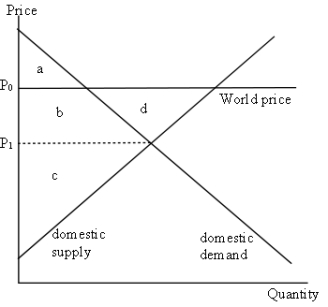 -According to Graph 9-4, total surplus in New Zealand before the trade in kiwifruit is:
 (Multiple Choice)
4.9/5 (81)
(81) Graph 9-9
-In Graph 9-9, producer surplus with free trade would be:
-In Graph 9-9, producer surplus with free trade would be: (Multiple Choice)
4.9/5 (86)
(86) Graph 9-6
This graph refers to the market for oil in Spain.
-According to Graph 9-6, producer surplus in Spain after trade would be:
-According to Graph 9-6, producer surplus in Spain after trade would be: (Multiple Choice)
4.8/5 (91)
(91) Graph 9-8 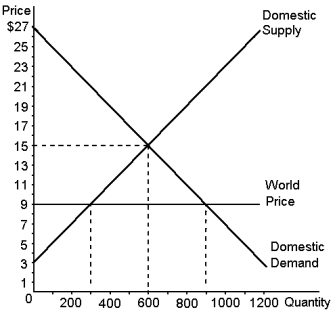 -According to Graph 9-8, equilibrium price and quantity before trade would be:
 (Multiple Choice)
4.8/5 (90)
(90) A multilateral approach to free trade has the potential to increase the gains from trade more than a unilateral approach does, because the multilateral approach can reduce trade restrictions abroad as well as at home.
(True/False)
4.9/5 (78)
(78) Which one of the According to Graph 9-1, if trade in beef is allowed, Japanese:
(Multiple Choice)
4.8/5 (68)
(68) Graph 9-7 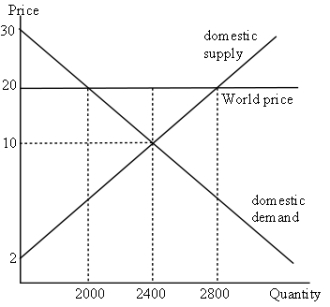 -According to Graph 9-7, consumer surplus after trade would be:
 (Multiple Choice)
5.0/5 (80)
(80) 
Filters
- Essay(0)
- Multiple Choice(0)
- Short Answer(0)
- True False(0)
- Matching(0)