



 Chat with AI
Exam 17: Business Strategy and Oligopoly

Exam 1: Ten Lessons From Economics146 Questions
Exam 2: Thinking Like an Economist133 Questions
Exam 3: Interdependence and the Gains From Trade139 Questions
Exam 4: The Market Forces of Supply and Demand215 Questions
Exam 5: Elasticity and Its Application178 Questions
Exam 6: Supply, Demand and Government Policies145 Questions
Exam 7: Consumers, Producers and the Efficiency of Markets171 Questions
Exam 8: Application: the Costs of Taxation135 Questions
Exam 9: Application: International Trade151 Questions
Exam 10: Externalities199 Questions
Exam 11: Public Goods and Common Resources178 Questions
Exam 12: The Design of the Tax System154 Questions
Exam 13: The Costs of Production191 Questions
Exam 14: Firms in Competitive Markets198 Questions
Exam 15: Monopoly212 Questions
Exam 16: Monopolistic Competition212 Questions
Exam 17: Business Strategy and Oligopoly179 Questions
Exam 18: Competition Policy103 Questions
Exam 19: The Markets for the Factors of Production214 Questions
Exam 20: Earnings, Unions and Discrimination201 Questions
Exam 21: Income Inequity and Poverty111 Questions
Exam 22: The Theory of Consumer Choice158 Questions
Exam 23: Frontiers of Microeconomics111 Questions
Exam 24: Measuring a Nations Income51 Questions
Exam 25: Measuring the Cost of Living55 Questions
Exam 26: Production and Growth62 Questions
Exam 27: Saving, Investment and the Financial System62 Questions
Exam 28: The Natural Rate of Unemployment58 Questions
Exam 29: The Monetary System66 Questions
Exam 30: Inflation: Its Causes and Costs74 Questions
Exam 31: Open-Economy Macroeconomics: Basic Concepts68 Questions
Exam 32: A Macroeconomic Theory of the Open Economy61 Questions
Exam 33: Aggregate Demand and Aggregate Supply81 Questions
Exam 34: The Influence of Monetary and Fiscal Policy on Aggregate Demand73 Questions
Exam 35: The Short-Run Trade-Off Between Inflation and Unemployment57 Questions
Exam 36: Global Financial Crisis of 2008 and Beyond37 Questions
Exam 37: Five Debates Over Macroeconomic Policy38 Questions
Select questions type


Table 16.7
The USA and China are locked in negotiations to cut emissions.The following table represents the pay-offs from cutting emissions and continuing to pollute:
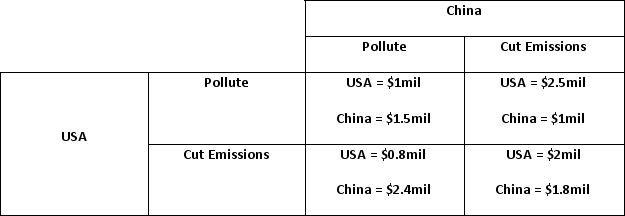 -Refer to Table 16-7.When this game reaches a Nash equilibrium, payoffs for the USA and China will be:
Free
(Multiple Choice)
4.8/5  (69)
(69) Correct Answer: Verified
B
In what type of market do the actions of any one seller have a significant impact on the profits of all other sellers?
Free
(Multiple Choice)
4.9/5 (66)
(66) Correct Answer:Verified
VerifiedB
Table 16-8
Consider two countries, Eudora and the Inhabit, that are engaged in an arms race.The question each country must face is whether to build new weapons or to disarm existing weapons.Each country prefers to have more arms than the other because a large arsenal gives it more influence in world affairs.But each country also prefers to live in a world safe from the other country's weapons.The table shows the possible outcomes for each decision combination. 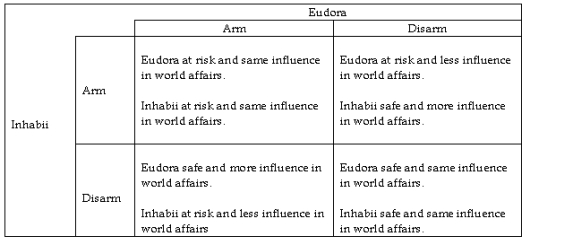 -Refer to Table 16-8.If both countries get together and agree on a certain level of arms, what will happen to social welfare, assuming that both countries keep their end of the bargain?
Free
(Multiple Choice)
4.8/5 (79)
(79) Correct Answer:Verified
VerifiedC
The only way a cartel is able to maintain its market power is if:
(Multiple Choice)
4.9/5 (86)
(86) Game theory is used to study oligopoly, but is not needed in the study of competitive and monopoly markets.
(True/False)
4.9/5 (78)
(78) Suppose an opal-mining firm notices that the price of opals is above marginal cost.Selling one more unit of opals at the going price also increases profit.This concept is known as the:
(Multiple Choice)
5.0/5 (78)
(78) When an oligopolist decreases production, it is likely that the output effect is less than the price effect.
(True/False)
4.8/5 (82)
(82) According to the information provided, even though Sam is an honest young man, he decides to cheat on the exam because he feels he is a victim of the prisoners' dilemma.Which of the following statements would support Sam's decision to cheat?
(Multiple Choice)
4.9/5 (81)
(81) One key difference between an oligopoly market and a competitive market is that oligopolistic firms:
(Multiple Choice)
4.8/5 (78)
(78) According to the information provided, as long as production levels are less than the Nash equilibrium, both Irun and Urun have the individual incentive to:
(Multiple Choice)
4.8/5 (64)
(64) According to the information provided, if Irun fails to live up to the production agreement and overproduces, Urun will be:
(Multiple Choice)
5.0/5 (82)
(82) Suppose a firm makes a product whose price decreases as the output increases.The firm is in a market with many other firms.It is most likely that the firm:
(Multiple Choice)
4.8/5 (88)
(88) Game theory is not necessary for understanding competitive markets but is quite useful in understanding the behaviour of:
(Multiple Choice)
4.9/5 (85)
(85) To increase their profits further, members of a cartel have an incentive to:
(Multiple Choice)
4.8/5 (77)
(77) When strategic interactions are important to pricing and production decisions, a firm will:
(Multiple Choice)
4.8/5 (74)
(74) As the number of firms in an oligopoly market grows larger, the price will approach:
(Multiple Choice)
5.0/5 (85)
(85) When an oligopoly market is in Nash equilibrium a firm will choose its best pricing strategy, given the strategies that it observes other firms taking.
(True/False)
5.0/5 (77)
(77) Insight from the prisoners' dilemma suggests we will exploit common resources, even when it is in the best interests of society to manage them.
(True/False)
4.9/5 (82)
(82) There are two types of markets in which firms face some competition, yet are still able to have some control over the prices of their products.The names given to these market structures are:
(Multiple Choice)
4.7/5 (90)
(90) 
Filters
- Essay(0)
- Multiple Choice(0)
- Short Answer(0)
- True False(0)
- Matching(0)