



 Chat with AI
Exam 17: Business Strategy and Oligopoly

Exam 1: Ten Lessons From Economics146 Questions
Exam 2: Thinking Like an Economist133 Questions
Exam 3: Interdependence and the Gains From Trade139 Questions
Exam 4: The Market Forces of Supply and Demand215 Questions
Exam 5: Elasticity and Its Application178 Questions
Exam 6: Supply, Demand and Government Policies145 Questions
Exam 7: Consumers, Producers and the Efficiency of Markets171 Questions
Exam 8: Application: the Costs of Taxation135 Questions
Exam 9: Application: International Trade151 Questions
Exam 10: Externalities199 Questions
Exam 11: Public Goods and Common Resources178 Questions
Exam 12: The Design of the Tax System154 Questions
Exam 13: The Costs of Production191 Questions
Exam 14: Firms in Competitive Markets198 Questions
Exam 15: Monopoly212 Questions
Exam 16: Monopolistic Competition212 Questions
Exam 17: Business Strategy and Oligopoly179 Questions
Exam 18: Competition Policy103 Questions
Exam 19: The Markets for the Factors of Production214 Questions
Exam 20: Earnings, Unions and Discrimination201 Questions
Exam 21: Income Inequity and Poverty111 Questions
Exam 22: The Theory of Consumer Choice158 Questions
Exam 23: Frontiers of Microeconomics111 Questions
Exam 24: Measuring a Nations Income51 Questions
Exam 25: Measuring the Cost of Living55 Questions
Exam 26: Production and Growth62 Questions
Exam 27: Saving, Investment and the Financial System62 Questions
Exam 28: The Natural Rate of Unemployment58 Questions
Exam 29: The Monetary System66 Questions
Exam 30: Inflation: Its Causes and Costs74 Questions
Exam 31: Open-Economy Macroeconomics: Basic Concepts68 Questions
Exam 32: A Macroeconomic Theory of the Open Economy61 Questions
Exam 33: Aggregate Demand and Aggregate Supply81 Questions
Exam 34: The Influence of Monetary and Fiscal Policy on Aggregate Demand73 Questions
Exam 35: The Short-Run Trade-Off Between Inflation and Unemployment57 Questions
Exam 36: Global Financial Crisis of 2008 and Beyond37 Questions
Exam 37: Five Debates Over Macroeconomic Policy38 Questions
Select questions type


When oligopolists collude and act like a monopoly, they charge a price above marginal cost.When they act independently, they charge a price equal to marginal cost.
(True/False)
4.8/5  (71)
(71) The prisoners' dilemma provides insights into how easy it is to maintain cooperation.
(True/False)
4.9/5 (87)
(87) The best way for oligopolists to increase their profits is to:
(Multiple Choice)
4.8/5 (76)
(76) When deciding whether the market is an oligopoly or not, there is no magical number of firms that defines an oligopoly.
(True/False)
4.9/5 (87)
(87) The collective action problem (where everyone is better off if action is coordinated, but free riding on the actions of others is possible) is an example of a prisoners' dilemma game.
(True/False)
4.7/5 (76)
(76) Table 16-4
In the following duopoly game, the two firms can either set the price of their product high or low.In this market, customers are very price sensitive: when one firm sets a low price it steals the majority of customers from its competitor.The game is represented in the table below. Firm B High Price Low Price Firm A High Price Firm A gets \5 00 Firm A get \3 00 Firm B gets \5 00 Firm B gets \6 00 Low Price Firm A gets \6 00 Firm A gets \4 00 Firm B gets \3 00 Firm B gets \4 00
-Refer to table 16-4.Profit for each firm would be maximised if:
(Multiple Choice)
4.9/5 (60)
(60) Suppose three firms are in an oligopoly and each firm has a dominant production strategy.Would it be possible to determine the Nash Equilibrium solely from knowledge about the firms' dominant strategies? Suppose one of the three firms is irrational and plays a strategy other than its dominant strategy.Is it possible to determine the best course of action of the other two firms?
(Essay)
4.8/5 (79)
(79) When prisoners' dilemma games are repeated over and over, sometimes the threat of penalty causes both parties to cooperate.
(True/False)
4.9/5 (75)
(75) Table 16-4
In the following duopoly game, the two firms can either set the price of their product high or low.In this market, customers are very price sensitive: when one firm sets a low price it steals the majority of customers from its competitor.The game is represented in the table below. Firm B High Price Low Price Firm A High Price Firm A gets \5 00 Firm A get \3 00 Firm B gets \5 00 Firm B gets \6 00 Low Price Firm A gets \6 00 Firm A gets \4 00 Firm B gets \3 00 Firm B gets \4 00
-Refer to table 16-4.The Nash-equilibrium in this market is:
(Multiple Choice)
4.8/5 (82)
(82) Table 16.7
The USA and China are locked in negotiations to cut emissions.The following table represents the pay-offs from cutting emissions and continuing to pollute:
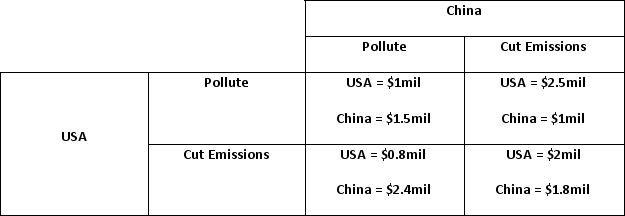 -Refer to Table 16-7.The Nash equilibrium for this game is for:
 (Multiple Choice)
4.8/5 (72)
(72) A prisoners' dilemma game demonstrates how cooperative action is often not rational even though:
(Multiple Choice)
4.9/5 (83)
(83) Table 16-1
The table below shows the total demand for viewing a rare penguin species at a local reserve.Ecotour companies have to build discreet viewing hides for tourists to view the penguins.Each ecotour company has to pay a fixed fee of $5000 for the right to build on the reserve.Assume that hides can be supplied to tourists at zero marginal cost.Tickets are sold to tourists to use the viewing hides. Quantity (Visits) Price(\ ticket) 0 48 2000 36 4000 24 6000 12 8000 8 10000 4 12000 0 Quantity (Visits) Price(\ ticket) Revenue 0 12 0 1000 10 10 2000 8 16 3000 6 18 4000 4 16 5000 2 10 6000 0 0 Any firm can change tickets by steps of 500 only.Any 500 step of quantity is assumed to be sold at the midpoint of the two prices (eg.3500 tickets would be sold for $5)
-Refer to Table 16-1.Assume that there are two profit-maximising ecotourist companies operating in this market.Further assume that they are able to collude on the price of the tickets they sell.As part of their collusive agreement, they decide to take an equal share of the market.How much profit will each company make?
(Multiple Choice)
4.9/5 (87)
(87) Society will always be better off if the prisoners' dilemma game is repeated numerous times in an oligopoly market.
(True/False)
4.9/5 (76)
(76) The game that oligopolists play in trying to reach the monopoly outcome is similar to the game that the two prisoners play in the prisoners' dilemma.
(True/False)
4.9/5 (88)
(88) Very often, the reason that players can solve the prisoners' dilemma game and reach the most profitable outcome is that:
(Multiple Choice)
4.7/5 (75)
(75) As a group, oligopolists would always be better off if they would act collectively:
(Multiple Choice)
4.9/5 (86)
(86) Self-interest usually dictates what kind of outcome for the players in a prisoners' dilemma game?
(Multiple Choice)
4.8/5 (81)
(81) 
Filters
- Essay(0)
- Multiple Choice(0)
- Short Answer(0)
- True False(0)
- Matching(0)