



 Chat with AI
Exam 16: Monopolistic Competition

Exam 1: Ten Lessons From Economics146 Questions
Exam 2: Thinking Like an Economist133 Questions
Exam 3: Interdependence and the Gains From Trade139 Questions
Exam 4: The Market Forces of Supply and Demand215 Questions
Exam 5: Elasticity and Its Application178 Questions
Exam 6: Supply, Demand and Government Policies145 Questions
Exam 7: Consumers, Producers and the Efficiency of Markets171 Questions
Exam 8: Application: the Costs of Taxation135 Questions
Exam 9: Application: International Trade151 Questions
Exam 10: Externalities199 Questions
Exam 11: Public Goods and Common Resources178 Questions
Exam 12: The Design of the Tax System154 Questions
Exam 13: The Costs of Production191 Questions
Exam 14: Firms in Competitive Markets198 Questions
Exam 15: Monopoly212 Questions
Exam 16: Monopolistic Competition212 Questions
Exam 17: Business Strategy and Oligopoly179 Questions
Exam 18: Competition Policy103 Questions
Exam 19: The Markets for the Factors of Production214 Questions
Exam 20: Earnings, Unions and Discrimination201 Questions
Exam 21: Income Inequity and Poverty111 Questions
Exam 22: The Theory of Consumer Choice158 Questions
Exam 23: Frontiers of Microeconomics111 Questions
Exam 24: Measuring a Nations Income51 Questions
Exam 25: Measuring the Cost of Living55 Questions
Exam 26: Production and Growth62 Questions
Exam 27: Saving, Investment and the Financial System62 Questions
Exam 28: The Natural Rate of Unemployment58 Questions
Exam 29: The Monetary System66 Questions
Exam 30: Inflation: Its Causes and Costs74 Questions
Exam 31: Open-Economy Macroeconomics: Basic Concepts68 Questions
Exam 32: A Macroeconomic Theory of the Open Economy61 Questions
Exam 33: Aggregate Demand and Aggregate Supply81 Questions
Exam 34: The Influence of Monetary and Fiscal Policy on Aggregate Demand73 Questions
Exam 35: The Short-Run Trade-Off Between Inflation and Unemployment57 Questions
Exam 36: Global Financial Crisis of 2008 and Beyond37 Questions
Exam 37: Five Debates Over Macroeconomic Policy38 Questions
Select questions type


The use of celebrity endorsements in advertising has enabled firms to differentiate their products.

Free
(True/False)
4.8/5  (76)
(76) Correct Answer: Verified
True
In markets where restrictions on advertising have been used to curtail competition, the US courts have generally:
Free
(Multiple Choice)
4.8/5 (73)
(73) Correct Answer:Verified
VerifiedB
Fill in the blanks.A monopolistically competitive firm, unlike a ________, could increase the quantity it produces and lower the ____________:
Free
(Multiple Choice)
4.8/5 (84)
(84) Correct Answer:Verified
VerifiedA
When the gain from a product-variety externality exceeds the loss from a business stealing externality in a monopolistically competitive market:
(Multiple Choice)
4.8/5 (76)
(76) Graph 17-4 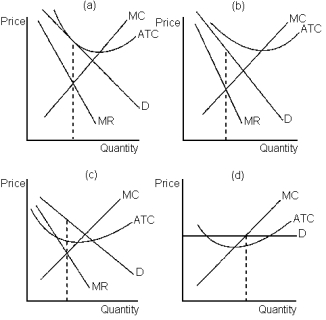 -Refer to Graph 17-4.Which of the panels shown reflects a long-run equilibrium for a firm in a monopolistically competitive market?
 (Multiple Choice)
4.8/5 (71)
(71) Graph 17-1  -Refer to Graph 17-1.The firm depicted in panel b faces a horizontal demand curve.If panel b depicts a profit-maximising firm:
 (Multiple Choice)
5.0/5 (71)
(71) If advertising decreases the elasticity of demand for specific brand names of hard liquor, we would expect firms to be more able to exercise market power.
(True/False)
4.7/5 (76)
(76) In relation to the branding of products, which of the following statement(s) are correct?
(i) brand names can cause consumers to perceive differences in products that do not really exist
(i) brand names can be a useful way for consumers to ensure the product they are buying is of high quality
(i) brand names give firms an incentive to maintain a high product quality
(Multiple Choice)
4.9/5 (78)
(78) Economic losses are in a monopolistically competitive markets:
(Multiple Choice)
4.7/5 (76)
(76) According to the information provided, advertising of computer hardware on billboards will most likely:
(Multiple Choice)
4.9/5 (84)
(84) Eunice consumes Coke exclusively.She claims that there is a clear taste difference and that competing brands of cola leave an unsavoury residual taste in her mouth.However, in a blind taste test, Eunice is found to prefer generic store-brand cola to Coke eight out of 10 times.The results of Eunice's taste test would reinforce claims by critics of brand names that:
(Multiple Choice)
4.9/5 (72)
(72) If regulators required firms in monopolistically competitive markets to set price equal to marginal cost:
(Multiple Choice)
4.8/5 (85)
(85) Firms in monopolistic competition sell products that are identical to those produced by other firms.
(True/False)
4.7/5 (83)
(83) Movies that prominently display name-brand consumer products are most likely sending a message about:
(Multiple Choice)
4.8/5 (72)
(72) The entry of new firms into a monopolistically competitive market is characterised by:
(Multiple Choice)
4.7/5 (86)
(86) Fill in the blanks.The deadweight loss that is associated with a ___________ market is a result of ___________:
(Multiple Choice)
4.8/5 (68)
(68) 
Filters
- Essay(0)
- Multiple Choice(0)
- Short Answer(0)
- True False(0)
- Matching(0)