



 Chat with AI
Exam 16: Monopolistic Competition

Exam 1: Ten Lessons From Economics146 Questions
Exam 2: Thinking Like an Economist133 Questions
Exam 3: Interdependence and the Gains From Trade139 Questions
Exam 4: The Market Forces of Supply and Demand215 Questions
Exam 5: Elasticity and Its Application178 Questions
Exam 6: Supply, Demand and Government Policies145 Questions
Exam 7: Consumers, Producers and the Efficiency of Markets171 Questions
Exam 8: Application: the Costs of Taxation135 Questions
Exam 9: Application: International Trade151 Questions
Exam 10: Externalities199 Questions
Exam 11: Public Goods and Common Resources178 Questions
Exam 12: The Design of the Tax System154 Questions
Exam 13: The Costs of Production191 Questions
Exam 14: Firms in Competitive Markets198 Questions
Exam 15: Monopoly212 Questions
Exam 16: Monopolistic Competition212 Questions
Exam 17: Business Strategy and Oligopoly179 Questions
Exam 18: Competition Policy103 Questions
Exam 19: The Markets for the Factors of Production214 Questions
Exam 20: Earnings, Unions and Discrimination201 Questions
Exam 21: Income Inequity and Poverty111 Questions
Exam 22: The Theory of Consumer Choice158 Questions
Exam 23: Frontiers of Microeconomics111 Questions
Exam 24: Measuring a Nations Income51 Questions
Exam 25: Measuring the Cost of Living55 Questions
Exam 26: Production and Growth62 Questions
Exam 27: Saving, Investment and the Financial System62 Questions
Exam 28: The Natural Rate of Unemployment58 Questions
Exam 29: The Monetary System66 Questions
Exam 30: Inflation: Its Causes and Costs74 Questions
Exam 31: Open-Economy Macroeconomics: Basic Concepts68 Questions
Exam 32: A Macroeconomic Theory of the Open Economy61 Questions
Exam 33: Aggregate Demand and Aggregate Supply81 Questions
Exam 34: The Influence of Monetary and Fiscal Policy on Aggregate Demand73 Questions
Exam 35: The Short-Run Trade-Off Between Inflation and Unemployment57 Questions
Exam 36: Global Financial Crisis of 2008 and Beyond37 Questions
Exam 37: Five Debates Over Macroeconomic Policy38 Questions
Select questions type


From a total welfare perspective, it is possible that too many firms can enter into a monopolistically competitive market.
(True/False)
4.9/5  (77)
(77) When a firm operates at efficient scale, it is producing at the maximum point on its average total cost curve.
(True/False)
4.9/5 (77)
(77) Professional organisations and producer groups have an incentive to:
(Multiple Choice)
4.8/5 (84)
(84) Graph 17-4 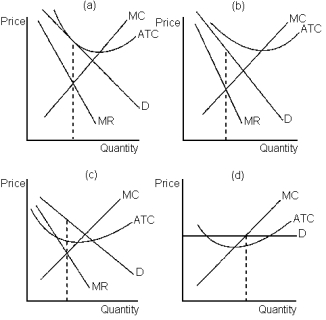 -Refer to graph 17-4.Which of the markets depicted in each panel is likely to see a firm enter in the long run?
 (Multiple Choice)
4.8/5 (71)
(71) In the market for hotel rooms in large metropolitan markets, the cost of a single night's stay can be several times higher than that of a similar room in a suburban market.If the market for hotel rooms is characterised by monopolistic competition, this difference in price can be partially explained by:
(Multiple Choice)
4.8/5 (83)
(83) Advertising during the Rugby World Cup is an example of providing information in the advertisement's content.
(True/False)
4.9/5 (81)
(81) For many years, Google has had market dominance in many of its online activities.Recently, it has been trying to take on Facebook's dominance of social media.Google has started to use its banner space on its website and the Tech media, as well as having 'invitees' to test the 'Beta'.What advertising theory does such an approach support? Explain.
(Essay)
4.9/5 (85)
(85) The 'monopoly' in monopolistically competitive markets is the result of a firm having a monopoly on a product for which there are no substitutes.
(True/False)
4.9/5 (90)
(90) Monopolistically competitive markets have all the desirable welfare properties of perfectly competitive markets.
(True/False)
4.9/5 (79)
(79) A new brewing company announces that it is releasing a new organic ale into the beer market.You can assume that the market for beer is characterised by monopolistic competition.According to the information provided, beer consumers are likely to experience what kind of externality as a result of the new ale?
(Multiple Choice)
4.9/5 (78)
(78) In a monopolistically competitive market structure, each firm sells a good that is:
(Multiple Choice)
4.9/5 (87)
(87) When free entry is one of the attributes of a market structure, economic profits are:
(Multiple Choice)
4.8/5 (77)
(77) Advertising only benefits suppliers of a good and has little value to consumers.
(True/False)
4.8/5 (80)
(80) A firm in a monopolistically competitive market is usually concerned about each additional customer walking through the door, since it will always end up earning additional economic profits.
(True/False)
4.9/5 (92)
(92) If firms in a monopolistically competitive market are earning positive profits, firms will enter until price equals the minimum of average total cost.
(True/False)
5.0/5 (74)
(74) If firms in a monopolistically competitive market are incurring economic losses, which of the following scenarios would best reflect the change facing incumbent firms (who are able to stay in the market) as the market adjusts to its new equilibrium?
(Multiple Choice)
4.8/5 (71)
(71) Graph 17-4
-Refer to graph 17-4.Which of the markets depicted in each panel is likely to see firms exit in the long run?
-Refer to graph 17-4.Which of the markets depicted in each panel is likely to see firms exit in the long run? (Multiple Choice)
4.8/5 (95)
(95) If advertising reduces a consumer's price sensitivity between identical goods, it is likely to:
(Multiple Choice)
4.8/5 (69)
(69) 
Filters
- Essay(0)
- Multiple Choice(0)
- Short Answer(0)
- True False(0)
- Matching(0)