



 Chat with AI
Exam 16: Monopolistic Competition

Exam 1: Ten Lessons From Economics146 Questions
Exam 2: Thinking Like an Economist133 Questions
Exam 3: Interdependence and the Gains From Trade139 Questions
Exam 4: The Market Forces of Supply and Demand215 Questions
Exam 5: Elasticity and Its Application178 Questions
Exam 6: Supply, Demand and Government Policies145 Questions
Exam 7: Consumers, Producers and the Efficiency of Markets171 Questions
Exam 8: Application: the Costs of Taxation135 Questions
Exam 9: Application: International Trade151 Questions
Exam 10: Externalities199 Questions
Exam 11: Public Goods and Common Resources178 Questions
Exam 12: The Design of the Tax System154 Questions
Exam 13: The Costs of Production191 Questions
Exam 14: Firms in Competitive Markets198 Questions
Exam 15: Monopoly212 Questions
Exam 16: Monopolistic Competition212 Questions
Exam 17: Business Strategy and Oligopoly179 Questions
Exam 18: Competition Policy103 Questions
Exam 19: The Markets for the Factors of Production214 Questions
Exam 20: Earnings, Unions and Discrimination201 Questions
Exam 21: Income Inequity and Poverty111 Questions
Exam 22: The Theory of Consumer Choice158 Questions
Exam 23: Frontiers of Microeconomics111 Questions
Exam 24: Measuring a Nations Income51 Questions
Exam 25: Measuring the Cost of Living55 Questions
Exam 26: Production and Growth62 Questions
Exam 27: Saving, Investment and the Financial System62 Questions
Exam 28: The Natural Rate of Unemployment58 Questions
Exam 29: The Monetary System66 Questions
Exam 30: Inflation: Its Causes and Costs74 Questions
Exam 31: Open-Economy Macroeconomics: Basic Concepts68 Questions
Exam 32: A Macroeconomic Theory of the Open Economy61 Questions
Exam 33: Aggregate Demand and Aggregate Supply81 Questions
Exam 34: The Influence of Monetary and Fiscal Policy on Aggregate Demand73 Questions
Exam 35: The Short-Run Trade-Off Between Inflation and Unemployment57 Questions
Exam 36: Global Financial Crisis of 2008 and Beyond37 Questions
Exam 37: Five Debates Over Macroeconomic Policy38 Questions
Select questions type


Brand names can help communicate the quality of a product, even when the consumer has never purchased that product before.
(True/False)
4.7/5  (71)
(71) You intend travelling to Shanghai, China, to market truck-parts to local manufacturers.Your travel agent provides a list of 120 local hotels and a Sheraton.In this case, the Sheraton brand-name is likely to be used as a signal of:
(Multiple Choice)
4.7/5 (84)
(84) Graph 17-2 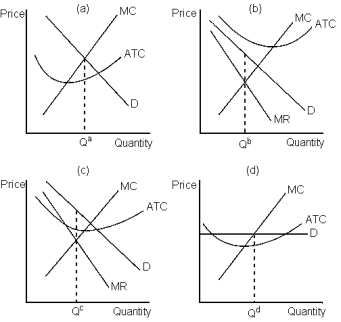 -Refer to graph 17-2.Which of the graphs shown would be consistent with the firm making short-run profit in a competitive market?
 (Multiple Choice)
4.9/5 (79)
(79) A new brewing company announces that it is releasing a new organic ale into the beer market.You can assume that the market for beer is characterised by monopolistic competition.As a result of the new organic ale, product-variety externalities would be manifest in the new product:
(Multiple Choice)
4.8/5 (68)
(68) Defenders of advertising would argue that advertising conveys information about which of the following?
(i) the prices of goods offered for sale
(ii) the existence of new products
(iii) the location of retail outlets
(Multiple Choice)
4.7/5 (74)
(74) What characteristics describe the long-run equilibrium in a monopolistically competitive market?
(i) price exceeds marginal cost
(ii) price equals average total cost
(iii) quantity produced is at each firm's efficient scale
(Multiple Choice)
4.9/5 (90)
(90) Excess capacity occurs whenever a firm is operating at an output level below where average total cost is minimised.
(True/False)
4.7/5 (76)
(76) The entry and exit of firms in a monopolistically competitive market guarantees that:
(Multiple Choice)
4.9/5 (95)
(95) Critics of markets that are characterised by firms that sell brand-name products argue that brand names encourage consumers to pay more for branded products that:
(Multiple Choice)
4.9/5 (79)
(79) In a monopolistically competitive industry, the profit-maximising firm will produce where marginal costs are equal to average total cost.
(True/False)
4.9/5 (75)
(75) Important similarities between firms in a monopolistically competitive market and a monopoly are which of the following?:
(i) they both face downward-sloping demand curves
(ii) they are both regulated by the government
(iii) firms in both markets can make economic profits in the long run
(Multiple Choice)
4.8/5 (83)
(83) Suppose a firm enters a monopolistically competitive market with a new product.Consumers now have more choice.This increase in choice means that:
(Multiple Choice)
5.0/5 (84)
(84) The product-variety externality associated with monopolistic competition arises because in monopolistically competitive markets firms try to mimic the success of other brands and products.
(True/False)
4.9/5 (79)
(79) What is the similarity between a long-run equilibrium in a monopolistically competitive market with a monopoly? What is the difference?
(Essay)
4.8/5 (79)
(79) As some incumbent firms exit a monopolistically competitive market, profits of existing firms:
(Multiple Choice)
4.8/5 (65)
(65) A monopolistically competitive firm chooses its production level the same way as a(n):
(Multiple Choice)
4.8/5 (91)
(91) Whenever a new firm considers entry into a monopolistically competitive market with a new product, it considers:
(Multiple Choice)
4.8/5 (69)
(69) The business stealing externality arises because firms post a price above marginal cost and are therefore always eager to sell additional units.
(True/False)
4.9/5 (83)
(83) Advertising may impede competition by fostering brand loyalty and allowing firms to increase their mark-up.
(True/False)
4.8/5 (85)
(85) If a firm is making zero profits, then which of the following must be true?
(Multiple Choice)
4.9/5 (69)
(69) 
Filters
- Essay(0)
- Multiple Choice(0)
- Short Answer(0)
- True False(0)
- Matching(0)