



 Chat with AI
Exam 16: Monopolistic Competition

Exam 1: Ten Lessons From Economics146 Questions
Exam 2: Thinking Like an Economist133 Questions
Exam 3: Interdependence and the Gains From Trade139 Questions
Exam 4: The Market Forces of Supply and Demand215 Questions
Exam 5: Elasticity and Its Application178 Questions
Exam 6: Supply, Demand and Government Policies145 Questions
Exam 7: Consumers, Producers and the Efficiency of Markets171 Questions
Exam 8: Application: the Costs of Taxation135 Questions
Exam 9: Application: International Trade151 Questions
Exam 10: Externalities199 Questions
Exam 11: Public Goods and Common Resources178 Questions
Exam 12: The Design of the Tax System154 Questions
Exam 13: The Costs of Production191 Questions
Exam 14: Firms in Competitive Markets198 Questions
Exam 15: Monopoly212 Questions
Exam 16: Monopolistic Competition212 Questions
Exam 17: Business Strategy and Oligopoly179 Questions
Exam 18: Competition Policy103 Questions
Exam 19: The Markets for the Factors of Production214 Questions
Exam 20: Earnings, Unions and Discrimination201 Questions
Exam 21: Income Inequity and Poverty111 Questions
Exam 22: The Theory of Consumer Choice158 Questions
Exam 23: Frontiers of Microeconomics111 Questions
Exam 24: Measuring a Nations Income51 Questions
Exam 25: Measuring the Cost of Living55 Questions
Exam 26: Production and Growth62 Questions
Exam 27: Saving, Investment and the Financial System62 Questions
Exam 28: The Natural Rate of Unemployment58 Questions
Exam 29: The Monetary System66 Questions
Exam 30: Inflation: Its Causes and Costs74 Questions
Exam 31: Open-Economy Macroeconomics: Basic Concepts68 Questions
Exam 32: A Macroeconomic Theory of the Open Economy61 Questions
Exam 33: Aggregate Demand and Aggregate Supply81 Questions
Exam 34: The Influence of Monetary and Fiscal Policy on Aggregate Demand73 Questions
Exam 35: The Short-Run Trade-Off Between Inflation and Unemployment57 Questions
Exam 36: Global Financial Crisis of 2008 and Beyond37 Questions
Exam 37: Five Debates Over Macroeconomic Policy38 Questions
Select questions type


In the long run, the profit for a monopolistically competitive firm moves to the competitive level due to:
(Multiple Choice)
4.9/5  (63)
(63) When a new firm enters a monopolistically competitive market, the individual demand curves faced by all existing firms in that market will:
(Multiple Choice)
5.0/5 (78)
(78) Graph 17-1  -Refer to Graph 17-1, panel A.Assume the market is monopolistically competitive and in long-run equilibrium.If drawn in, the average total cost curve would be:
 (Multiple Choice)
4.8/5 (72)
(72) Consider the following graph 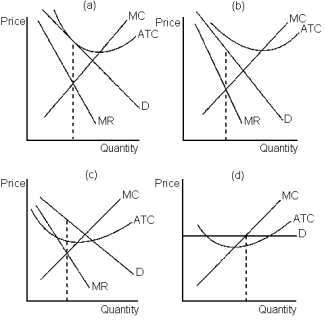 Identify:
(a) Which panel(s) could represent a firm in monopolistic competition in the long run;
(b) Which panel(s) could not represent a firm in monopolistic competition in the short run;
(c) Which panel(s) could represent a firm in monopolistic competition making a loss;
(d) Which panel(s) could represent a firm in monopolistic competition making a positive economic profit
Identify:
(a) Which panel(s) could represent a firm in monopolistic competition in the long run;
(b) Which panel(s) could not represent a firm in monopolistic competition in the short run;
(c) Which panel(s) could represent a firm in monopolistic competition making a loss;
(d) Which panel(s) could represent a firm in monopolistic competition making a positive economic profit (Essay)
4.8/5 (76)
(76) The reason that monopoly remains a root-word for monopolistically competitive market is because of:
(Multiple Choice)
4.9/5 (83)
(83) Refer to the information provided.By its willingness to spend money on advertising, Firm B:
(Multiple Choice)
4.9/5 (73)
(73) The costs and benefits of advertising are still open to debate.What are the critiques of advertising? If advertising contains no information about the product, is it necessarily welfare destroying?
(Essay)
4.7/5 (85)
(85) A new brewing company announces that it is releasing a new organic ale into the beer market.You can assume that the market for beer is characterised by monopolistic competition.According to the information provided, the beer market is likely to be more efficient if the:
(Multiple Choice)
4.9/5 (74)
(74) The Pizza Hut in Agra, India has a very similar menu design, layout and content as the Pizza Hut in Bondi Junction, Sydney.This is an example of a brand name enhancing market efficiency for Australian tourists visiting India.
(True/False)
5.0/5 (73)
(73) Inefficiency in monopolistically competitive markets can be identified with:
(Multiple Choice)
4.8/5 (81)
(81) What is meant by the term 'excess capacity' as it relates to monopolistically competitive firms?
(Essay)
4.9/5 (75)
(75) Long-run economic profit in a monopolistically competitive market is mainly a function of which of the following?
(i) free entry
(ii) free exit
(iii) strategic pricing among the sellers
(Multiple Choice)
4.9/5 (73)
(73) Graph 17-1
-Refer to Graph 17-1.Which of the following graphs would most likely represent a profit-maximising firm in a monopolistically competitive market?
-Refer to Graph 17-1.Which of the following graphs would most likely represent a profit-maximising firm in a monopolistically competitive market? (Multiple Choice)
4.8/5 (84)
(84) For the purposes of imperfect competition, a "few" firms is defined as:
(Multiple Choice)
4.9/5 (76)
(76) Hotels in Sydney observe that on most nights, about 80 per cent of their rooms are occupied, with the remainder being empty.This kind of excess capacity is indicative of what kind of market?
(Multiple Choice)
4.7/5 (71)
(71) Are the resources devoted to advertising wasted? Explain how advertising may not be of social value.
(Essay)
4.9/5 (89)
(89) In some countries, brand name fast-food restaurants are not allowed to operate.Such restrictions are likely to:
(Multiple Choice)
4.8/5 (64)
(64) 
Filters
- Essay(0)
- Multiple Choice(0)
- Short Answer(0)
- True False(0)
- Matching(0)