



 Chat with AI
Exam 7: Consumers, Producers and the Efficiency of Markets

Exam 1: Ten Lessons From Economics146 Questions
Exam 2: Thinking Like an Economist133 Questions
Exam 3: Interdependence and the Gains From Trade139 Questions
Exam 4: The Market Forces of Supply and Demand215 Questions
Exam 5: Elasticity and Its Application178 Questions
Exam 6: Supply, Demand and Government Policies145 Questions
Exam 7: Consumers, Producers and the Efficiency of Markets171 Questions
Exam 8: Application: the Costs of Taxation135 Questions
Exam 9: Application: International Trade151 Questions
Exam 10: Externalities199 Questions
Exam 11: Public Goods and Common Resources178 Questions
Exam 12: The Design of the Tax System154 Questions
Exam 13: The Costs of Production191 Questions
Exam 14: Firms in Competitive Markets198 Questions
Exam 15: Monopoly212 Questions
Exam 16: Monopolistic Competition212 Questions
Exam 17: Business Strategy and Oligopoly179 Questions
Exam 18: Competition Policy103 Questions
Exam 19: The Markets for the Factors of Production214 Questions
Exam 20: Earnings, Unions and Discrimination201 Questions
Exam 21: Income Inequity and Poverty111 Questions
Exam 22: The Theory of Consumer Choice158 Questions
Exam 23: Frontiers of Microeconomics111 Questions
Exam 24: Measuring a Nations Income51 Questions
Exam 25: Measuring the Cost of Living55 Questions
Exam 26: Production and Growth62 Questions
Exam 27: Saving, Investment and the Financial System62 Questions
Exam 28: The Natural Rate of Unemployment58 Questions
Exam 29: The Monetary System66 Questions
Exam 30: Inflation: Its Causes and Costs74 Questions
Exam 31: Open-Economy Macroeconomics: Basic Concepts68 Questions
Exam 32: A Macroeconomic Theory of the Open Economy61 Questions
Exam 33: Aggregate Demand and Aggregate Supply81 Questions
Exam 34: The Influence of Monetary and Fiscal Policy on Aggregate Demand73 Questions
Exam 35: The Short-Run Trade-Off Between Inflation and Unemployment57 Questions
Exam 36: Global Financial Crisis of 2008 and Beyond37 Questions
Exam 37: Five Debates Over Macroeconomic Policy38 Questions
Select questions type


Donald produces nails at a cost of $700 per ton.If he sells the nails for $900 per ton, his producer surplus is:

Free
(Multiple Choice)
4.8/5  (79)
(79) Correct Answer: Verified
A
Caitlin would be willing to pay $120 to see The Lion King musical but buys a ticket for only $40.Caitlin values the performance at:
Free
(Multiple Choice)
4.7/5 (73)
(73) Correct Answer:Verified
VerifiedD
Graph 7-4 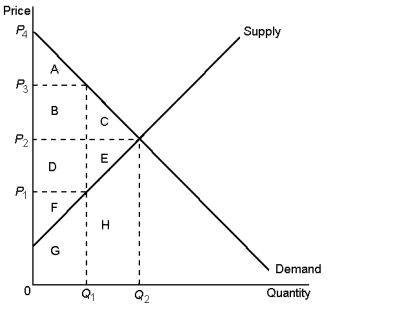 -In Graph 7-4, at the market-clearing equilibrium, total producer surplus is represented by the area:
Free
(Multiple Choice)
5.0/5 (73)
(73) Correct Answer:Verified
VerifiedC
Jean wants to sell her camera.Greg offers her $250.Lee offers her $300.We can say for sure that she will sell it to Lee, as he has offered the highest price.
(True/False)
4.9/5 (72)
(72) Lee can sell coffee at $3 per cup.The market equilibrium price of coffee is $3.50.Suppose Lee sells 100 cups of coffee.The producer surplus captured by Lee is $100.
(True/False)
4.7/5 (61)
(61) Graph 7-2  -Refer to Graph 7-2.When the price is P₁, consumer surplus is:
 (Multiple Choice)
4.9/5 (84)
(84) Use the information in Table A to graph a demand curve for this product.
(Essay)
4.9/5 (74)
(74) Each seller of a product is willing to sell as long as the price he or she can receive is less than the opportunity cost of producing the product.
(True/False)
4.8/5 (57)
(57) Nick's willingness to sell his homemade chocolate chip biscuits is $9 per dozen.He sells them and realises a producer surplus of $5 per dozen.Nick sells his biscuits for:
(Multiple Choice)
4.7/5 (70)
(70) Pollution and other externalities, while bothersome, do not interfere with efficiency.
(True/False)
4.9/5 (72)
(72) Many economists believe that a market for human organs would lead to an:
(Multiple Choice)
4.7/5 (71)
(71) For any given quantity, the price on a supply curve represents the marginal buyer's willingness to pay.
(True/False)
4.9/5 (81)
(81) What is the relationship between the willingness to sell and the supply curve?
(Essay)
4.7/5 (73)
(73) Information regarding the consumer's willingness to pay can be derived from the demand curve.
(True/False)
5.0/5 (84)
(84) If a seller is able to control the market price, the seller has market power and the market outcome will be inefficient.
(True/False)
4.8/5 (90)
(90) 
Filters
- Essay(0)
- Multiple Choice(0)
- Short Answer(0)
- True False(0)
- Matching(0)