



 Chat with AI
Exam 7: Consumers, Producers and the Efficiency of Markets

Exam 1: Ten Lessons From Economics146 Questions
Exam 2: Thinking Like an Economist133 Questions
Exam 3: Interdependence and the Gains From Trade139 Questions
Exam 4: The Market Forces of Supply and Demand215 Questions
Exam 5: Elasticity and Its Application178 Questions
Exam 6: Supply, Demand and Government Policies145 Questions
Exam 7: Consumers, Producers and the Efficiency of Markets171 Questions
Exam 8: Application: the Costs of Taxation135 Questions
Exam 9: Application: International Trade151 Questions
Exam 10: Externalities199 Questions
Exam 11: Public Goods and Common Resources178 Questions
Exam 12: The Design of the Tax System154 Questions
Exam 13: The Costs of Production191 Questions
Exam 14: Firms in Competitive Markets198 Questions
Exam 15: Monopoly212 Questions
Exam 16: Monopolistic Competition212 Questions
Exam 17: Business Strategy and Oligopoly179 Questions
Exam 18: Competition Policy103 Questions
Exam 19: The Markets for the Factors of Production214 Questions
Exam 20: Earnings, Unions and Discrimination201 Questions
Exam 21: Income Inequity and Poverty111 Questions
Exam 22: The Theory of Consumer Choice158 Questions
Exam 23: Frontiers of Microeconomics111 Questions
Exam 24: Measuring a Nations Income51 Questions
Exam 25: Measuring the Cost of Living55 Questions
Exam 26: Production and Growth62 Questions
Exam 27: Saving, Investment and the Financial System62 Questions
Exam 28: The Natural Rate of Unemployment58 Questions
Exam 29: The Monetary System66 Questions
Exam 30: Inflation: Its Causes and Costs74 Questions
Exam 31: Open-Economy Macroeconomics: Basic Concepts68 Questions
Exam 32: A Macroeconomic Theory of the Open Economy61 Questions
Exam 33: Aggregate Demand and Aggregate Supply81 Questions
Exam 34: The Influence of Monetary and Fiscal Policy on Aggregate Demand73 Questions
Exam 35: The Short-Run Trade-Off Between Inflation and Unemployment57 Questions
Exam 36: Global Financial Crisis of 2008 and Beyond37 Questions
Exam 37: Five Debates Over Macroeconomic Policy38 Questions
Select questions type


Lee is willing and able to pay $250 for an iPhone but is able to buy it for $199.Lee's consumer surplus is:
(Multiple Choice)
5.0/5  (86)
(86) A supply curve provides a graphical measure of a producer's true willingness to sell.
(True/False)
4.8/5 (77)
(77) Consumer surplus is the amount a buyer actually has to pay for a good minus the amount the buyer is willing to pay for it.
(True/False)
4.9/5 (72)
(72) The producer surplus in a market is the area above the price plus the area below the demand curve.
(True/False)
4.8/5 (67)
(67) Sharon is bidding on a new camera on an internet auction.She values the camera at $700 and wins the auction with a bid of $650, therefore:
(Multiple Choice)
4.8/5 (72)
(72) Peter owns a sawmill and produces timber for construction.He sells the timber for $250 per cubic metre.His production costs are $90 per cubic metre.His producer surplus is:
(Multiple Choice)
4.8/5 (83)
(83) Laissez-faire is a French expression that literally means 'let the market fare well'.
(True/False)
4.8/5 (77)
(77) Graph 7-3 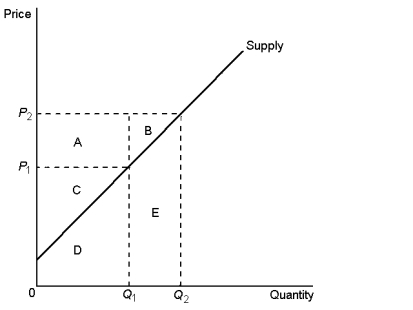 -According to Graph 7-3, when the price falls from P₂ to P₁, producer surplus:
 (Multiple Choice)
4.9/5 (78)
(78) Out-of-pocket expenses plus the value of the seller's own resources used in production are considered to be:
(Multiple Choice)
4.8/5 (68)
(68) Graph 7-2  -Refer to Graph 7-2.At the higher price P₂, consumer surplus is:
 (Multiple Choice)
5.0/5 (95)
(95) The tools of consumer surplus and producer surplus enables us to determine whether free-market allocation of resources is desirable.
(True/False)
4.7/5 (73)
(73) Graph 7-3
-Refer to Graph 7-3.When the price falls from P₂ to P₁, which of the following is NOT true?
-Refer to Graph 7-3.When the price falls from P₂ to P₁, which of the following is NOT true? (Multiple Choice)
4.8/5 (77)
(77) Total surplus in a market can be measured as the area below the supply curve and the area above the demand curve.
(True/False)
4.9/5 (83)
(83) A group of people are bidding on an internet auction for a used car.Each bidder will not bid more than a maximum amount that is unique to them.This maximum is called:
(Multiple Choice)
4.8/5 (86)
(86) Efficiency is related to the size of the economic pie, whereas equity is related to how the pie gets sliced and distributed.
(True/False)
5.0/5 (79)
(79) The cost of producing digital cameras decreases.As a result, the consumer surplus associated with digital cameras:
(Multiple Choice)
4.9/5 (79)
(79) Graph 7-3
-According to Graph 7-3, at the price P₁, producer surplus is:
-According to Graph 7-3, at the price P₁, producer surplus is: (Multiple Choice)
5.0/5 (74)
(74) 
Filters
- Essay(0)
- Multiple Choice(0)
- Short Answer(0)
- True False(0)
- Matching(0)