



 Chat with AI
Exam 7: Consumers, Producers and the Efficiency of Markets

Exam 1: Ten Lessons From Economics146 Questions
Exam 2: Thinking Like an Economist133 Questions
Exam 3: Interdependence and the Gains From Trade139 Questions
Exam 4: The Market Forces of Supply and Demand215 Questions
Exam 5: Elasticity and Its Application178 Questions
Exam 6: Supply, Demand and Government Policies145 Questions
Exam 7: Consumers, Producers and the Efficiency of Markets171 Questions
Exam 8: Application: the Costs of Taxation135 Questions
Exam 9: Application: International Trade151 Questions
Exam 10: Externalities199 Questions
Exam 11: Public Goods and Common Resources178 Questions
Exam 12: The Design of the Tax System154 Questions
Exam 13: The Costs of Production191 Questions
Exam 14: Firms in Competitive Markets198 Questions
Exam 15: Monopoly212 Questions
Exam 16: Monopolistic Competition212 Questions
Exam 17: Business Strategy and Oligopoly179 Questions
Exam 18: Competition Policy103 Questions
Exam 19: The Markets for the Factors of Production214 Questions
Exam 20: Earnings, Unions and Discrimination201 Questions
Exam 21: Income Inequity and Poverty111 Questions
Exam 22: The Theory of Consumer Choice158 Questions
Exam 23: Frontiers of Microeconomics111 Questions
Exam 24: Measuring a Nations Income51 Questions
Exam 25: Measuring the Cost of Living55 Questions
Exam 26: Production and Growth62 Questions
Exam 27: Saving, Investment and the Financial System62 Questions
Exam 28: The Natural Rate of Unemployment58 Questions
Exam 29: The Monetary System66 Questions
Exam 30: Inflation: Its Causes and Costs74 Questions
Exam 31: Open-Economy Macroeconomics: Basic Concepts68 Questions
Exam 32: A Macroeconomic Theory of the Open Economy61 Questions
Exam 33: Aggregate Demand and Aggregate Supply81 Questions
Exam 34: The Influence of Monetary and Fiscal Policy on Aggregate Demand73 Questions
Exam 35: The Short-Run Trade-Off Between Inflation and Unemployment57 Questions
Exam 36: Global Financial Crisis of 2008 and Beyond37 Questions
Exam 37: Five Debates Over Macroeconomic Policy38 Questions
Select questions type


Table 7-2
The costs of five possible sellers
-Refer to Table 7-2.If the price is $11 who will be willing to supply the product?
(Multiple Choice)
4.9/5  (90)
(90) The less elastic demand is, the higher the consumer surplus ceteris paribus.
(True/False)
4.8/5 (77)
(77) Graph 7-7 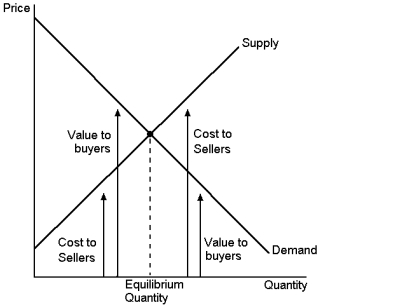 -Refer to Graph 7-7.Explain why this graph verifies the fact that the market equilibrium (quantity) maximises the sum of producer and consumer surplus.
 (Essay)
4.9/5 (79)
(79) Cameron visits a sporting goods store to buy a new set of golf clubs.He has willing to pay $950 for the clubs but buys them on sale for $425.Cameron's consumer surplus from the purchase is:
(Multiple Choice)
4.8/5 (70)
(70) Lucy often buys fish and is able to buy it for less than she is willing-to-pay.She later learns that fish has more health benefits than she realised.She now values fish even more than before.If the market price of fish does not change then:
(Multiple Choice)
4.9/5 (85)
(85) A perfectly competitive free market will maximise total surplus.
(True/False)
4.8/5 (70)
(70) The highest price a buyer is prepared to spend on a good, is that buyer's willingness to pay.
(True/False)
4.7/5 (97)
(97) Graph 7-1  -Refer to Graph 7-1.What area represents consumer surplus when the price is P₁?
 (Multiple Choice)
4.8/5 (71)
(71) Antonio's Pizza has the following willingness to sell:
Price Quantity supplied \ 15 28 \ 14 24 \ 13 20 \ 12 16 \ 11 12 \ 10 8 \ 9 4 <\ 9 0
Determine Antonio's producer surplus at a price of:
a.$10
b.$12
c.$15
d.$9
e.$7
(Short Answer)
4.9/5 (84)
(84) 
Filters
- Essay(0)
- Multiple Choice(0)
- Short Answer(0)
- True False(0)
- Matching(0)