



 Chat with AI
Exam 7: Consumers, Producers and the Efficiency of Markets

Exam 1: Ten Lessons From Economics146 Questions
Exam 2: Thinking Like an Economist133 Questions
Exam 3: Interdependence and the Gains From Trade139 Questions
Exam 4: The Market Forces of Supply and Demand215 Questions
Exam 5: Elasticity and Its Application178 Questions
Exam 6: Supply, Demand and Government Policies145 Questions
Exam 7: Consumers, Producers and the Efficiency of Markets171 Questions
Exam 8: Application: the Costs of Taxation135 Questions
Exam 9: Application: International Trade151 Questions
Exam 10: Externalities199 Questions
Exam 11: Public Goods and Common Resources178 Questions
Exam 12: The Design of the Tax System154 Questions
Exam 13: The Costs of Production191 Questions
Exam 14: Firms in Competitive Markets198 Questions
Exam 15: Monopoly212 Questions
Exam 16: Monopolistic Competition212 Questions
Exam 17: Business Strategy and Oligopoly179 Questions
Exam 18: Competition Policy103 Questions
Exam 19: The Markets for the Factors of Production214 Questions
Exam 20: Earnings, Unions and Discrimination201 Questions
Exam 21: Income Inequity and Poverty111 Questions
Exam 22: The Theory of Consumer Choice158 Questions
Exam 23: Frontiers of Microeconomics111 Questions
Exam 24: Measuring a Nations Income51 Questions
Exam 25: Measuring the Cost of Living55 Questions
Exam 26: Production and Growth62 Questions
Exam 27: Saving, Investment and the Financial System62 Questions
Exam 28: The Natural Rate of Unemployment58 Questions
Exam 29: The Monetary System66 Questions
Exam 30: Inflation: Its Causes and Costs74 Questions
Exam 31: Open-Economy Macroeconomics: Basic Concepts68 Questions
Exam 32: A Macroeconomic Theory of the Open Economy61 Questions
Exam 33: Aggregate Demand and Aggregate Supply81 Questions
Exam 34: The Influence of Monetary and Fiscal Policy on Aggregate Demand73 Questions
Exam 35: The Short-Run Trade-Off Between Inflation and Unemployment57 Questions
Exam 36: Global Financial Crisis of 2008 and Beyond37 Questions
Exam 37: Five Debates Over Macroeconomic Policy38 Questions
Select questions type


Amy buys a new computer for her studies for $1500.She receives consumer surplus of $250 from the purchase.How much does Amy value her computer?
(Multiple Choice)
4.8/5  (71)
(71) Gayle decides that she would pay as much as $900 for a new laptop computer.She buys the computer and realises a consumer surplus of $600.How much did Gayle pay for her computer?
(Multiple Choice)
4.9/5 (75)
(75) What is the relationship between the demand curve and the willingness to pay?
(Essay)
4.9/5 (71)
(71) Suppose the price of music downloads falls.Explain what will happen to:
a.existing buyers who were already downloading music.
b.potential buyers who have not yet begun downloading music.
c.the consumer surplus in this market.
d.the number of downloads that will now occur.
(Essay)
4.8/5 (82)
(82) Graph 7-6 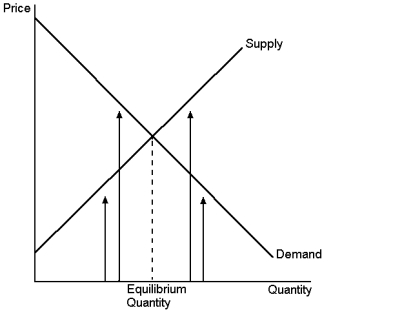 -In Graph 7-6, beyond the equilibrium quantity in a free market:
 (Multiple Choice)
4.9/5 (76)
(76) If you pay a price exactly equal to your willingness to pay, then:
(Multiple Choice)
4.9/5 (76)
(76) At all quantity levels the price given by the supply curve shows the cost of the lowest cost seller.
(True/False)
4.8/5 (78)
(78) A seller would be willing to sell a product ONLY if the price received is:
(Multiple Choice)
4.8/5 (80)
(80) 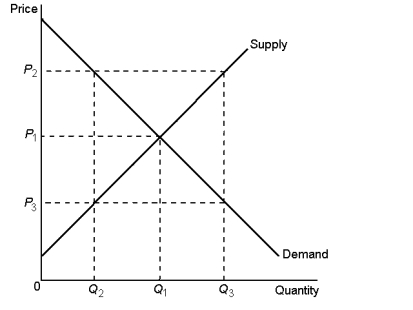 -In Graph 7-5, at the quantity Q₂:
If a consumer is not willing to purchase a product, her willingness to pay must be below the market price.
(True/False)
4.8/5 (72)
(72) In order for market outcomes to maximise the total benefits to buyers and sellers, the markets must be perfectly competitive.
(True/False)
4.8/5 (72)
(72) Other things being equal, if the price of a good falls, the consumer surplus:
(Multiple Choice)
4.8/5 (81)
(81) Suppose hail storms damage vineyards in South Australia.The supply of grapes to local winemakers declines.What happens to consumer surplus in the market for South Australian wine?
(Multiple Choice)
4.8/5 (87)
(87) Many economists believe that a market in human organs would lead to an efficient allocation of organs.
(True/False)
4.8/5 (78)
(78) Restrictions against ticket scalping actually drive up the cost of many tickets.
(True/False)
4.8/5 (84)
(84) 
Filters
- Essay(0)
- Multiple Choice(0)
- Short Answer(0)
- True False(0)
- Matching(0)