



 Chat with AI
Exam 7: Consumers, Producers and the Efficiency of Markets

Exam 1: Ten Lessons From Economics146 Questions
Exam 2: Thinking Like an Economist133 Questions
Exam 3: Interdependence and the Gains From Trade139 Questions
Exam 4: The Market Forces of Supply and Demand215 Questions
Exam 5: Elasticity and Its Application178 Questions
Exam 6: Supply, Demand and Government Policies145 Questions
Exam 7: Consumers, Producers and the Efficiency of Markets171 Questions
Exam 8: Application: the Costs of Taxation135 Questions
Exam 9: Application: International Trade151 Questions
Exam 10: Externalities199 Questions
Exam 11: Public Goods and Common Resources178 Questions
Exam 12: The Design of the Tax System154 Questions
Exam 13: The Costs of Production191 Questions
Exam 14: Firms in Competitive Markets198 Questions
Exam 15: Monopoly212 Questions
Exam 16: Monopolistic Competition212 Questions
Exam 17: Business Strategy and Oligopoly179 Questions
Exam 18: Competition Policy103 Questions
Exam 19: The Markets for the Factors of Production214 Questions
Exam 20: Earnings, Unions and Discrimination201 Questions
Exam 21: Income Inequity and Poverty111 Questions
Exam 22: The Theory of Consumer Choice158 Questions
Exam 23: Frontiers of Microeconomics111 Questions
Exam 24: Measuring a Nations Income51 Questions
Exam 25: Measuring the Cost of Living55 Questions
Exam 26: Production and Growth62 Questions
Exam 27: Saving, Investment and the Financial System62 Questions
Exam 28: The Natural Rate of Unemployment58 Questions
Exam 29: The Monetary System66 Questions
Exam 30: Inflation: Its Causes and Costs74 Questions
Exam 31: Open-Economy Macroeconomics: Basic Concepts68 Questions
Exam 32: A Macroeconomic Theory of the Open Economy61 Questions
Exam 33: Aggregate Demand and Aggregate Supply81 Questions
Exam 34: The Influence of Monetary and Fiscal Policy on Aggregate Demand73 Questions
Exam 35: The Short-Run Trade-Off Between Inflation and Unemployment57 Questions
Exam 36: Global Financial Crisis of 2008 and Beyond37 Questions
Exam 37: Five Debates Over Macroeconomic Policy38 Questions
Select questions type


Table 7-1
This table refers to five possible buyers' willingness to pay for good Z. Buyer Willingness to pay ( \ ) Cassie 15.00 Jamie 11.00 John 9.50 Jeremy 6.00 Sarah 4.50
-Refer to Table 7-1.If the price of good Z is $9.99, who will not purchase the good?
(Multiple Choice)
4.9/5  (83)
(83) We can say that the allocation of resources is efficient if:
(Multiple Choice)
4.9/5 (79)
(79) If the cost of producing automobiles increases, consumer surplus will:
(Multiple Choice)
4.9/5 (75)
(75) To measure the total consumer surplus in a market, the area above the demand curve is added to the area below the price.
(True/False)
4.8/5 (91)
(91) If all sellers in the market have an identical willingness to sell, then producer surplus will be zero.
(True/False)
4.7/5 (96)
(96) According to many economists, government restrictions on ticket scalping do all of the following EXCEPT:
(Multiple Choice)
4.9/5 (84)
(84) Graph 7-4 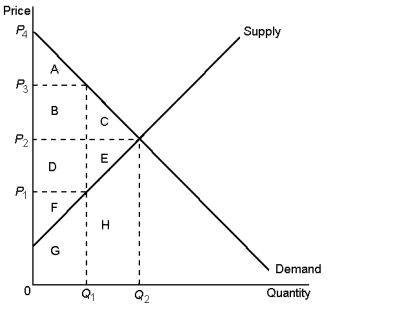 -In Graph 7-4, at the market-clearing equilibrium, total consumer surplus is represented by the area:
 (Multiple Choice)
4.8/5 (80)
(80) Table 7-1
This table refers to five possible buyers' willingness to pay for good Z. Buyer Willingness to pay ( \ ) Cassie 15.00 Jamie 11.00 John 9.50 Jeremy 6.00 Sarah 4.50
-Refer to Table 7-1.Which of the following is NOT true?
(Multiple Choice)
4.8/5 (70)
(70) Producer surplus is the amount a seller is paid minus the cost of production.
(True/False)
4.9/5 (75)
(75) Graph 7-1  -Refer to Graph 7-1.What area represents producer surplus when the price is P₁?
 (Multiple Choice)
4.8/5 (80)
(80) When a good is purchased, the difference between what a consumer is willing to pay and what they actually have to pay is consumer surplus.
(True/False)
4.9/5 (82)
(82) Costa and Soula sell lemonade on the corner for $0.20 per glass.Their producer surplus is $0.18 per glass.Their willingness to sell is:
(Multiple Choice)
4.8/5 (95)
(95) Suppose a market clears and this generates an equilibrium price and quantity.An important outcome of this equilibrium is that it maximises the total benefits to both buyers and sellers.
(True/False)
4.9/5 (87)
(87) Table 7-3
Market supply and demand for good X
-Refer to Table 7-3.At a price of $6.00, total surplus would be:
(Multiple Choice)
5.0/5 (72)
(72) Ticket scalping leads to a reduction in economic efficiency and therefore to a reduction in economic wellbeing.
(True/False)
4.9/5 (66)
(66) 
Filters
- Essay(0)
- Multiple Choice(0)
- Short Answer(0)
- True False(0)
- Matching(0)