



 Chat with AI
Exam 16: Monopolistic Competition

Exam 1: Ten Lessons From Economics146 Questions
Exam 2: Thinking Like an Economist133 Questions
Exam 3: Interdependence and the Gains From Trade139 Questions
Exam 4: The Market Forces of Supply and Demand215 Questions
Exam 5: Elasticity and Its Application178 Questions
Exam 6: Supply, Demand and Government Policies145 Questions
Exam 7: Consumers, Producers and the Efficiency of Markets171 Questions
Exam 8: Application: the Costs of Taxation135 Questions
Exam 9: Application: International Trade151 Questions
Exam 10: Externalities199 Questions
Exam 11: Public Goods and Common Resources178 Questions
Exam 12: The Design of the Tax System154 Questions
Exam 13: The Costs of Production191 Questions
Exam 14: Firms in Competitive Markets198 Questions
Exam 15: Monopoly212 Questions
Exam 16: Monopolistic Competition212 Questions
Exam 17: Business Strategy and Oligopoly179 Questions
Exam 18: Competition Policy103 Questions
Exam 19: The Markets for the Factors of Production214 Questions
Exam 20: Earnings, Unions and Discrimination201 Questions
Exam 21: Income Inequity and Poverty111 Questions
Exam 22: The Theory of Consumer Choice158 Questions
Exam 23: Frontiers of Microeconomics111 Questions
Exam 24: Measuring a Nations Income51 Questions
Exam 25: Measuring the Cost of Living55 Questions
Exam 26: Production and Growth62 Questions
Exam 27: Saving, Investment and the Financial System62 Questions
Exam 28: The Natural Rate of Unemployment58 Questions
Exam 29: The Monetary System66 Questions
Exam 30: Inflation: Its Causes and Costs74 Questions
Exam 31: Open-Economy Macroeconomics: Basic Concepts68 Questions
Exam 32: A Macroeconomic Theory of the Open Economy61 Questions
Exam 33: Aggregate Demand and Aggregate Supply81 Questions
Exam 34: The Influence of Monetary and Fiscal Policy on Aggregate Demand73 Questions
Exam 35: The Short-Run Trade-Off Between Inflation and Unemployment57 Questions
Exam 36: Global Financial Crisis of 2008 and Beyond37 Questions
Exam 37: Five Debates Over Macroeconomic Policy38 Questions
Select questions type


If brand names are efficient market mechanisms, banning them will lead to less competition and higher prices in the markets brand names from which they are absent.
(True/False)
4.7/5  (96)
(96) Long-run profit earned by a monopolistically competitive firm is driven to the competitive level due to a shift in:
(Multiple Choice)
4.8/5 (89)
(89) The profit-maximising rule for a firm in a monopolistically competitive market is to select the quantity at which:
(Multiple Choice)
4.8/5 (75)
(75) For many years, Pepsi operated a 'taste-test' booth across the US.Visitors to the booth would be encouraged to take a blind 'taste-test' between Pepsi and its primary market competitor, Coke.Pepsi then used the taste-test results in advertising Pepsi.What advertising theory does such an approach support? Pepsi no longer uses this as an advertising strategy, instead relying on celebrity endorsements and other forms of advertising.What advertising theory do you think now dominates the market between Pepsi and Coke? Explain.
(Essay)
4.8/5 (63)
(63) Brand names can improve product quality because firms will want to avoid the financial loss that would follow a fall in reputation.Firms will thus work harder to maintain high quality.
(True/False)
4.8/5 (78)
(78) In centrally planned economies the usefulness of brand names is demonstrated when brand names allow consumers to identify producers.
(True/False)
4.8/5 (63)
(63) A monopolistically competitive market can have too many firms enter, that is, the number of firms in a market can be greater than the socially optimal number.For there to be too much entry, which of the following needs to occur?
(Multiple Choice)
4.8/5 (75)
(75) Graph 17-4 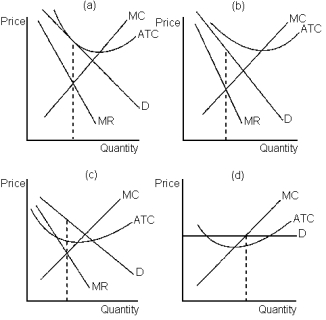 -Refer to Graph 17-4.Panel b in the set of figures shown is consistent with a firm in a monopolistically competitive market that is:
 (Multiple Choice)
4.8/5 (73)
(73) Critics of advertising make which of the following claims?
(i) advertising is informational rather than psychological
(ii) advertising manipulates people's tastes
(iii) advertising costs generally exceed labour costs
(Multiple Choice)
4.9/5 (81)
(81) What is the main point of difference between a monopolistically competitive market and an oligopoly?
(Multiple Choice)
4.7/5 (93)
(93) As developing countries make the transition to market-based economies, one of the first major capital investments is in 'Western-quality' hotels.Explain why the establishment of brand-name hotel accommodation is a critical step in attracting foreign investment.
(Essay)
4.8/5 (79)
(79) Graph 17-3  Lines in these figures reflect the potential effect of entry and exit in a monopolistically competitive market on the demand and/or marginal cost curves of incumbent firms.
-Refer to the graphs in 17-3.Which panel is consistent with a celebrity announcing her endorsement of a specific brand's product?
Lines in these figures reflect the potential effect of entry and exit in a monopolistically competitive market on the demand and/or marginal cost curves of incumbent firms.
-Refer to the graphs in 17-3.Which panel is consistent with a celebrity announcing her endorsement of a specific brand's product? (Multiple Choice)
4.8/5 (74)
(74) When McDonald's opens a store in Dhaka, Bangladesh, it will have an incentive to set product quality and customer service consistent with local standards.
(True/False)
4.7/5 (69)
(69) In the long-run equilibrium, a monopolistically competitive firm makes zero profit because:
(Multiple Choice)
4.9/5 (86)
(86) When a profit-maximising firm in a monopolistically competitive market is producing the short-run equilibrium quantity:
(Multiple Choice)
4.8/5 (82)
(82) Refer to the information provided.Under what circumstances will both firms choose to advertise?
(Multiple Choice)
4.7/5 (89)
(89) A firm in a monopolistically competitive market operates on the:
(Multiple Choice)
4.8/5 (69)
(69) The main reason that a monopolistically competitive market is considered inefficient is because:
(Multiple Choice)
4.9/5 (72)
(72) 
Filters
- Essay(0)
- Multiple Choice(0)
- Short Answer(0)
- True False(0)
- Matching(0)