



 Chat with AI
Exam 16: Monopolistic Competition

Exam 1: Ten Lessons From Economics146 Questions
Exam 2: Thinking Like an Economist133 Questions
Exam 3: Interdependence and the Gains From Trade139 Questions
Exam 4: The Market Forces of Supply and Demand215 Questions
Exam 5: Elasticity and Its Application178 Questions
Exam 6: Supply, Demand and Government Policies145 Questions
Exam 7: Consumers, Producers and the Efficiency of Markets171 Questions
Exam 8: Application: the Costs of Taxation135 Questions
Exam 9: Application: International Trade151 Questions
Exam 10: Externalities199 Questions
Exam 11: Public Goods and Common Resources178 Questions
Exam 12: The Design of the Tax System154 Questions
Exam 13: The Costs of Production191 Questions
Exam 14: Firms in Competitive Markets198 Questions
Exam 15: Monopoly212 Questions
Exam 16: Monopolistic Competition212 Questions
Exam 17: Business Strategy and Oligopoly179 Questions
Exam 18: Competition Policy103 Questions
Exam 19: The Markets for the Factors of Production214 Questions
Exam 20: Earnings, Unions and Discrimination201 Questions
Exam 21: Income Inequity and Poverty111 Questions
Exam 22: The Theory of Consumer Choice158 Questions
Exam 23: Frontiers of Microeconomics111 Questions
Exam 24: Measuring a Nations Income51 Questions
Exam 25: Measuring the Cost of Living55 Questions
Exam 26: Production and Growth62 Questions
Exam 27: Saving, Investment and the Financial System62 Questions
Exam 28: The Natural Rate of Unemployment58 Questions
Exam 29: The Monetary System66 Questions
Exam 30: Inflation: Its Causes and Costs74 Questions
Exam 31: Open-Economy Macroeconomics: Basic Concepts68 Questions
Exam 32: A Macroeconomic Theory of the Open Economy61 Questions
Exam 33: Aggregate Demand and Aggregate Supply81 Questions
Exam 34: The Influence of Monetary and Fiscal Policy on Aggregate Demand73 Questions
Exam 35: The Short-Run Trade-Off Between Inflation and Unemployment57 Questions
Exam 36: Global Financial Crisis of 2008 and Beyond37 Questions
Exam 37: Five Debates Over Macroeconomic Policy38 Questions
Select questions type


Empirical evidence suggests that advertising usually leads to an increase in the price of advertised products.
(True/False)
4.9/5  (87)
(87) Refer to the information provided.Consumer advocacy groups that have encouraged the Premier to restrict advertising of computer hardware on billboards are most likely to do so on the basis that advertising:
(Multiple Choice)
4.9/5 (73)
(73) Evaluate the following statement: 'Advertisements that use celebrity endorsements are devoid of any value and do not enhance the efficient functioning of markets'.
(Essay)
4.8/5 (80)
(80) In many university towns, private independent bookstores typically locate on the periphery of the campus.However, in some university towns, the university has used political power to restrict private bookstores near the campus through community zoning laws.Use your knowledge of markets to predict the price and quality of service difference in the market for university textbooks under these two different market regimes.
(Essay)
4.9/5 (68)
(68) If firms in a monopolistically competitive industry are making losses:
(Multiple Choice)
4.8/5 (78)
(78) Edward consumes Arnott's Tim Tams exclusively.He claims that there is a clear taste difference and that competing brands of chocolate biscuits leave an unsavoury residual taste in his mouth.However, in a blind taste test, Edward is found to prefer generic store brand chocolate biscuits to Tim Tams eight out of ten times.The results of Edward's taste test would be consistent with which of the following statements?
(Multiple Choice)
4.7/5 (87)
(87) The debate over whether society is wasting the resources it devotes to advertising has largely been resolved by which of the following groups?
(i) economists who study the tastes and preferences of individuals
(ii) psychologists who evaluate the manipulative effects of advertising
(iii) sociologists who document the destructive social forces inherent in advertising
(Multiple Choice)
4.9/5 (91)
(91) Whenever a monopolistically competitive firm marks price above marginal cost, the firm will make a profit.
(True/False)
4.8/5 (71)
(71) Policymakers do not accept the view that advertising enhances the efficiency of markets.
(True/False)
4.8/5 (86)
(86) Which of the following markets impose deadweight losses on society?
(i) monopoly
(ii) monopolistic competition
(iii) oligopoly
(Multiple Choice)
4.9/5 (78)
(78) Graph 17-1 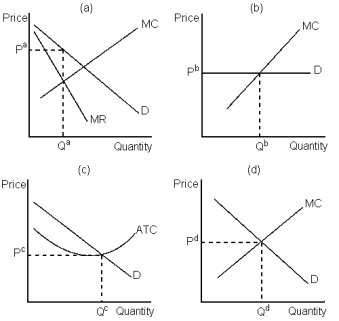 -Refer to Graph 17-1.If a firm in a monopolistically competitive market was producing the level of output depicted as Qd in panel d, it would:
 (Multiple Choice)
5.0/5 (71)
(71) Suppose that in the short run, a monopolistically competitive firm sells its product for $20 per unit.Its average total cost at the optimal level of output is $30.This means that:
(Multiple Choice)
4.9/5 (91)
(91) In the long run, the output of a monopolistically competitive firm will be:
(Multiple Choice)
4.8/5 (71)
(71) If the principal effect of advertising is to decrease the elasticity of demand, the critics argue that firms will be able to:
(Multiple Choice)
4.9/5 (82)
(82) If firms in a monopolistically competitive market are earning economic profits, which of the following scenarios would best reflect the change facing incumbent firms as the market adjusts to its new equilibrium?
(Multiple Choice)
4.8/5 (73)
(73) If firms in a monopolistically competitive market are making accounting profits, this will always encourage more firms to enter the market.
(True/False)
4.8/5 (87)
(87) Which of the following are attributes of a monopolistic competitive market?
(i) many firms competing for the same group of sellers
(ii) each firm produces a product that is slightly different from the other firms
(iii) in the long run, entry into the industry is restricted
(Multiple Choice)
4.9/5 (82)
(82) In a small university town, four micro-breweries have opened in the last two years.Demonstrate the effect of these new market entrants on demand for incumbent firms (micro-breweries) that already served this market.Assume that the local community now places a moratorium on new liquor licenses for micro-breweries.How will this moratorium affect the long-run profitability of incumbent firms?
(Essay)
4.8/5 (64)
(64) If an economic justification for advertising is that it enhances the ability of a market to allocate resources, then advertising is probably:
(Multiple Choice)
4.9/5 (87)
(87) 
Filters
- Essay(0)
- Multiple Choice(0)
- Short Answer(0)
- True False(0)
- Matching(0)