



 Chat with AI
Exam 16: Monopolistic Competition

Exam 1: Ten Lessons From Economics146 Questions
Exam 2: Thinking Like an Economist133 Questions
Exam 3: Interdependence and the Gains From Trade139 Questions
Exam 4: The Market Forces of Supply and Demand215 Questions
Exam 5: Elasticity and Its Application178 Questions
Exam 6: Supply, Demand and Government Policies145 Questions
Exam 7: Consumers, Producers and the Efficiency of Markets171 Questions
Exam 8: Application: the Costs of Taxation135 Questions
Exam 9: Application: International Trade151 Questions
Exam 10: Externalities199 Questions
Exam 11: Public Goods and Common Resources178 Questions
Exam 12: The Design of the Tax System154 Questions
Exam 13: The Costs of Production191 Questions
Exam 14: Firms in Competitive Markets198 Questions
Exam 15: Monopoly212 Questions
Exam 16: Monopolistic Competition212 Questions
Exam 17: Business Strategy and Oligopoly179 Questions
Exam 18: Competition Policy103 Questions
Exam 19: The Markets for the Factors of Production214 Questions
Exam 20: Earnings, Unions and Discrimination201 Questions
Exam 21: Income Inequity and Poverty111 Questions
Exam 22: The Theory of Consumer Choice158 Questions
Exam 23: Frontiers of Microeconomics111 Questions
Exam 24: Measuring a Nations Income51 Questions
Exam 25: Measuring the Cost of Living55 Questions
Exam 26: Production and Growth62 Questions
Exam 27: Saving, Investment and the Financial System62 Questions
Exam 28: The Natural Rate of Unemployment58 Questions
Exam 29: The Monetary System66 Questions
Exam 30: Inflation: Its Causes and Costs74 Questions
Exam 31: Open-Economy Macroeconomics: Basic Concepts68 Questions
Exam 32: A Macroeconomic Theory of the Open Economy61 Questions
Exam 33: Aggregate Demand and Aggregate Supply81 Questions
Exam 34: The Influence of Monetary and Fiscal Policy on Aggregate Demand73 Questions
Exam 35: The Short-Run Trade-Off Between Inflation and Unemployment57 Questions
Exam 36: Global Financial Crisis of 2008 and Beyond37 Questions
Exam 37: Five Debates Over Macroeconomic Policy38 Questions
Select questions type


When advertising encourages customers to become more informed about all firms in the market:
(Multiple Choice)
4.9/5  (68)
(68) Graph 17-3 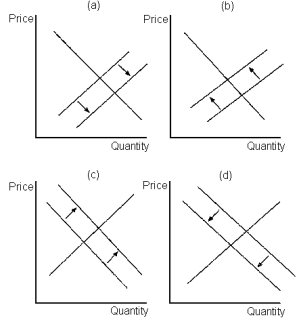 Lines in these figures reflect the potential effect of entry and exit in a monopolistically competitive market on the demand and/or marginal cost curves of incumbent firms.
-Refer to Graph 17-3.Panel c in the set of graphs shown depicts the effect on incumbent firms of:
Lines in these figures reflect the potential effect of entry and exit in a monopolistically competitive market on the demand and/or marginal cost curves of incumbent firms.
-Refer to Graph 17-3.Panel c in the set of graphs shown depicts the effect on incumbent firms of: (Multiple Choice)
5.0/5 (80)
(80) Firms that spend a large amount of money on advertising a particular product are likely to be providing consumers with a signal of product quality.
(True/False)
4.9/5 (80)
(80) Graph 17-3 Lines in these figures reflect the potential effect of entry and exit in a monopolistically competitive market on the demand and/or marginal cost curves of incumbent firms.
-Refer to Graph 17-3.Panel d in the set of figures shown depicts the effect on incumbent firms of:
Lines in these figures reflect the potential effect of entry and exit in a monopolistically competitive market on the demand and/or marginal cost curves of incumbent firms.
-Refer to Graph 17-3.Panel d in the set of figures shown depicts the effect on incumbent firms of: (Multiple Choice)
4.8/5 (88)
(88) In differentiated product markets that are characterised by advertising, evidence suggests that which of the following statements are true?
(i) markets are less efficient
(ii) consumers make better choices
(iii) in general, firms are less profitable
(Multiple Choice)
4.8/5 (90)
(90) For profit-maximising firms in a monopolistically competitive market, another customer means:
(Multiple Choice)
5.0/5 (76)
(76) Monopolistically competitive markets have two main sources of inefficiency: mark-up over marginal cost, and externalities associated with entry of new firms.Explain how these inefficiencies can have an impact on total welfare (Hint: there are both positive and negative externalities associated with firms entering the market).
(Essay)
4.9/5 (74)
(74) As in a monopoly market, monopolistically competitive firms:
(Multiple Choice)
4.9/5 (71)
(71) If a firm in a monopolistically competitive market uses advertising to decrease elasticity of demand for its product:
(Multiple Choice)
4.9/5 (87)
(87) Suppose a new competitor enters a market and the incumbent firms lose customers and profits.This means that a:
(Multiple Choice)
5.0/5 (78)
(78) Advertising can be used as a signal of product quality, even if the advertisement contains little information about the product.
(True/False)
4.8/5 (75)
(75) When firms in a monopolistically competitive market are said to experience excess capacity, this fact is:
(Multiple Choice)
4.8/5 (74)
(74) When firms are encouraged to enter monopolistically competitive markets:
(Multiple Choice)
4.8/5 (101)
(101) A profit-maximising firm in a monopolistically competitive market is eager for another customer because:
(Multiple Choice)
4.9/5 (87)
(87) Suppose a current-affairs investigation reveals that in a market that was monopolistically competitive all the goods are actually homogenous, that is, there is no differentiation between them.In the short run, the market is then most likely to represent:
(Multiple Choice)
4.9/5 (75)
(75) Monopolistic competition is characterised by which of the following attributes?
(i) many sellers
(ii) product differentiation
(iii) barriers to entry
(Multiple Choice)
4.9/5 (75)
(75) Which of the following are important differences between monopolistically competitive markets and monopoly markets?
(i) one market is efficient while the other entrails dead-weight losses
(ii) upward sloping marginal costs is only seen in one of the markets
(iii) long-run profits are possible in one but not the other
(Multiple Choice)
4.8/5 (83)
(83) Critics of advertisements that depict 'beautiful' human bodies as the primary focus of the message are likely to claim that the purpose of the advertisement is to create desires that do not already exist.
(True/False)
4.8/5 (89)
(89) According to the information provided, if Firm A decides to advertise its product, it can expect to:
(Multiple Choice)
4.9/5 (83)
(83) Which two curves are tangent in a monopolistically competitive market with zero economic profit?
(Multiple Choice)
4.8/5 (84)
(84) 
Filters
- Essay(0)
- Multiple Choice(0)
- Short Answer(0)
- True False(0)
- Matching(0)