



 Chat with AI
Exam 17: Business Strategy and Oligopoly

Exam 1: Ten Lessons From Economics146 Questions
Exam 2: Thinking Like an Economist133 Questions
Exam 3: Interdependence and the Gains From Trade139 Questions
Exam 4: The Market Forces of Supply and Demand215 Questions
Exam 5: Elasticity and Its Application178 Questions
Exam 6: Supply, Demand and Government Policies145 Questions
Exam 7: Consumers, Producers and the Efficiency of Markets171 Questions
Exam 8: Application: the Costs of Taxation135 Questions
Exam 9: Application: International Trade151 Questions
Exam 10: Externalities199 Questions
Exam 11: Public Goods and Common Resources178 Questions
Exam 12: The Design of the Tax System154 Questions
Exam 13: The Costs of Production191 Questions
Exam 14: Firms in Competitive Markets198 Questions
Exam 15: Monopoly212 Questions
Exam 16: Monopolistic Competition212 Questions
Exam 17: Business Strategy and Oligopoly179 Questions
Exam 18: Competition Policy103 Questions
Exam 19: The Markets for the Factors of Production214 Questions
Exam 20: Earnings, Unions and Discrimination201 Questions
Exam 21: Income Inequity and Poverty111 Questions
Exam 22: The Theory of Consumer Choice158 Questions
Exam 23: Frontiers of Microeconomics111 Questions
Exam 24: Measuring a Nations Income51 Questions
Exam 25: Measuring the Cost of Living55 Questions
Exam 26: Production and Growth62 Questions
Exam 27: Saving, Investment and the Financial System62 Questions
Exam 28: The Natural Rate of Unemployment58 Questions
Exam 29: The Monetary System66 Questions
Exam 30: Inflation: Its Causes and Costs74 Questions
Exam 31: Open-Economy Macroeconomics: Basic Concepts68 Questions
Exam 32: A Macroeconomic Theory of the Open Economy61 Questions
Exam 33: Aggregate Demand and Aggregate Supply81 Questions
Exam 34: The Influence of Monetary and Fiscal Policy on Aggregate Demand73 Questions
Exam 35: The Short-Run Trade-Off Between Inflation and Unemployment57 Questions
Exam 36: Global Financial Crisis of 2008 and Beyond37 Questions
Exam 37: Five Debates Over Macroeconomic Policy38 Questions
Select questions type


Total profit for an oligopolist is more than that of a perfectly competitive firm.
(True/False)
4.9/5  (66)
(66) As the number of firms in an oligopoly grows larger, what happens to the quantity produced?
(i) it approaches the socially optimal level
(ii) it increases
(iii) it decreases
(Multiple Choice)
4.9/5 (62)
(62) An oligopolist will increase production if the output effect is:
(Multiple Choice)
4.8/5 (77)
(77) Two fishing firms share a common fishery.One strategy available to the firms is to fish sustainably.This maintains a healthy breeding population of fish, and keeps the price of fish relatively high.The other strategy is to overfish.This reduces the breeding population and fish prices tend to fall.The game is represented in the following table: 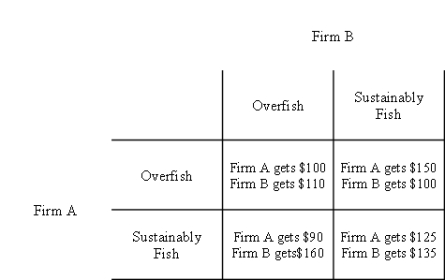 Explain what the Nash equilibrium for this game is and identify the profit each player gets at this solution.Is the Nash equilibrium the best social outcome for this problem?
 (Essay)
4.9/5 (90)
(90) In the case of oligopoly markets, self-interest prevents cooperation and leads to an inferior outcome for the parties involved.
(True/False)
4.7/5 (87)
(87) Table 16-8
Consider two countries, Eudora and the Inhabit, that are engaged in an arms race.The question each country must face is whether to build new weapons or to disarm existing weapons.Each country prefers to have more arms than the other because a large arsenal gives it more influence in world affairs.But each country also prefers to live in a world safe from the other country's weapons.The table shows the possible outcomes for each decision combination. 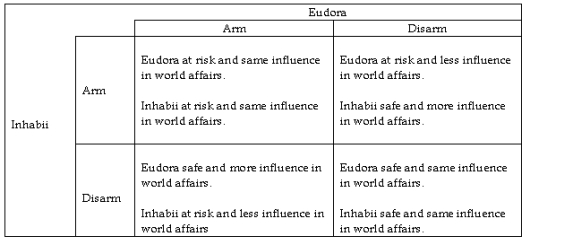 -Refer to the information provided.What will these two companies do if they behave as individual profit maximisers?
 (Multiple Choice)
5.0/5 (78)
(78) According to the information provided, Gargantuan Gas's dominant strategy would lead to what sort of well-drilling behaviour?
(Multiple Choice)
4.9/5 (78)
(78) When deciding which structure best describes a market, you will need to know which of the following?
(i) the number of sellers
(ii) the type of product being sold
(iii) the average fixed cost curves for the given firms
(Multiple Choice)
4.9/5 (82)
(82) Table 16-2
In the following duopoly game, the two firms can either set the price of their product high or low.The game is represented in the table below. Firm B High Price Low Price Firm A High Price Firm A gets \1 000 Firm A get \1 250 Firm B gets \1 000 Firm B gets \1 100 Low Price Firm A gets \8 00 Firm A gets \9 00 Firm B gets \8 00 Firm B gets \9 00
-Refer to Table 16-2.The Nash equilibrium for this game is for:
(Multiple Choice)
4.7/5 (91)
(91) Describe the source of tension between cooperation and self-interest in a market characterised by oligopoly.Use an example of an actual cartel arrangement to demonstrate why this tension creates instability in cartels.
(Essay)
4.9/5 (77)
(77) In which of the following prisoners' dilemma games is the non-cooperative outcome actually bad for society as well as for the players?
(i) oligopolists try to maintain monopoly profits
(ii) two countries are involved in an arms race
(iii) two oil producers act on their own self-interest when deciding how many wells to dig
(Multiple Choice)
4.8/5 (92)
(92) The logic of self-interest causes the duopoly's output level to be which of the following?
(i) above the monopoly level
(ii) above the oligopoly level
(iii) below the competitive level
(Multiple Choice)
4.7/5 (76)
(76) Why is a lack of cooperation between criminal suspects desirable for society as a whole?
(Multiple Choice)
4.7/5 (81)
(81) Monopolistically competitive firms are typically characterised by:
(Multiple Choice)
4.8/5 (85)
(85) According to the information provided, the fact that both countries have colluded to earn higher profit shows their desire to keep production levels:
(Multiple Choice)
4.8/5 (73)
(73) Table 16-8
Consider two countries, Eudora and the Inhabit, that are engaged in an arms race.The question each country must face is whether to build new weapons or to disarm existing weapons.Each country prefers to have more arms than the other because a large arsenal gives it more influence in world affairs.But each country also prefers to live in a world safe from the other country's weapons.The table shows the possible outcomes for each decision combination.
-Refer to Table 16-8.In reality these two countries may have a hard time keeping arms levels at the social optimal level due to which of the following reasons?
(i) both countries have incentives to cheat on the agreement
(ii) they may have trouble agreeing on the level of allowable arms
(iii) they both want to increase their world power
-Refer to Table 16-8.In reality these two countries may have a hard time keeping arms levels at the social optimal level due to which of the following reasons?
(i) both countries have incentives to cheat on the agreement
(ii) they may have trouble agreeing on the level of allowable arms
(iii) they both want to increase their world power (Multiple Choice)
4.8/5 (83)
(83) If duopolists individually pursue their own self-interest when deciding how much to produce, the price they are able to charge for their product will be equal to the monopoly price.
(True/False)
4.8/5 (74)
(74) Table 16-5
Consider the following Duopoly game. Firm B U D Firm A U Firm A gets \1 40 Firm A get \2 20 Firm B gets \8 0 Firm B gets \1 60 D Firm A gets \1 60 Firm A gets \8 0 Firm B gets \2 20 Firm B gets \1 00
-Refer to Table 16-5.If both firms follow a dominant strategy, firm A's profits (losses) will be:
(Multiple Choice)
4.8/5 (83)
(83) What is OPEC and how effective was it at colluding to maintain high prices for its product?
(Essay)
4.8/5 (79)
(79) Refer to the information provided.In a non-repetitive game, which of the following is the dominant strategy of Irun when production levels are in accordance with the collusive agreement?
(Multiple Choice)
4.9/5 (87)
(87) 
Filters
- Essay(0)
- Multiple Choice(0)
- Short Answer(0)
- True False(0)
- Matching(0)