



 Chat with AI
Exam 9: Application: International Trade

Exam 1: Ten Lessons From Economics146 Questions
Exam 2: Thinking Like an Economist133 Questions
Exam 3: Interdependence and the Gains From Trade139 Questions
Exam 4: The Market Forces of Supply and Demand215 Questions
Exam 5: Elasticity and Its Application178 Questions
Exam 6: Supply, Demand and Government Policies145 Questions
Exam 7: Consumers, Producers and the Efficiency of Markets171 Questions
Exam 8: Application: the Costs of Taxation135 Questions
Exam 9: Application: International Trade151 Questions
Exam 10: Externalities199 Questions
Exam 11: Public Goods and Common Resources178 Questions
Exam 12: The Design of the Tax System154 Questions
Exam 13: The Costs of Production191 Questions
Exam 14: Firms in Competitive Markets198 Questions
Exam 15: Monopoly212 Questions
Exam 16: Monopolistic Competition212 Questions
Exam 17: Business Strategy and Oligopoly179 Questions
Exam 18: Competition Policy103 Questions
Exam 19: The Markets for the Factors of Production214 Questions
Exam 20: Earnings, Unions and Discrimination201 Questions
Exam 21: Income Inequity and Poverty111 Questions
Exam 22: The Theory of Consumer Choice158 Questions
Exam 23: Frontiers of Microeconomics111 Questions
Exam 24: Measuring a Nations Income51 Questions
Exam 25: Measuring the Cost of Living55 Questions
Exam 26: Production and Growth62 Questions
Exam 27: Saving, Investment and the Financial System62 Questions
Exam 28: The Natural Rate of Unemployment58 Questions
Exam 29: The Monetary System66 Questions
Exam 30: Inflation: Its Causes and Costs74 Questions
Exam 31: Open-Economy Macroeconomics: Basic Concepts68 Questions
Exam 32: A Macroeconomic Theory of the Open Economy61 Questions
Exam 33: Aggregate Demand and Aggregate Supply81 Questions
Exam 34: The Influence of Monetary and Fiscal Policy on Aggregate Demand73 Questions
Exam 35: The Short-Run Trade-Off Between Inflation and Unemployment57 Questions
Exam 36: Global Financial Crisis of 2008 and Beyond37 Questions
Exam 37: Five Debates Over Macroeconomic Policy38 Questions
Select questions type


Graph 9-6
This graph refers to the market for oil in Spain. 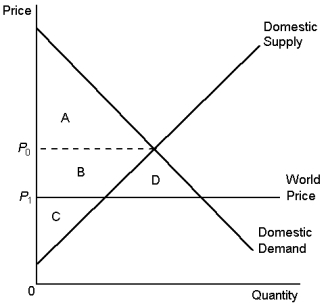 -According to Graph 9-6, the change in total surplus in Spain because of trade would be:
 (Multiple Choice)
4.7/5  (72)
(72) Most economists argue that international trade increases social welfare.What are some of the other benefits of international trade?
(Essay)
4.9/5 (84)
(84) Graph 9-9 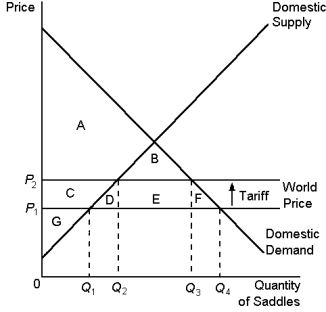 -In Graph 9-9, producer surplus after the tariff would be:
 (Multiple Choice)
4.7/5 (75)
(75) Graph 9-9
-In Graph 9-9, as a result of the tariff, deadweight loss would be:
-In Graph 9-9, as a result of the tariff, deadweight loss would be: (Multiple Choice)
5.0/5 (74)
(74) Graph 9-1
This graph refers to the market for beef in Japan.  -According to Graph 9-1, if the world price rose to $6 and trade in beef is allowed, the price of beef in Japan will be:
 (Multiple Choice)
4.9/5 (76)
(76) Australia is considering whether it should import palm oil from Indonesia.If the Australian government is only interested in increasing consumer surplus, what factors should it take into account when deciding whether to import the palm oil?
(Essay)
4.9/5 (88)
(88) The Closer Economic Relations agreement between New Zealand and Australia is designed to ensure that Australia can exercise its absolute advantage.
(True/False)
4.8/5 (81)
(81) When a country allows trade and becomes an exporter of a good, consumer surplus:
(Multiple Choice)
4.8/5 (88)
(88) The decrease in total surplus that results from a tariff or quota is called the gains from trade.
(True/False)
4.9/5 (77)
(77) If the price of torches in Estonia is $100 and the world price is $150, how would producer surplus change if Estonia opened to world trade?
(Multiple Choice)
4.9/5 (73)
(73) France imports a lot of snow peas from Africa.This means that France has comparative advantage in producing snow peas.
(True/False)
4.8/5 (73)
(73) If France has a comparative advantage in producing cheese and it allows trade:
(Multiple Choice)
4.8/5 (70)
(70) Graph 9-4
This graph refers to the market for kiwifruit in New Zealand. 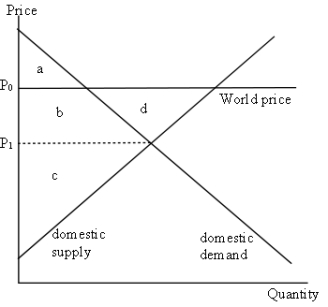 -According to Graph 9-4, producer surplus in New Zealand after trade is:
 (Multiple Choice)
4.8/5 (83)
(83) Graph 9-6
This graph refers to the market for oil in Spain.
-According to Graph 9-6, consumer surplus in Spain before trade would be:
-According to Graph 9-6, consumer surplus in Spain before trade would be: (Multiple Choice)
4.9/5 (78)
(78) If the domestic price of a good is low relative to the world price, the country has a comparative advantage in producing that good.
(True/False)
4.9/5 (90)
(90) Many economists oppose the infant industry argument because it is difficult to remove.
(True/False)
4.8/5 (76)
(76) Graph 9-9
-In Graph 9-9, consumer surplus after the tariff would be:
-In Graph 9-9, consumer surplus after the tariff would be: (Multiple Choice)
4.9/5 (94)
(94) Without free trade, the import price of a good must be equal to the export price of a good.
(True/False)
4.9/5 (76)
(76) Suppose that China can produce every product at an absolutely lower cost than can Australia.Does it pay for China to trade with Australia? Explain.
(Essay)
4.8/5 (77)
(77) 
Filters
- Essay(0)
- Multiple Choice(0)
- Short Answer(0)
- True False(0)
- Matching(0)