



 Chat with AI
Exam 2: Thinking Like an Economist

Exam 1: Ten Lessons From Economics146 Questions
Exam 2: Thinking Like an Economist133 Questions
Exam 3: Interdependence and the Gains From Trade139 Questions
Exam 4: The Market Forces of Supply and Demand215 Questions
Exam 5: Elasticity and Its Application178 Questions
Exam 6: Supply, Demand and Government Policies145 Questions
Exam 7: Consumers, Producers and the Efficiency of Markets171 Questions
Exam 8: Application: the Costs of Taxation135 Questions
Exam 9: Application: International Trade151 Questions
Exam 10: Externalities199 Questions
Exam 11: Public Goods and Common Resources178 Questions
Exam 12: The Design of the Tax System154 Questions
Exam 13: The Costs of Production191 Questions
Exam 14: Firms in Competitive Markets198 Questions
Exam 15: Monopoly212 Questions
Exam 16: Monopolistic Competition212 Questions
Exam 17: Business Strategy and Oligopoly179 Questions
Exam 18: Competition Policy103 Questions
Exam 19: The Markets for the Factors of Production214 Questions
Exam 20: Earnings, Unions and Discrimination201 Questions
Exam 21: Income Inequity and Poverty111 Questions
Exam 22: The Theory of Consumer Choice158 Questions
Exam 23: Frontiers of Microeconomics111 Questions
Exam 24: Measuring a Nations Income51 Questions
Exam 25: Measuring the Cost of Living55 Questions
Exam 26: Production and Growth62 Questions
Exam 27: Saving, Investment and the Financial System62 Questions
Exam 28: The Natural Rate of Unemployment58 Questions
Exam 29: The Monetary System66 Questions
Exam 30: Inflation: Its Causes and Costs74 Questions
Exam 31: Open-Economy Macroeconomics: Basic Concepts68 Questions
Exam 32: A Macroeconomic Theory of the Open Economy61 Questions
Exam 33: Aggregate Demand and Aggregate Supply81 Questions
Exam 34: The Influence of Monetary and Fiscal Policy on Aggregate Demand73 Questions
Exam 35: The Short-Run Trade-Off Between Inflation and Unemployment57 Questions
Exam 36: Global Financial Crisis of 2008 and Beyond37 Questions
Exam 37: Five Debates Over Macroeconomic Policy38 Questions
Select questions type


Graph 2-9 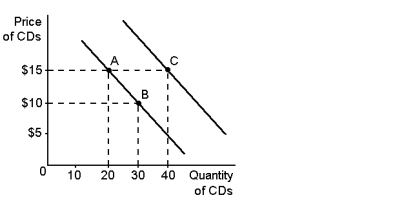 -Refer to Graph 2-9.In the graph shown, the movement from point A to point C is a:
 (Multiple Choice)
4.8/5  (81)
(81) Both scientists and economists make assumptions to simplify their analysis.
(True/False)
4.9/5 (70)
(70) Factors of production are factors like labour, land and capital.
(True/False)
4.8/5 (66)
(66) Graph 2-4 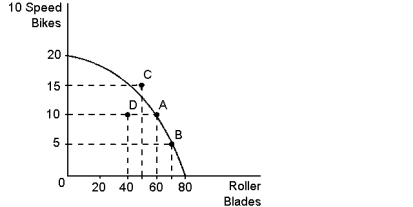 -Refer to Graph 2-4.On the production possibilities frontier shown, the opportunity cost of moving from point A to point D is:
 (Multiple Choice)
4.8/5 (84)
(84) The revenue that households receive from selling the factors of production can be described as:
(Multiple Choice)
4.8/5 (81)
(81) Which of the following is an example of a positive statement?
(Multiple Choice)
4.9/5 (71)
(71) If computers become easier to produce because of technological improvements, then producing more computers will mean a larger trade-off in the production of other goods.
(True/False)
4.9/5 (87)
(87) An economist who says that all policy decisions are easy is an economist not to be trusted.
(True/False)
4.9/5 (89)
(89) Graph 2-4
-Refer to Graph 2-4.On the production possibilities frontier shown, the opportunity cost of getting five additional bikes by moving from point A to point C is:
-Refer to Graph 2-4.On the production possibilities frontier shown, the opportunity cost of getting five additional bikes by moving from point A to point C is: (Multiple Choice)
4.8/5 (75)
(75) Most economic theories have been developed and tested by using controlled experiments.
(True/False)
5.0/5 (81)
(81) If we know an assumption about an economic system is not true, what is the justification for keeping this assumption in a model?
(Essay)
4.8/5 (84)
(84) The efficient production points for the production possibilities frontier, all lie on the actual frontier itself.
(True/False)
4.9/5 (90)
(90) Economic models always attempt to include as many real life factors as possible.
(True/False)
4.8/5 (74)
(74) Economists may disagree on how the government can reduce unemployment.
(True/False)
4.9/5 (83)
(83) The parameters chosen by economists may be a reason why differences of judgements result from the same issue.
(True/False)
5.0/5 (80)
(80) 
Filters
- Essay(0)
- Multiple Choice(0)
- Short Answer(0)
- True False(0)
- Matching(0)