



 Chat with AI
Exam 8: Application: the Costs of Taxation

Exam 1: Ten Lessons From Economics146 Questions
Exam 2: Thinking Like an Economist133 Questions
Exam 3: Interdependence and the Gains From Trade139 Questions
Exam 4: The Market Forces of Supply and Demand215 Questions
Exam 5: Elasticity and Its Application178 Questions
Exam 6: Supply, Demand and Government Policies145 Questions
Exam 7: Consumers, Producers and the Efficiency of Markets171 Questions
Exam 8: Application: the Costs of Taxation135 Questions
Exam 9: Application: International Trade151 Questions
Exam 10: Externalities199 Questions
Exam 11: Public Goods and Common Resources178 Questions
Exam 12: The Design of the Tax System154 Questions
Exam 13: The Costs of Production191 Questions
Exam 14: Firms in Competitive Markets198 Questions
Exam 15: Monopoly212 Questions
Exam 16: Monopolistic Competition212 Questions
Exam 17: Business Strategy and Oligopoly179 Questions
Exam 18: Competition Policy103 Questions
Exam 19: The Markets for the Factors of Production214 Questions
Exam 20: Earnings, Unions and Discrimination201 Questions
Exam 21: Income Inequity and Poverty111 Questions
Exam 22: The Theory of Consumer Choice158 Questions
Exam 23: Frontiers of Microeconomics111 Questions
Exam 24: Measuring a Nations Income51 Questions
Exam 25: Measuring the Cost of Living55 Questions
Exam 26: Production and Growth62 Questions
Exam 27: Saving, Investment and the Financial System62 Questions
Exam 28: The Natural Rate of Unemployment58 Questions
Exam 29: The Monetary System66 Questions
Exam 30: Inflation: Its Causes and Costs74 Questions
Exam 31: Open-Economy Macroeconomics: Basic Concepts68 Questions
Exam 32: A Macroeconomic Theory of the Open Economy61 Questions
Exam 33: Aggregate Demand and Aggregate Supply81 Questions
Exam 34: The Influence of Monetary and Fiscal Policy on Aggregate Demand73 Questions
Exam 35: The Short-Run Trade-Off Between Inflation and Unemployment57 Questions
Exam 36: Global Financial Crisis of 2008 and Beyond37 Questions
Exam 37: Five Debates Over Macroeconomic Policy38 Questions
Select questions type


Suppose Australia puts the same tax on cycads harvested in the wild and ornamental ferns sold in nurseries.Cycads are a very slow growing plant that is subject to a small, regular harvest in the wild, often by Aborigines.Assume that the tax is the same for both plants and that the elasticity of demand is the same for both plants.What would be the difference in the tax burden for these cycads and ferns and why?
(Essay)
4.9/5  (70)
(70) A tax levied on the supplier of a product shifts the demand curve downward or to the left.
(True/False)
4.8/5 (77)
(77) If the government tripled the taxes on new cameras, the deadweight loss from the camera tax would:
(Multiple Choice)
4.8/5 (86)
(86) Graph 8-1 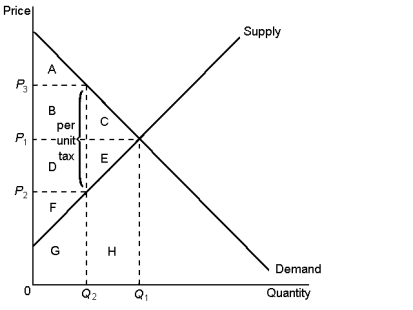 -According to Graph 8-1, the benefits to the government (total tax revenue) is represented by area:
 (Multiple Choice)
4.9/5 (74)
(74) A tax raises the price received by sellers and lowers the price paid by buyers.
(True/False)
4.8/5 (81)
(81) What is the relationship between a change in the size of a tax and the change in the deadweight loss from the tax?
(Essay)
5.0/5 (72)
(72) The deadweight loss of taxation may be less than supply and demand analysis suggests as some economic activity may be forced "under the table" where it is not counted in official figures.
(True/False)
4.7/5 (69)
(69) Suppose the Government is looking to raise revenue by taxing a market and has hired you for advice on minimising the deadweight loss of taxation.In identifying which market to tax, you would advise the government to choose a market where:
(Multiple Choice)
4.9/5 (82)
(82) Graph 8-1
-According to Graph 8-1, the tax caused a reduction in producer surplus, it is represented by area:
-According to Graph 8-1, the tax caused a reduction in producer surplus, it is represented by area: (Multiple Choice)
4.9/5 (79)
(79) Tax cuts and deregulation may cause output in an economy to increase by each of the following, except:
(Multiple Choice)
5.0/5 (67)
(67) Economists disagree on whether labour taxes have a small or a large deadweight loss.
(True/False)
4.9/5 (82)
(82) According to the information provided, assume that Joe is required to pay a tax of $60 when he hires someone to clean his house.Which of the following is true?
(Multiple Choice)
4.8/5 (82)
(82) Assume that the demand for salt is relatively inelastic and the demand for orange juice is relatively elastic.Compared to the deadweight loss from the same percentage tax on orange juice, the deadweight loss from imposing a tax on salt would be:
(Multiple Choice)
4.7/5 (85)
(85) Graph 8-1
-According to Graph 8-1, the tax caused a reduction in consumer surplus, it is represented by area:
-According to Graph 8-1, the tax caused a reduction in consumer surplus, it is represented by area: (Multiple Choice)
4.9/5 (84)
(84) One of the important economic costs of imposing taxes on a market is the deadweight loss.
(True/False)
4.7/5 (69)
(69) Graph 8-2 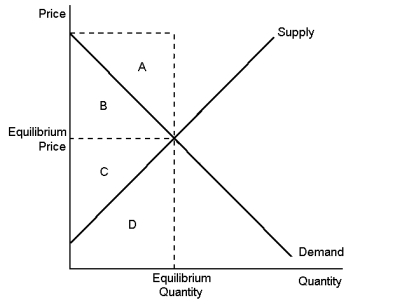 This graph shows supply and demand in a free market.
-According to Graph 8-2, when the market is in equilibrium, producer surplus is represented by area:
This graph shows supply and demand in a free market.
-According to Graph 8-2, when the market is in equilibrium, producer surplus is represented by area: (Multiple Choice)
4.9/5 (92)
(92) Graph 8-3 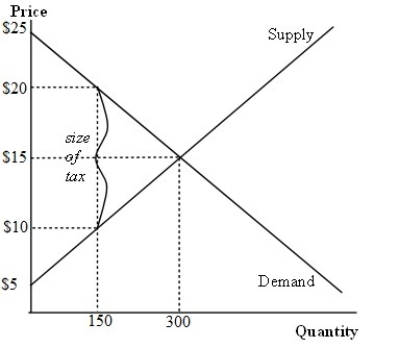 -According to Graph 8-3, producer surplus before the tax equals:
 (Multiple Choice)
4.8/5 (83)
(83) If the supply of land is fixed, a tax on land would be paid:
(Multiple Choice)
4.8/5 (85)
(85) 
Filters
- Essay(0)
- Multiple Choice(0)
- Short Answer(0)
- True False(0)
- Matching(0)