



 Chat with AI
Exam 8: Application: the Costs of Taxation

Exam 1: Ten Lessons From Economics146 Questions
Exam 2: Thinking Like an Economist133 Questions
Exam 3: Interdependence and the Gains From Trade139 Questions
Exam 4: The Market Forces of Supply and Demand215 Questions
Exam 5: Elasticity and Its Application178 Questions
Exam 6: Supply, Demand and Government Policies145 Questions
Exam 7: Consumers, Producers and the Efficiency of Markets171 Questions
Exam 8: Application: the Costs of Taxation135 Questions
Exam 9: Application: International Trade151 Questions
Exam 10: Externalities199 Questions
Exam 11: Public Goods and Common Resources178 Questions
Exam 12: The Design of the Tax System154 Questions
Exam 13: The Costs of Production191 Questions
Exam 14: Firms in Competitive Markets198 Questions
Exam 15: Monopoly212 Questions
Exam 16: Monopolistic Competition212 Questions
Exam 17: Business Strategy and Oligopoly179 Questions
Exam 18: Competition Policy103 Questions
Exam 19: The Markets for the Factors of Production214 Questions
Exam 20: Earnings, Unions and Discrimination201 Questions
Exam 21: Income Inequity and Poverty111 Questions
Exam 22: The Theory of Consumer Choice158 Questions
Exam 23: Frontiers of Microeconomics111 Questions
Exam 24: Measuring a Nations Income51 Questions
Exam 25: Measuring the Cost of Living55 Questions
Exam 26: Production and Growth62 Questions
Exam 27: Saving, Investment and the Financial System62 Questions
Exam 28: The Natural Rate of Unemployment58 Questions
Exam 29: The Monetary System66 Questions
Exam 30: Inflation: Its Causes and Costs74 Questions
Exam 31: Open-Economy Macroeconomics: Basic Concepts68 Questions
Exam 32: A Macroeconomic Theory of the Open Economy61 Questions
Exam 33: Aggregate Demand and Aggregate Supply81 Questions
Exam 34: The Influence of Monetary and Fiscal Policy on Aggregate Demand73 Questions
Exam 35: The Short-Run Trade-Off Between Inflation and Unemployment57 Questions
Exam 36: Global Financial Crisis of 2008 and Beyond37 Questions
Exam 37: Five Debates Over Macroeconomic Policy38 Questions
Select questions type


The marginal tax rate on labour income for many workers in Australia is almost:
(Multiple Choice)
4.8/5  (70)
(70) A tax on luxuries will create a smaller deadweight loss than will the same tax on necessities, ceteris paribus.
(True/False)
4.7/5 (71)
(71) Graph 8-3 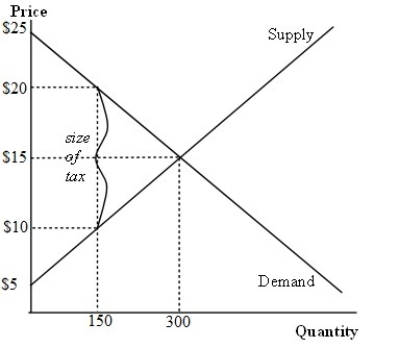 -According to Graph 8-3, after the tax is levied, producer surplus is:
 (Multiple Choice)
4.8/5 (101)
(101) Graph 8-3
-According to Graph 8-3, the amount of deadweight loss in this market resulting from the levying of the tax is:
-According to Graph 8-3, the amount of deadweight loss in this market resulting from the levying of the tax is: (Multiple Choice)
4.9/5 (67)
(67) Graph 8-1 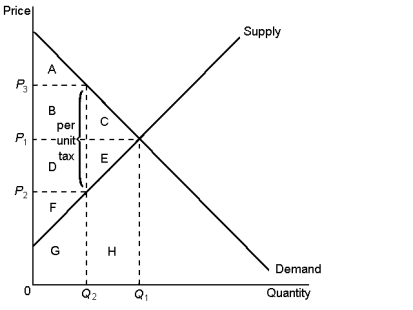 -According to Graph 8-1, after the tax is levied, producer surplus is represented by area:
 (Multiple Choice)
4.7/5 (69)
(69) Graph 8-2 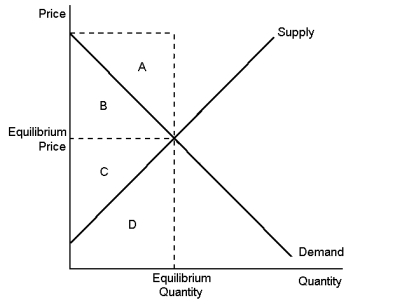 This graph shows supply and demand in a free market.
-According to Graph 8-2, if the market is in equilibrium, consumer surplus is represented by area:
This graph shows supply and demand in a free market.
-According to Graph 8-2, if the market is in equilibrium, consumer surplus is represented by area: (Multiple Choice)
4.8/5 (90)
(90) Sachin has agreed to mow his sister Darien's lawn each week, for $35.Sachin's opportunity cost is $22, and Darien would be willing to pay $27 to have her lawn mown.What is the maximum tax the government can impose on lawn mowing without discouraging Sachin and Darien from continuing their mutually beneficial arrangement?
(Essay)
5.0/5 (95)
(95) Often the tax revenue collected by the government equals the reduced welfare of buyers and sellers caused by the tax.
(True/False)
4.8/5 (84)
(84) A tax places a wedge between the price buyers pay and the price sellers receive.
(True/False)
4.8/5 (78)
(78) Since the amount of land is fixed, the total supply of land is:
(Multiple Choice)
4.9/5 (79)
(79) Taxes cause inefficiencies only when government revenue is less than the deadweight loss.
(True/False)
4.7/5 (86)
(86) Economists disagree on the issue of how much labour taxes distort the outcome in labour markets and create deadweight loss.What characteristic of labour supply is at the heart of the disagreement?
(Essay)
4.9/5 (90)
(90) The benefit received by the government from a tax is measured by:
(Multiple Choice)
4.7/5 (85)
(85) Because taxes distort incentives, they cause markets to allocate resources inefficiently.
(True/False)
4.9/5 (81)
(81) When a tax is levied on a good buyers are worse off but not sellers.
(True/False)
5.0/5 (94)
(94) The less freedom people are given to choose the date of their retirement the:
(Multiple Choice)
4.9/5 (80)
(80) According to the information provided, the total gain in welfare due to the transaction described here is:
(Multiple Choice)
4.8/5 (99)
(99) Graph 8-3
-According to Graph 8-3, the total surplus (consumer, producer and government) with the tax is:
-According to Graph 8-3, the total surplus (consumer, producer and government) with the tax is: (Multiple Choice)
5.0/5 (79)
(79) Graph 8-1
-According to Graph 8-1, the price buyers pay after the tax is:
-According to Graph 8-1, the price buyers pay after the tax is: (Multiple Choice)
5.0/5 (86)
(86) 
Filters
- Essay(0)
- Multiple Choice(0)
- Short Answer(0)
- True False(0)
- Matching(0)