



 Chat with AI
Exam 8: Application: the Costs of Taxation

Exam 1: Ten Lessons From Economics146 Questions
Exam 2: Thinking Like an Economist133 Questions
Exam 3: Interdependence and the Gains From Trade139 Questions
Exam 4: The Market Forces of Supply and Demand215 Questions
Exam 5: Elasticity and Its Application178 Questions
Exam 6: Supply, Demand and Government Policies145 Questions
Exam 7: Consumers, Producers and the Efficiency of Markets171 Questions
Exam 8: Application: the Costs of Taxation135 Questions
Exam 9: Application: International Trade151 Questions
Exam 10: Externalities199 Questions
Exam 11: Public Goods and Common Resources178 Questions
Exam 12: The Design of the Tax System154 Questions
Exam 13: The Costs of Production191 Questions
Exam 14: Firms in Competitive Markets198 Questions
Exam 15: Monopoly212 Questions
Exam 16: Monopolistic Competition212 Questions
Exam 17: Business Strategy and Oligopoly179 Questions
Exam 18: Competition Policy103 Questions
Exam 19: The Markets for the Factors of Production214 Questions
Exam 20: Earnings, Unions and Discrimination201 Questions
Exam 21: Income Inequity and Poverty111 Questions
Exam 22: The Theory of Consumer Choice158 Questions
Exam 23: Frontiers of Microeconomics111 Questions
Exam 24: Measuring a Nations Income51 Questions
Exam 25: Measuring the Cost of Living55 Questions
Exam 26: Production and Growth62 Questions
Exam 27: Saving, Investment and the Financial System62 Questions
Exam 28: The Natural Rate of Unemployment58 Questions
Exam 29: The Monetary System66 Questions
Exam 30: Inflation: Its Causes and Costs74 Questions
Exam 31: Open-Economy Macroeconomics: Basic Concepts68 Questions
Exam 32: A Macroeconomic Theory of the Open Economy61 Questions
Exam 33: Aggregate Demand and Aggregate Supply81 Questions
Exam 34: The Influence of Monetary and Fiscal Policy on Aggregate Demand73 Questions
Exam 35: The Short-Run Trade-Off Between Inflation and Unemployment57 Questions
Exam 36: Global Financial Crisis of 2008 and Beyond37 Questions
Exam 37: Five Debates Over Macroeconomic Policy38 Questions
Select questions type


According to the famous economist Milton Friedman, the 'least bad' tax is a tax on:
(Multiple Choice)
4.8/5  (79)
(79) 'Assume that the supply of forest products is relatively inelastic and the supply of coffee is relatively elastic'.According to this statement, suppose both forest products and coffee have the same percentage tax applied to them, the fall in quantity supplied of forest products will be:
(Multiple Choice)
4.8/5 (83)
(83) A tax on land will distort economic incentives unless the tax applies only to raw (unimproved) land.
(True/False)
4.8/5 (67)
(67) According to the information provided, if Jane cleans Joe's house, the consumer surplus is:
(Multiple Choice)
4.9/5 (81)
(81) If an economy is on the downward sloping section of the Laffer curve, then decreasing taxes would lead to an increase in tax revenue.
(True/False)
4.9/5 (70)
(70) Graph 8-1 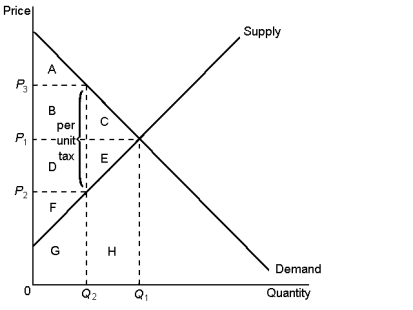 -According to Graph 8-1, the loss in total welfare resulting from the levying of the tax is represented by area:
 (Multiple Choice)
4.9/5 (78)
(78) Taxes are costly to market participants because they transfer resources from those participants to the government, even though they do not usually distort incentives or resource allocation.
(True/False)
4.8/5 (79)
(79) Graph 8-3 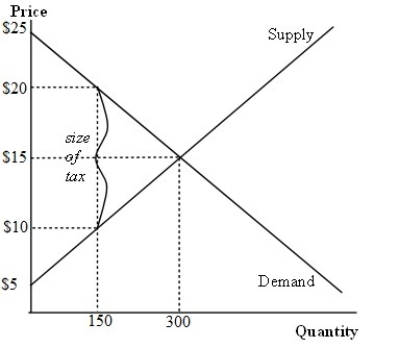 -According to Graph 8-3, consumer surplus before the tax is levied equals:
 (Multiple Choice)
4.9/5 (68)
(68) Taxes cause deadweight losses because they prevent buyers and sellers from realising some of the gains from trade.
(True/False)
4.9/5 (78)
(78) Suppose the supply curve becomes more inelastic, but nothing else changes.This implies that the deadweight loss of a tax will be smaller.
(True/False)
4.8/5 (78)
(78) Studies indicate that if income tax rates in Sweden had been reduced, income tax collections would have:
(Multiple Choice)
4.7/5 (84)
(84) Graph 8-1
-According to Graph 8-1, after the tax is levied, consumer surplus is represented by area:
-According to Graph 8-1, after the tax is levied, consumer surplus is represented by area: (Multiple Choice)
4.9/5 (86)
(86) Labour taxes encourage workers to work fewer hours, second earners to stay at home, the elderly to retire early, and the unscrupulous to engage in illegal activities.
(True/False)
4.9/5 (85)
(85) Suppose the demand curve becomes more elastic, but nothing else changes, this implies that the deadweight loss from a given tax will be smaller.
(True/False)
4.7/5 (74)
(74) The benefit received by the sellers of a good in a market is measured by:
(Multiple Choice)
4.7/5 (78)
(78) The effect of a tax on a good makes both sellers and buyers better off.
(True/False)
4.9/5 (78)
(78) Government revenue from a tax equals the sum of the lost producer surplus and lost consumer surplus.
(True/False)
4.7/5 (85)
(85) 
Filters
- Essay(0)
- Multiple Choice(0)
- Short Answer(0)
- True False(0)
- Matching(0)