



 Chat with AI
Exam 6: Supply, Demand and Government Policies

Exam 1: Ten Lessons From Economics146 Questions
Exam 2: Thinking Like an Economist133 Questions
Exam 3: Interdependence and the Gains From Trade139 Questions
Exam 4: The Market Forces of Supply and Demand215 Questions
Exam 5: Elasticity and Its Application178 Questions
Exam 6: Supply, Demand and Government Policies145 Questions
Exam 7: Consumers, Producers and the Efficiency of Markets171 Questions
Exam 8: Application: the Costs of Taxation135 Questions
Exam 9: Application: International Trade151 Questions
Exam 10: Externalities199 Questions
Exam 11: Public Goods and Common Resources178 Questions
Exam 12: The Design of the Tax System154 Questions
Exam 13: The Costs of Production191 Questions
Exam 14: Firms in Competitive Markets198 Questions
Exam 15: Monopoly212 Questions
Exam 16: Monopolistic Competition212 Questions
Exam 17: Business Strategy and Oligopoly179 Questions
Exam 18: Competition Policy103 Questions
Exam 19: The Markets for the Factors of Production214 Questions
Exam 20: Earnings, Unions and Discrimination201 Questions
Exam 21: Income Inequity and Poverty111 Questions
Exam 22: The Theory of Consumer Choice158 Questions
Exam 23: Frontiers of Microeconomics111 Questions
Exam 24: Measuring a Nations Income51 Questions
Exam 25: Measuring the Cost of Living55 Questions
Exam 26: Production and Growth62 Questions
Exam 27: Saving, Investment and the Financial System62 Questions
Exam 28: The Natural Rate of Unemployment58 Questions
Exam 29: The Monetary System66 Questions
Exam 30: Inflation: Its Causes and Costs74 Questions
Exam 31: Open-Economy Macroeconomics: Basic Concepts68 Questions
Exam 32: A Macroeconomic Theory of the Open Economy61 Questions
Exam 33: Aggregate Demand and Aggregate Supply81 Questions
Exam 34: The Influence of Monetary and Fiscal Policy on Aggregate Demand73 Questions
Exam 35: The Short-Run Trade-Off Between Inflation and Unemployment57 Questions
Exam 36: Global Financial Crisis of 2008 and Beyond37 Questions
Exam 37: Five Debates Over Macroeconomic Policy38 Questions
Select questions type


A price floor is a legal minimum on the price of a good or service.
(True/False)
4.9/5  (84)
(84) Graph 6-7 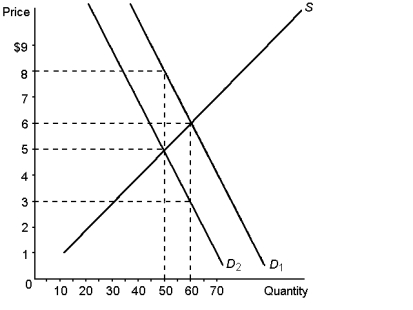 -According to Graph 6-7, the price buyers will pay after the tax is imposed is:
 (Multiple Choice)
4.8/5 (84)
(84) If a tax is levied on a market, sellers will receive more for their goods and buyers will have to pay more for their purchases.
(True/False)
4.9/5 (75)
(75) The minimum wage creates the most benefits for teenage workers as their wages are typically much lower than adult workers.
(True/False)
4.8/5 (76)
(76) Suppose that the equilibrium wage rate in an industry is $10 per hour.The government then sets a minimum wage of $12 per hour.The result will be a surplus of labour supply.
(True/False)
4.9/5 (74)
(74) Using the graph below, analyse the effect a $70 price floor would have on the market for tennis shoes.Would this be a binding price floor? Why would policymakers choose to impose a price floor? 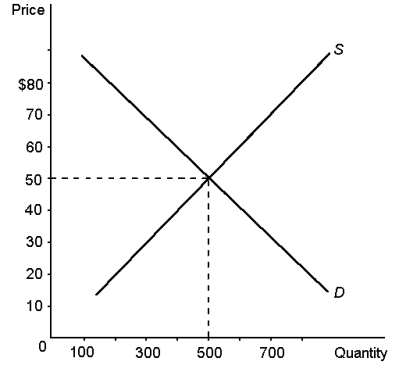
(Essay)
4.8/5 (89)
(89) If supply is perfectly inelastic, then a subsidy paid to buyers of a good can never increase the size of the market.
(True/False)
4.9/5 (69)
(69) When sellers are legally required to pay a tax, the burden of the tax falls solely on the sellers.
(True/False)
4.8/5 (84)
(84) Price controls are an effective way of allocating resources in an economy.For this reason there is widespread support for price controls among economists.
(True/False)
4.8/5 (91)
(91) Graph 6-8 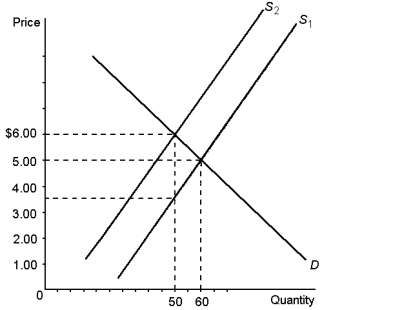 -According to Graph 6-8, the amount of the tax imposed in this market is:
 (Multiple Choice)
4.8/5 (72)
(72) If the demand for coffee and the supply of coffee are both elastic then:
(Multiple Choice)
4.8/5 (83)
(83) Many advocates of raising the minimum wage argue that the adverse effects of such a move, for example higher unemployment, are likely to be small.Suppose the minimum wage is binding.Under what conditions will an increase in the minimum wage lead to only a small increase in unemployment?
(Essay)
4.7/5 (76)
(76) Graph 6-8
-According to Graph 6-8, the price buyers will pay after the tax is imposed is:
-According to Graph 6-8, the price buyers will pay after the tax is imposed is: (Multiple Choice)
4.8/5 (62)
(62) To fund new green energy research, suppose the government requires every buyer of a new car to pay a $100 tax.When compared to the pre-tax equilibrium, such a tax will:
(Multiple Choice)
4.8/5 (81)
(81) Which of the following is the most correct statement about price controls?
(Multiple Choice)
4.9/5 (77)
(77) A legal maximum price at which a good can be sold is a price:
(Multiple Choice)
4.9/5 (78)
(78) 
Filters
- Essay(0)
- Multiple Choice(0)
- Short Answer(0)
- True False(0)
- Matching(0)