



 Chat with AI
Exam 15: Monopoly

Exam 1: Ten Lessons From Economics146 Questions
Exam 2: Thinking Like an Economist133 Questions
Exam 3: Interdependence and the Gains From Trade139 Questions
Exam 4: The Market Forces of Supply and Demand215 Questions
Exam 5: Elasticity and Its Application178 Questions
Exam 6: Supply, Demand and Government Policies145 Questions
Exam 7: Consumers, Producers and the Efficiency of Markets171 Questions
Exam 8: Application: the Costs of Taxation135 Questions
Exam 9: Application: International Trade151 Questions
Exam 10: Externalities199 Questions
Exam 11: Public Goods and Common Resources178 Questions
Exam 12: The Design of the Tax System154 Questions
Exam 13: The Costs of Production191 Questions
Exam 14: Firms in Competitive Markets198 Questions
Exam 15: Monopoly212 Questions
Exam 16: Monopolistic Competition212 Questions
Exam 17: Business Strategy and Oligopoly179 Questions
Exam 18: Competition Policy103 Questions
Exam 19: The Markets for the Factors of Production214 Questions
Exam 20: Earnings, Unions and Discrimination201 Questions
Exam 21: Income Inequity and Poverty111 Questions
Exam 22: The Theory of Consumer Choice158 Questions
Exam 23: Frontiers of Microeconomics111 Questions
Exam 24: Measuring a Nations Income51 Questions
Exam 25: Measuring the Cost of Living55 Questions
Exam 26: Production and Growth62 Questions
Exam 27: Saving, Investment and the Financial System62 Questions
Exam 28: The Natural Rate of Unemployment58 Questions
Exam 29: The Monetary System66 Questions
Exam 30: Inflation: Its Causes and Costs74 Questions
Exam 31: Open-Economy Macroeconomics: Basic Concepts68 Questions
Exam 32: A Macroeconomic Theory of the Open Economy61 Questions
Exam 33: Aggregate Demand and Aggregate Supply81 Questions
Exam 34: The Influence of Monetary and Fiscal Policy on Aggregate Demand73 Questions
Exam 35: The Short-Run Trade-Off Between Inflation and Unemployment57 Questions
Exam 36: Global Financial Crisis of 2008 and Beyond37 Questions
Exam 37: Five Debates Over Macroeconomic Policy38 Questions
Select questions type


Table 15-1
Qunatity Price Total revenue Average revenue Marginal revenue 1 47 47 2 88 44 41 3 41 4 29 5 35 23 6 192 7 29 11 8 5 9 207 23 -1 10 20 200
-Refer to Table 15-1.What is the average revenue received from selling four units of the monopolist's product?
(Multiple Choice)
4.9/5  (82)
(82) Refer to the information provided.If Black Box Pay TV is unable to price discriminate, what price will it choose to maximise its profit and what is the amount of profit?
(Multiple Choice)
4.9/5 (73)
(73) Along with the monopoly firms' cost curves, the shape and position of the demand curve determine which of the following?
(i) the price the monopoly will charge for its good
(ii) the shape and position of the marginal-revenue curve
(iii) the profit-maximising quantity
(Multiple Choice)
4.8/5 (85)
(85) Graph 15-3 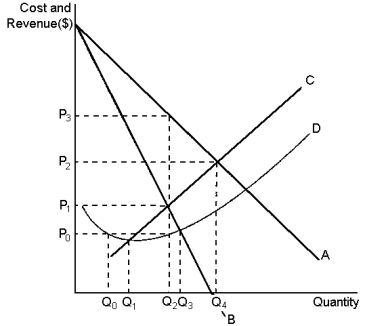 This graph reflects the cost and revenue structure for a monopoly firm.Use the graph to answer the following question(s).
-Refer to Graph 15-3.A profit-maximising monopoly would have profit equal to:
This graph reflects the cost and revenue structure for a monopoly firm.Use the graph to answer the following question(s).
-Refer to Graph 15-3.A profit-maximising monopoly would have profit equal to: (Multiple Choice)
4.8/5 (85)
(85) For a competitive firm, average revenue always equals the price of the good.This is also true for monopolies.
(True/False)
4.8/5 (82)
(82) The practice of selling the same goods to different customers at different prices, but with the same marginal cost, is known as:
(Multiple Choice)
5.0/5 (77)
(77) Suppose a drug patent runs out, the market consequences of this are?
(i) the price will increase
(ii) the price will converge on the marginal cost
(iii) the quantity sold will increase
(Multiple Choice)
4.9/5 (75)
(75) When AT&T had a monopoly on telephones as a result of patents, it:
(Multiple Choice)
4.8/5 (69)
(69) Graph 15-2 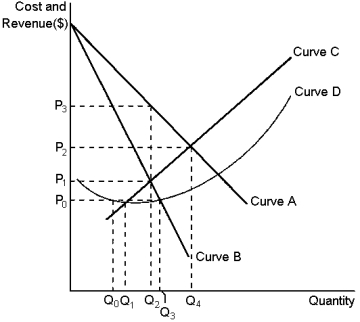 This graph reflects the cost and revenue structure for a monopoly firm.Use the graph to answer the following question(s).
-Refer to Graph 15-2.The demand curve for a monopoly firm is depicted by curve:
This graph reflects the cost and revenue structure for a monopoly firm.Use the graph to answer the following question(s).
-Refer to Graph 15-2.The demand curve for a monopoly firm is depicted by curve: (Multiple Choice)
4.7/5 (80)
(80) When a firm's average-total-cost curve continually declines, the firm is:
(Multiple Choice)
4.7/5 (70)
(70) Which of the following statements concerning profit maximisation for a monopoly firm is correct?
(Multiple Choice)
4.9/5 (73)
(73) According to the information provided, what is the deadweight loss associated with the non-discriminating pricing policy compared to the price-discriminating policy?
(Multiple Choice)
4.9/5 (73)
(73) Choose the correct statement.The deadweight loss from monopoly pricing arises because:
i. monopolists profits are a transfer from consumers to producers
ii. the value some consumers place on the good is greater than the cost of providing it
iii. the market price is above marginal cost
(Multiple Choice)
4.9/5 (93)
(93) Characteristics of a monopoly include which of the following?
(i) it is the sole seller of its product
(ii) its product does not have close substitutes
(iii) it generates large economic profits
(iv) it is located in a small geographic market
(Multiple Choice)
4.9/5 (96)
(96) Adult and concession prices for movie tickets are examples of perfect price discrimination.
(True/False)
4.9/5 (88)
(88) Perfect price discrimination describes a situation in which the monopolist:
(Multiple Choice)
4.9/5 (81)
(81) The socially efficient level of production occurs where the marginal-cost curve intersects which of the following curves?
(Multiple Choice)
4.8/5 (82)
(82) A profit-maximising monopolist chooses the output level where marginal revenue equals marginal cost and chooses the corresponding price off the marginal-revenue curve.
(True/False)
4.9/5 (72)
(72) If a firm's average total cost is everywhere decreasing, then this is likely to lead to a natural monopoly.
(True/False)
4.9/5 (85)
(85) 
Filters
- Essay(0)
- Multiple Choice(0)
- Short Answer(0)
- True False(0)
- Matching(0)