



 Chat with AI
Exam 15: Monopoly

Exam 1: Ten Lessons From Economics146 Questions
Exam 2: Thinking Like an Economist133 Questions
Exam 3: Interdependence and the Gains From Trade139 Questions
Exam 4: The Market Forces of Supply and Demand215 Questions
Exam 5: Elasticity and Its Application178 Questions
Exam 6: Supply, Demand and Government Policies145 Questions
Exam 7: Consumers, Producers and the Efficiency of Markets171 Questions
Exam 8: Application: the Costs of Taxation135 Questions
Exam 9: Application: International Trade151 Questions
Exam 10: Externalities199 Questions
Exam 11: Public Goods and Common Resources178 Questions
Exam 12: The Design of the Tax System154 Questions
Exam 13: The Costs of Production191 Questions
Exam 14: Firms in Competitive Markets198 Questions
Exam 15: Monopoly212 Questions
Exam 16: Monopolistic Competition212 Questions
Exam 17: Business Strategy and Oligopoly179 Questions
Exam 18: Competition Policy103 Questions
Exam 19: The Markets for the Factors of Production214 Questions
Exam 20: Earnings, Unions and Discrimination201 Questions
Exam 21: Income Inequity and Poverty111 Questions
Exam 22: The Theory of Consumer Choice158 Questions
Exam 23: Frontiers of Microeconomics111 Questions
Exam 24: Measuring a Nations Income51 Questions
Exam 25: Measuring the Cost of Living55 Questions
Exam 26: Production and Growth62 Questions
Exam 27: Saving, Investment and the Financial System62 Questions
Exam 28: The Natural Rate of Unemployment58 Questions
Exam 29: The Monetary System66 Questions
Exam 30: Inflation: Its Causes and Costs74 Questions
Exam 31: Open-Economy Macroeconomics: Basic Concepts68 Questions
Exam 32: A Macroeconomic Theory of the Open Economy61 Questions
Exam 33: Aggregate Demand and Aggregate Supply81 Questions
Exam 34: The Influence of Monetary and Fiscal Policy on Aggregate Demand73 Questions
Exam 35: The Short-Run Trade-Off Between Inflation and Unemployment57 Questions
Exam 36: Global Financial Crisis of 2008 and Beyond37 Questions
Exam 37: Five Debates Over Macroeconomic Policy38 Questions
Select questions type


Graph 15-5 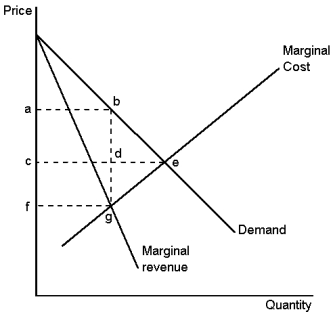 This graph depicts the demand, marginal-revenue and marginal-cost curves of a profit-maximising monopolist.Use the graph to answer the following question(s).
-Refer to Graph 15-5.Compared to the monopoly outcome, an economy designed by a social planner would have a total surplus greater by an amount equal to:
This graph depicts the demand, marginal-revenue and marginal-cost curves of a profit-maximising monopolist.Use the graph to answer the following question(s).
-Refer to Graph 15-5.Compared to the monopoly outcome, an economy designed by a social planner would have a total surplus greater by an amount equal to: (Multiple Choice)
4.7/5  (72)
(72) Graph 15-6 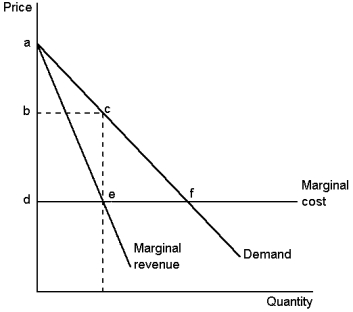 This graph depicts the demand, marginal-revenue and marginal-cost curves of a profit-maximising monopolist.Use the graph to answer the following question(s).
-Refer to Graph 15-6.What is the deadweight loss equal to when the monopolist does NOT price discriminate?
This graph depicts the demand, marginal-revenue and marginal-cost curves of a profit-maximising monopolist.Use the graph to answer the following question(s).
-Refer to Graph 15-6.What is the deadweight loss equal to when the monopolist does NOT price discriminate? (Multiple Choice)
4.9/5 (84)
(84) In which of the following situations will a firm be unable to price discriminate?
(Multiple Choice)
4.8/5 (73)
(73) Graph 15-6 This graph depicts the demand, marginal-revenue and marginal-cost curves of a profit-maximising monopolist.Use the graph to answer the following question(s).
-Refer to Graph 15-6.If the monopoly firm perfectly price discriminates, what will the consumer surplus be?
This graph depicts the demand, marginal-revenue and marginal-cost curves of a profit-maximising monopolist.Use the graph to answer the following question(s).
-Refer to Graph 15-6.If the monopoly firm perfectly price discriminates, what will the consumer surplus be? (Multiple Choice)
4.9/5 (66)
(66) Monopoly pricing prevents some mutually beneficial trades from taking place.These unrealised mutually beneficial trades are:
(Multiple Choice)
4.8/5 (60)
(60) Patent and copyright laws are major sources of government created monopolies.
(True/False)
4.9/5 (77)
(77) A profit-maximising monopolist will choose a level of output at where:
(Multiple Choice)
4.8/5 (72)
(72) Total economic loss due to monopoly pricing is equal to the loss to producer surplus minus the loss in consumer surplus.
(True/False)
4.8/5 (89)
(89) Given a monopolist is the sole producer in a market, it is able to change the price of its product:
(i) without affecting the quantity sold
(ii) by adjusting the quantity it supplies to the market
(iii) but its profit could increase or decrease as a result
(Multiple Choice)
4.8/5 (87)
(87) Table 15-1
Qunatity Price Total revenue Average revenue Marginal revenue 1 47 47 2 88 44 41 3 41 4 29 5 35 23 6 192 7 29 11 8 5 9 207 23 -1 10 20 200
-Refer to Table 15-1.If the monopolist sells eight units of its product, how much revenue will it receive from the sale?
(Multiple Choice)
4.7/5 (88)
(88) Identify the true statements about economic wellbeing from the following list.Economic wellbeing is:
(i) the sum of consumer surplus and producer surplus
(ii) marginal revenue to the producer minus the average cost to the consumer
(iii) total profit of producers
(Multiple Choice)
4.8/5 (71)
(71) The main constraint facing the ability of a natural monopolist to price its product is:
(Multiple Choice)
4.7/5 (71)
(71) If a monopolist faces a downward-sloping market demand curve, its:
(Multiple Choice)
4.8/5 (74)
(74) Graph 15-2 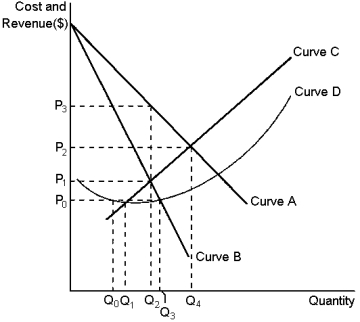 This graph reflects the cost and revenue structure for a monopoly firm.Use the graph to answer the following question(s).
-Refer to Graph 15-2.The number of consumers who did not buy the good despite a willingness-to-pay greater than marginal cost is given by:
This graph reflects the cost and revenue structure for a monopoly firm.Use the graph to answer the following question(s).
-Refer to Graph 15-2.The number of consumers who did not buy the good despite a willingness-to-pay greater than marginal cost is given by: (Multiple Choice)
4.9/5 (72)
(72) Which of the following statements are true?
i. in a monopoly, average revenue always equals the price of the good
ii. a monopoly's profit is maximised when price equals marginal revenue
iii. the marginal revenue curve will always lie below the demand curve
(Multiple Choice)
4.8/5 (77)
(77) Suppose that Dave's Camera Shop operates in a competitive market for cameras, which of the following statements is (are) true?
(i) he can maximise profit by raising his prices
(ii) he can maximise profit by altering the quantity of cameras that he supplies
(iii) he will be able to earn a profit only if he differentiates his cameras from the rest of the market
(Multiple Choice)
4.8/5 (90)
(90) The inefficiency of a deadweight loss stems from the fact that:
(Multiple Choice)
4.9/5 (66)
(66) Monopolies are inefficient because at the profit maximising quantity there will still be consumers whose willingness-to-pay is higher than the product's marginal cost.
(True/False)
4.8/5 (85)
(85) 
Filters
- Essay(0)
- Multiple Choice(0)
- Short Answer(0)
- True False(0)
- Matching(0)