



 Chat with AI
Exam 15: Monopoly

Exam 1: Ten Lessons From Economics146 Questions
Exam 2: Thinking Like an Economist133 Questions
Exam 3: Interdependence and the Gains From Trade139 Questions
Exam 4: The Market Forces of Supply and Demand215 Questions
Exam 5: Elasticity and Its Application178 Questions
Exam 6: Supply, Demand and Government Policies145 Questions
Exam 7: Consumers, Producers and the Efficiency of Markets171 Questions
Exam 8: Application: the Costs of Taxation135 Questions
Exam 9: Application: International Trade151 Questions
Exam 10: Externalities199 Questions
Exam 11: Public Goods and Common Resources178 Questions
Exam 12: The Design of the Tax System154 Questions
Exam 13: The Costs of Production191 Questions
Exam 14: Firms in Competitive Markets198 Questions
Exam 15: Monopoly212 Questions
Exam 16: Monopolistic Competition212 Questions
Exam 17: Business Strategy and Oligopoly179 Questions
Exam 18: Competition Policy103 Questions
Exam 19: The Markets for the Factors of Production214 Questions
Exam 20: Earnings, Unions and Discrimination201 Questions
Exam 21: Income Inequity and Poverty111 Questions
Exam 22: The Theory of Consumer Choice158 Questions
Exam 23: Frontiers of Microeconomics111 Questions
Exam 24: Measuring a Nations Income51 Questions
Exam 25: Measuring the Cost of Living55 Questions
Exam 26: Production and Growth62 Questions
Exam 27: Saving, Investment and the Financial System62 Questions
Exam 28: The Natural Rate of Unemployment58 Questions
Exam 29: The Monetary System66 Questions
Exam 30: Inflation: Its Causes and Costs74 Questions
Exam 31: Open-Economy Macroeconomics: Basic Concepts68 Questions
Exam 32: A Macroeconomic Theory of the Open Economy61 Questions
Exam 33: Aggregate Demand and Aggregate Supply81 Questions
Exam 34: The Influence of Monetary and Fiscal Policy on Aggregate Demand73 Questions
Exam 35: The Short-Run Trade-Off Between Inflation and Unemployment57 Questions
Exam 36: Global Financial Crisis of 2008 and Beyond37 Questions
Exam 37: Five Debates Over Macroeconomic Policy38 Questions
Select questions type


For a profit-maximising monopolist, output should be increased to enhance economic wellbeing as long as:
(Multiple Choice)
4.9/5  (83)
(83) Many bus companies allow discount tickets to be sold to students because:
(Multiple Choice)
4.9/5 (66)
(66) A monopolist's marginal-revenue curve is less than price for which of the following reasons?
(i) to sell additional units of the good, the price charged on all units must decrease
(ii) with the sale of an additional unit, the monopolist receives less revenue for each of the previous units it planned to sell
(iii) because of the downward-sloping demand curve
(Multiple Choice)
4.9/5 (68)
(68) Round-trip airline tickets are usually cheaper if you stay over a Saturday night before you fly back.What is the reason for this price discrepancy?
(Multiple Choice)
4.8/5 (83)
(83) Governments should always avoid creating monopolies, as it leads to prices above marginal costs.
(True/False)
4.9/5 (67)
(67) When a natural monopoly exists, it is always more cost-effective for two or more private firms to produce the product.
(True/False)
4.9/5 (75)
(75) When a firm operates under conditions of a monopoly, its price is:
(Multiple Choice)
4.7/5 (93)
(93) In many cases additional firms do not try to compete with a natural monopoly because:
(Multiple Choice)
4.9/5 (85)
(85) Graph 15-2 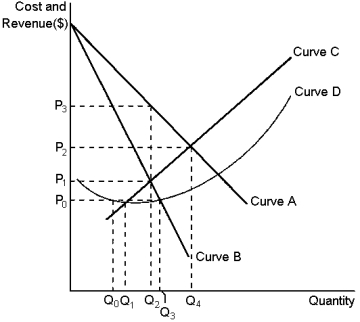 This graph reflects the cost and revenue structure for a monopoly firm.Use the graph to answer the following question(s).
-Refer to Graph 15-2.Profit can always be increased by decreasing the level of output by one unit if the monopolist is currently operating at a level of output in which:
This graph reflects the cost and revenue structure for a monopoly firm.Use the graph to answer the following question(s).
-Refer to Graph 15-2.Profit can always be increased by decreasing the level of output by one unit if the monopolist is currently operating at a level of output in which: (Multiple Choice)
4.8/5 (76)
(76) Which of the following are barriers to entry that can give rise to a monopoly?
(i) a patent giving exclusive right to manufacture a new electronic device
(ii) a single firm buys all the rights to mine iron ore in Australia
(iii) a single firm can produce at lower cost than several firms
(Multiple Choice)
4.8/5 (86)
(86) If a resource can be traded internationally, then it is less likely that a single domestic supplier will be able to price at the monopoly price.
(True/False)
4.9/5 (80)
(80) Graph 15-5 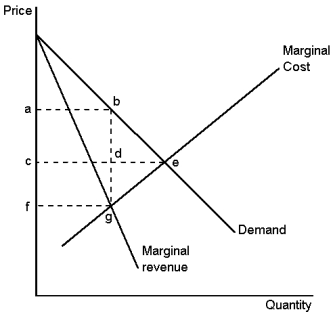 This graph depicts the demand, marginal-revenue and marginal-cost curves of a profit-maximising monopolist.Use the graph to answer the following question(s).
-Refer to Graph 15-5.Which of the following areas represents the deadweight loss due to monopoly pricing?
This graph depicts the demand, marginal-revenue and marginal-cost curves of a profit-maximising monopolist.Use the graph to answer the following question(s).
-Refer to Graph 15-5.Which of the following areas represents the deadweight loss due to monopoly pricing? (Multiple Choice)
4.7/5 (70)
(70) The De Beers Diamond company advertises heavily to promote the sale of all diamonds, not just its own.This is evidence that they have a monopoly position to some degree.
(True/False)
4.9/5 (89)
(89) In a market characterised by monopoly, the market demand curve is:
(Multiple Choice)
4.9/5 (88)
(88) When a firm operates under conditions of a monopoly, its price is constrained by demand.
(True/False)
5.0/5 (93)
(93) Graph 15-2 This graph reflects the cost and revenue structure for a monopoly firm.Use the graph to answer the following question(s).
-Refer to Graph 15-2.The marginal-revenue curve for a monopoly firm is depicted by curve:
This graph reflects the cost and revenue structure for a monopoly firm.Use the graph to answer the following question(s).
-Refer to Graph 15-2.The marginal-revenue curve for a monopoly firm is depicted by curve: (Multiple Choice)
4.9/5 (78)
(78) 
Filters
- Essay(0)
- Multiple Choice(0)
- Short Answer(0)
- True False(0)
- Matching(0)