



 Chat with AI
Exam 15: Monopoly

Exam 1: Ten Lessons From Economics146 Questions
Exam 2: Thinking Like an Economist133 Questions
Exam 3: Interdependence and the Gains From Trade139 Questions
Exam 4: The Market Forces of Supply and Demand215 Questions
Exam 5: Elasticity and Its Application178 Questions
Exam 6: Supply, Demand and Government Policies145 Questions
Exam 7: Consumers, Producers and the Efficiency of Markets171 Questions
Exam 8: Application: the Costs of Taxation135 Questions
Exam 9: Application: International Trade151 Questions
Exam 10: Externalities199 Questions
Exam 11: Public Goods and Common Resources178 Questions
Exam 12: The Design of the Tax System154 Questions
Exam 13: The Costs of Production191 Questions
Exam 14: Firms in Competitive Markets198 Questions
Exam 15: Monopoly212 Questions
Exam 16: Monopolistic Competition212 Questions
Exam 17: Business Strategy and Oligopoly179 Questions
Exam 18: Competition Policy103 Questions
Exam 19: The Markets for the Factors of Production214 Questions
Exam 20: Earnings, Unions and Discrimination201 Questions
Exam 21: Income Inequity and Poverty111 Questions
Exam 22: The Theory of Consumer Choice158 Questions
Exam 23: Frontiers of Microeconomics111 Questions
Exam 24: Measuring a Nations Income51 Questions
Exam 25: Measuring the Cost of Living55 Questions
Exam 26: Production and Growth62 Questions
Exam 27: Saving, Investment and the Financial System62 Questions
Exam 28: The Natural Rate of Unemployment58 Questions
Exam 29: The Monetary System66 Questions
Exam 30: Inflation: Its Causes and Costs74 Questions
Exam 31: Open-Economy Macroeconomics: Basic Concepts68 Questions
Exam 32: A Macroeconomic Theory of the Open Economy61 Questions
Exam 33: Aggregate Demand and Aggregate Supply81 Questions
Exam 34: The Influence of Monetary and Fiscal Policy on Aggregate Demand73 Questions
Exam 35: The Short-Run Trade-Off Between Inflation and Unemployment57 Questions
Exam 36: Global Financial Crisis of 2008 and Beyond37 Questions
Exam 37: Five Debates Over Macroeconomic Policy38 Questions
Select questions type


Another form of price discrimination is when a monopoly offers lower prices to customers who buy small quantities.
(True/False)
4.8/5  (77)
(77) Graph 15-2 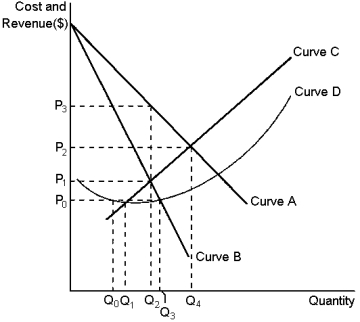 This graph reflects the cost and revenue structure for a monopoly firm.Use the graph to answer the following question(s).
-Refer to Graph 15-2.Profit can always be increased by decreasing the level of output by one unit if the monopolist is currently operating at which of the following output levels?
(i) q₀
(ii) Q₁
(iii) Q₂
(iv) Q₃
This graph reflects the cost and revenue structure for a monopoly firm.Use the graph to answer the following question(s).
-Refer to Graph 15-2.Profit can always be increased by decreasing the level of output by one unit if the monopolist is currently operating at which of the following output levels?
(i) q₀
(ii) Q₁
(iii) Q₂
(iv) Q₃ (Multiple Choice)
5.0/5 (90)
(90) In a monopoly, the firm demand-curve and market demand-curve are identical.
(True/False)
4.9/5 (81)
(81) Using the above information, how much higher would profit be if the publisher can price-discriminate?
(Multiple Choice)
4.8/5 (82)
(82) Because monopoly firms do not have to compete with other firms, the outcome in a market with a monopoly is often efficient, but not equitable.
(True/False)
4.9/5 (78)
(78) Perfect price discrimination leads to zero consumer surplus.With this in mind, why do economists argue that perfect price discrimination maximises total welfare?
(Essay)
4.8/5 (83)
(83) When a local grocery store offers discount coupons in the Sunday paper, it is most likely trying to:
(Multiple Choice)
4.8/5 (78)
(78) Suppose a pesticide company discovers and patents a new weed killer.This patent gives the company:
(Multiple Choice)
4.9/5 (68)
(68) One example of price discrimination occurs in the publishing industry when a publisher initially releases an expensive hardcover edition of a popular novel, and later releases a cheaper paperback edition.Use this example to demonstrate the benefits and potential pitfalls of a price discrimination pricing strategy.
(Essay)
4.8/5 (81)
(81) A rational pricing strategy for a profit-maximising monopolist is:
(Multiple Choice)
4.9/5 (67)
(67) Due to the nature of the patent laws on pharmaceuticals, the market for such drugs:
(Multiple Choice)
4.9/5 (82)
(82) Competitive firms maximise profit by setting MR = MC.This is not always true for monopoly firms.
(True/False)
4.9/5 (76)
(76) Suppose demand for a monopoly's product is perfectly elastic.In this case the monopoly should set P = MR = MC and the monopoly market outcome will be identical to the competitive market outcome.
(True/False)
4.8/5 (90)
(90) Graph 15-4 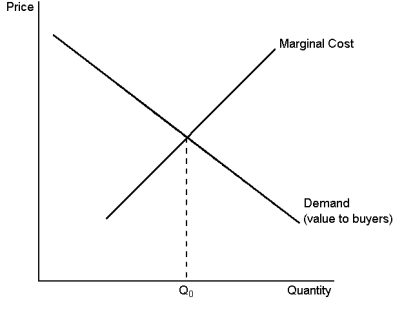 This graph depicts the demand and marginal-cost curves of a profit-maximising monopolist.Use the graph to answer the following question(s).
-Refer to Graph 15-4.A benevolent social planner would cause the monopoly firm to operate at an output level:
This graph depicts the demand and marginal-cost curves of a profit-maximising monopolist.Use the graph to answer the following question(s).
-Refer to Graph 15-4.A benevolent social planner would cause the monopoly firm to operate at an output level: (Multiple Choice)
4.7/5 (73)
(73) Suppose the market for coffee cups is a monopoly.If a consumer's willingness to pay is below the market price, then it is not possible for a mutually beneficial trade to occur.
(True/False)
4.9/5 (66)
(66) In the market for home heating, consumers typically have several options (e.g.electricity, heating fuel, natural gas, propane, etc.), yet we often think of firms in this industry as behaving like monopolists.Using your understanding of monopoly, discuss the context in which your electricity provider is a monopolist.Is this characterisation universally applicable? Carefully explain your answer.
(Essay)
4.8/5 (82)
(82) Discount coupons have the ability to help a supermarket price discriminate.
(True/False)
5.0/5 (93)
(93) Graph 15-6 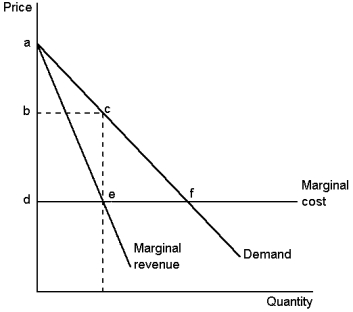 This graph depicts the demand, marginal-revenue and marginal-cost curves of a profit-maximising monopolist.Use the graph to answer the following question(s).
-Refer to Graph 15-6.If the monopoly firm is NOT allowed to price discriminate, what will the consumer surplus be?
This graph depicts the demand, marginal-revenue and marginal-cost curves of a profit-maximising monopolist.Use the graph to answer the following question(s).
-Refer to Graph 15-6.If the monopoly firm is NOT allowed to price discriminate, what will the consumer surplus be? (Multiple Choice)
5.0/5 (61)
(61) 
Filters
- Essay(0)
- Multiple Choice(0)
- Short Answer(0)
- True False(0)
- Matching(0)