



 Chat with AI
Exam 10: Externalities

Exam 1: Ten Lessons From Economics146 Questions
Exam 2: Thinking Like an Economist133 Questions
Exam 3: Interdependence and the Gains From Trade139 Questions
Exam 4: The Market Forces of Supply and Demand215 Questions
Exam 5: Elasticity and Its Application178 Questions
Exam 6: Supply, Demand and Government Policies145 Questions
Exam 7: Consumers, Producers and the Efficiency of Markets171 Questions
Exam 8: Application: the Costs of Taxation135 Questions
Exam 9: Application: International Trade151 Questions
Exam 10: Externalities199 Questions
Exam 11: Public Goods and Common Resources178 Questions
Exam 12: The Design of the Tax System154 Questions
Exam 13: The Costs of Production191 Questions
Exam 14: Firms in Competitive Markets198 Questions
Exam 15: Monopoly212 Questions
Exam 16: Monopolistic Competition212 Questions
Exam 17: Business Strategy and Oligopoly179 Questions
Exam 18: Competition Policy103 Questions
Exam 19: The Markets for the Factors of Production214 Questions
Exam 20: Earnings, Unions and Discrimination201 Questions
Exam 21: Income Inequity and Poverty111 Questions
Exam 22: The Theory of Consumer Choice158 Questions
Exam 23: Frontiers of Microeconomics111 Questions
Exam 24: Measuring a Nations Income51 Questions
Exam 25: Measuring the Cost of Living55 Questions
Exam 26: Production and Growth62 Questions
Exam 27: Saving, Investment and the Financial System62 Questions
Exam 28: The Natural Rate of Unemployment58 Questions
Exam 29: The Monetary System66 Questions
Exam 30: Inflation: Its Causes and Costs74 Questions
Exam 31: Open-Economy Macroeconomics: Basic Concepts68 Questions
Exam 32: A Macroeconomic Theory of the Open Economy61 Questions
Exam 33: Aggregate Demand and Aggregate Supply81 Questions
Exam 34: The Influence of Monetary and Fiscal Policy on Aggregate Demand73 Questions
Exam 35: The Short-Run Trade-Off Between Inflation and Unemployment57 Questions
Exam 36: Global Financial Crisis of 2008 and Beyond37 Questions
Exam 37: Five Debates Over Macroeconomic Policy38 Questions
Select questions type


Graph 10-3 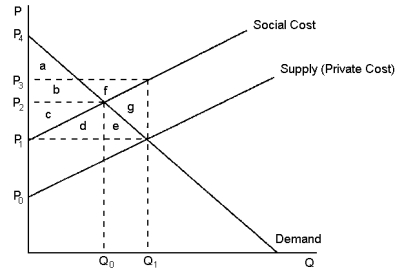 This graph reflects the market for kiwifruit, where pesticide used by kiwifruit orchardists also unintentionally kills honey bees.
-Refer to Graph 10-3.At the private market outcome, the equilibrium price of kiwifruit will be:
This graph reflects the market for kiwifruit, where pesticide used by kiwifruit orchardists also unintentionally kills honey bees.
-Refer to Graph 10-3.At the private market outcome, the equilibrium price of kiwifruit will be: (Multiple Choice)
4.8/5  (74)
(74) Which of the following suggests that the private market can be effective in dealing with externalities?
(Multiple Choice)
4.9/5 (71)
(71) Government can solve externality problems that are too costly for private parties to solve.
(True/False)
4.8/5 (69)
(69) Medical research is often presented as an example of a positive externality.Which of the following options available to policymakers would encourage producers of medical knowledge to provide a socially optimal level of production?
(i) imposing price ceilings on selected medical procedures
(ii) placing taxes on the sale of prescription drugs
(iii) providing subsidies to these firms
(Multiple Choice)
4.7/5 (84)
(84) Consider a local factory that pollutes a nearby stream.Local fishers may be unable to negotiate a deal with the local factory to eliminate the negative externality because:
(Multiple Choice)
4.8/5 (86)
(86) Dick owns a dog whose barking annoys Dick's neighbour Jane.Dick receives personal benefit from owning the dog and Jane bears a cost of Dick's ownership of the dog.Assuming that Dick has the legal right to keep the dog, which of the following statements is true?
(Multiple Choice)
4.8/5 (71)
(71) What is an externality? Give three examples of different types of externalities.
(Essay)
4.7/5 (63)
(63) Because a driver's private motoring costs do not completely reflect the costs he imposes on others, he is likely to use the car more than is socially desirable.
(True/False)
4.7/5 (81)
(81) Graph 10-3 This graph reflects the market for kiwifruit, where pesticide used by kiwifruit orchardists also unintentionally kills honey bees.
-Refer to Graph 10-3.At the private market outcome, quantity Q₁ represents the:
This graph reflects the market for kiwifruit, where pesticide used by kiwifruit orchardists also unintentionally kills honey bees.
-Refer to Graph 10-3.At the private market outcome, quantity Q₁ represents the: (Multiple Choice)
4.8/5 (74)
(74) Graph 10-5 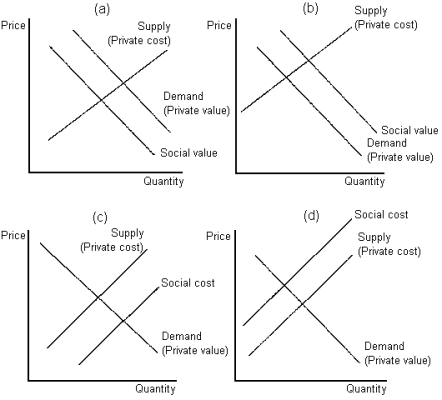 -Refer to Graph 10-5.Which of the graphs shown best depicts the case of a negative production externality?
 (Multiple Choice)
4.8/5 (75)
(75) When the government reverts to command-and-control policy to solve an externality, it:
(Multiple Choice)
4.9/5 (86)
(86) If the government were to decide that for the best interests of the country each litre of petrol should cost $2.50 instead of $1.50, it would be making an assumption about:
(Multiple Choice)
4.8/5 (93)
(93) The distribution of rights among parties affected by an externality:
(Multiple Choice)
4.9/5 (81)
(81) Assuming that transaction costs are small, the Coase theorem is likely to be helpful in articulating a solution to:
(Multiple Choice)
5.0/5 (76)
(76) The externality associated with the consumption of fatty foods will lead the market to produce a larger quantity than socially desirable.
(True/False)
5.0/5 (81)
(81) Graph 10-3 This graph reflects the market for kiwifruit, where pesticide used by kiwifruit orchardists also unintentionally kills honey bees.
-Refer to Graph 10-3.For each tray of kiwifruit produced, the social cost would include which of the following?
(i) the private costs of the kiwifruit farmers
(ii) the enjoyment that buyers get from eating kiwifruit
(iii) the cost beekeepers incur to replace hives that die because of pesticide use
This graph reflects the market for kiwifruit, where pesticide used by kiwifruit orchardists also unintentionally kills honey bees.
-Refer to Graph 10-3.For each tray of kiwifruit produced, the social cost would include which of the following?
(i) the private costs of the kiwifruit farmers
(ii) the enjoyment that buyers get from eating kiwifruit
(iii) the cost beekeepers incur to replace hives that die because of pesticide use (Multiple Choice)
4.9/5 (98)
(98) Assume that your housemate is very messy.Suppose she gets a $100 benefit from being messy but imposes a $200 cost on you.The Coase theorem would suggest that an efficient solution would be for you to:
(Multiple Choice)
4.8/5 (82)
(82) It is generally difficult or impossible for private markets to take externalities into account because:
(Multiple Choice)
4.8/5 (78)
(78) 
Filters
- Essay(0)
- Multiple Choice(0)
- Short Answer(0)
- True False(0)
- Matching(0)